

Reported by Manit Maneephantakun
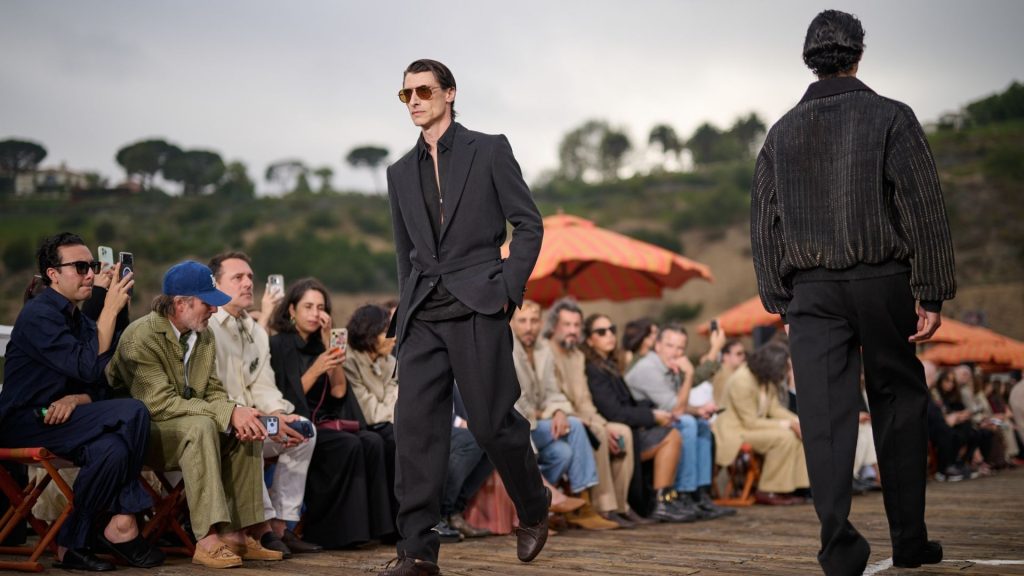
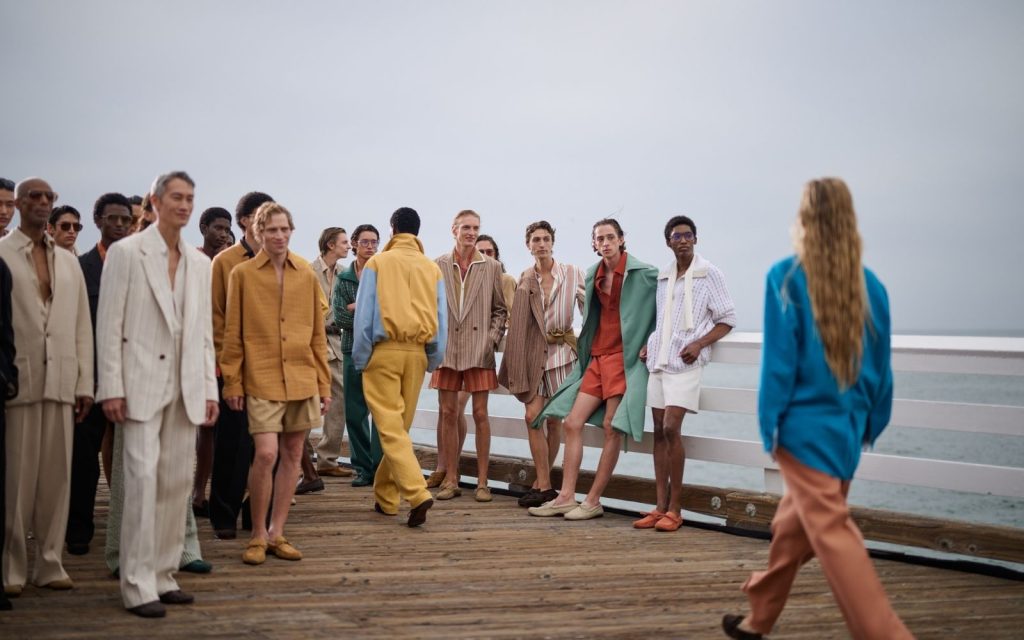
At the far end of Malibu Pier, in the final light of the day, there was something that almost resisted explanation. The Pacific Ocean stretched below in deep, shifting blue, its colour reflected across the surfaces of jackets, knits and silhouettes that moved naturally with the sea breeze. As the sun slowly descended behind the soft haze of Southern California, Zegna models stood at the edge of the pier in shades of sand, faded blue, muted cream and stripes that recalled old beach umbrellas. It became one of those moments almost everyone felt compelled to capture, not simply because the scene was beautiful, but because it revealed something essential about fashion shows today. They are no longer only about clothes. They are about creating a state of being, a world one wants to enter, even if only for a fleeting moment.
For Zegna, arriving in Malibu was not merely a change of scenery from Milan to Los Angeles. It was not only about borrowing California’s sky, sunlight and ocean as a dramatic backdrop for a summer collection. It was, more meaningfully, a way of expanding the idea of Italian elegance beyond its familiar geography. In the hands of Alessandro Sartori, Italian style does not have to remain confined to the image of a three-piece suit, old stone streets or formal luxury. It can travel to the American coast, breathe in sea air, soften its leather shoes, loosen its shirts, and still preserve a sense of manners, taste and precision without appearing to try too hard.
At the heart of the collection was the idea of La Villeggiatura, an Italian word rooted in villeggiare, meaning to spend time in a villa. Yet this is not the idea of a simple vacation or a brief escape. It refers to a cultivated Mediterranean way of life: the act of temporarily moving one’s entire world to another place, bringing along family, daily rituals, conversations, habits and a refined understanding of elegance. The tradition reached its height between the 1950s and 1970s, but its meaning is not merely nostalgic. It feels newly relevant in a time when people are once again asking how quality of life might move more gracefully with season, place and the rhythm of the body.
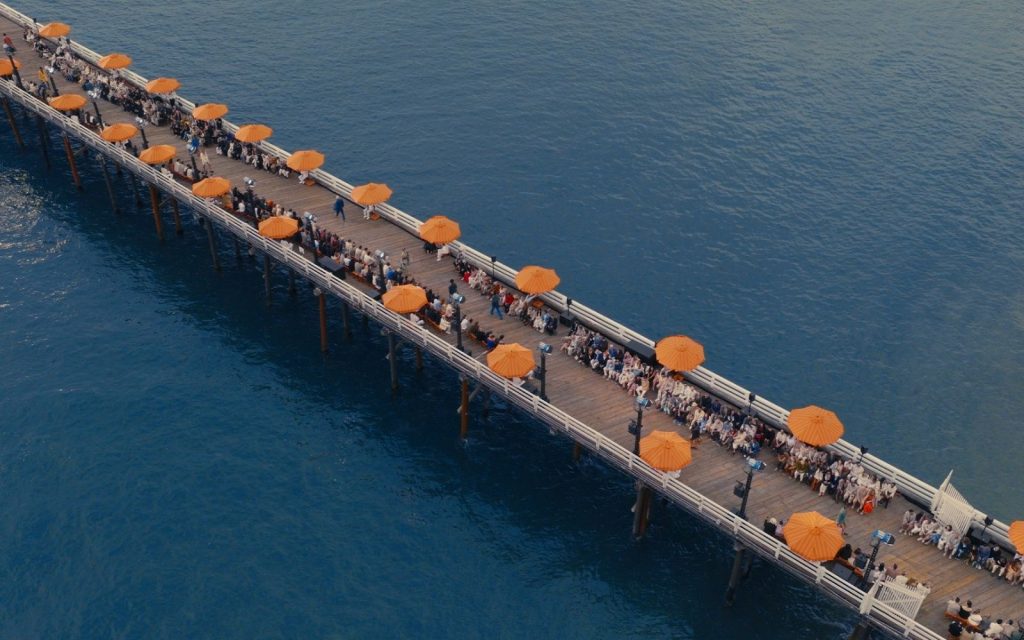
In Zegna’s interpretation, La Villeggiatura becomes something more than summer travel. It is the idea of living in a “temporary home” at a slower pace, stepping away from the city without abandoning the rituals that give life shape. It is leisure with manners, rest with refinement, ease with structure. It reminds us that comfort does not have to mean carelessness, that relaxation does not have to dissolve into shapelessness, and that leisure does not require elegance to be left behind.
For Zegna, this idea carries particular weight because it is tied to family memory, old photographs and a history of villeggiatura lived both near and far. More importantly, it reflects two deeply Italian philosophies: saper vivere, the art of living, and saper vestire, the art of dressing. These two concepts are almost the key to reading the entire collection. Zegna does not treat clothing as something that merely covers the body. It sees clothing as a tool that can shape attitude, thought and the pace of life. When the season changes, when the home changes, when life itself shifts tempo, dressing must move naturally with it.
Sartori explains the starting point of the collection with clarity: “Creating new categories and erasing old boundaries in the endless search for ways of dressing suited to the fluid life of today allows me to build an aesthetic that is constantly evolving, rooted in classicism but freed from its traditional limits.” The sentence feels central to understanding Zegna now. The house is not rejecting its own classicism. It is making that classicism more flexible, more mobile and more attuned to the realities of contemporary men, who may no longer wish to dress simply to declare status, but still seek clothes with weight, language and thought within them.
He continues, “For this collection, I wanted to express Zegna’s view of summer, and an idea of leisure dressing filled with a cultivated attitude, seen through a gaze that is sharp and profoundly Italian.” This is where Zegna separates itself from the usual American image of beach dressing. California beach culture is often written through board shorts, flip-flops, loose sweatshirts and a studied absence of concern. Zegna looks at the beach differently. This is the world of a man who may remove his tie, but not his sense of civility. A man who may stand by the sea, yet still understands the weight of fabric, the line of a jacket’s back, the width of a trouser, and the way a knit can catch evening light more eloquently than any declaration.
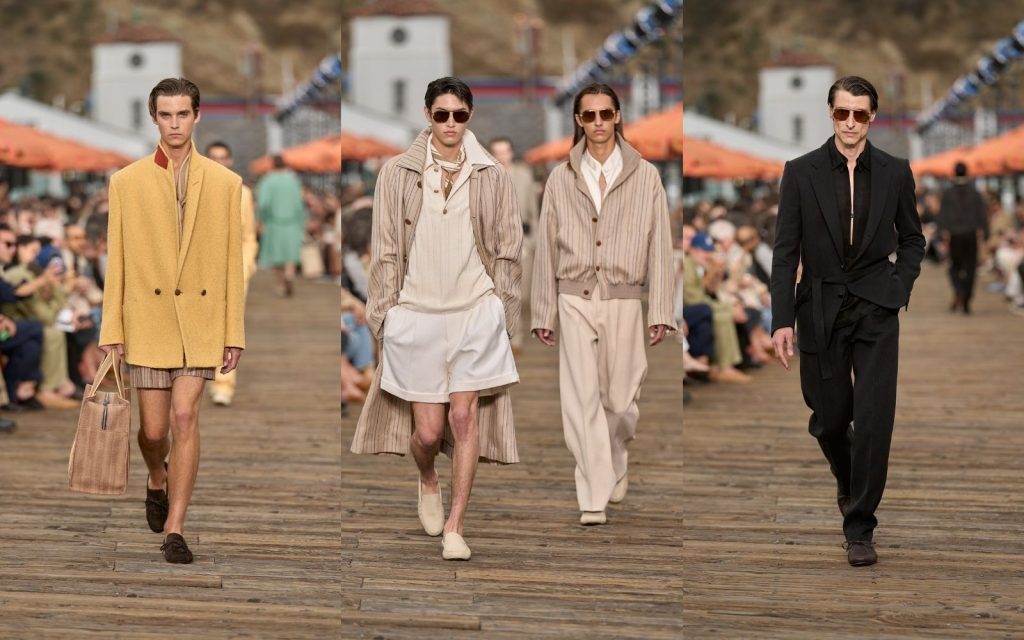
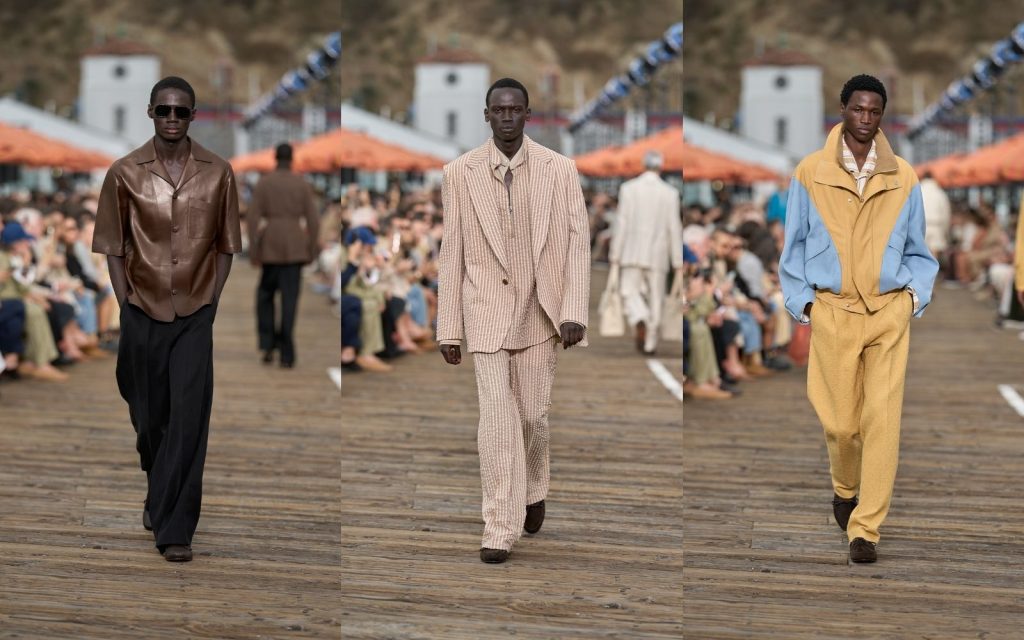
On the open-air runway of Malibu Pier, Sartori’s clothes did not try to turn Zegna into a surf brand, nor did they dress themselves up as Californian in any literal sense. What happened was far more subtle. He did not imitate Malibu. He allowed Malibu to soften Zegna’s language, to brighten it, to let more air pass through it. The boxy jackets that have become part of his vocabulary remained, but they were released into something lighter and more relaxed. Seersucker shirts appeared almost like hybrids between dress shirts and tunics. Full trousers kept the authority of tailoring, but moved as though made for a sea breeze. Some outerwear carried structure, yet felt like the kind of evening layer one might put on after swimming. The result placed Zegna between formality and informality with remarkable control, like a sentence spoken softly but composed with every word carefully chosen.
When Sartori says, “There is something distinctly ours in what we have done this season, but at the same time it opens itself to a cosmopolitan attitude rather than remaining confined to a local frame,” the collection becomes easier to understand. This is not Italian style imposing itself on America. It is a meeting of two cultures. Italy contributes structure, taste and a belief in craft. California brings light, air, openness and the ability to make seriousness feel lighter without making it shallow.
What makes Sartori’s work compelling is that he is not a designer who creates excitement through the collision of countless references, nor does he complicate clothes merely to make them appear new. He believes in a system of shapes, materials and design ideas that evolve over time. In recent years, he has built a clear vocabulary for Zegna: chore jackets, overshirts, generous trousers, knits with visual weight, hybrid pieces that sit between jacket, shirt and outerwear. This season, that vocabulary was not discarded. It was placed in a new context on the West Coast, as if a language once spoken in a Milanese salon had been carried to the edge of the sea and discovered that it still sounded beautiful there.
The core of this language begins with fabric rather than surface decoration. Sartori emphasises that “the impulse to experiment, which for Zegna means both shape and material, continues to drive us. Everything begins with fabric, with texture and pattern that can be endlessly reinterpreted by twisting or adjusting the smallest detail, even a single thread.” This may be one of the most precise ways to understand Zegna today. For the house, newness does not require destroying everything and starting over. It can come from the smallest shift, from a thread that changes the way light lands on cloth, from a stripe that alters the mood of tailoring, from a texture that appears quiet at first but comes alive when the body moves.
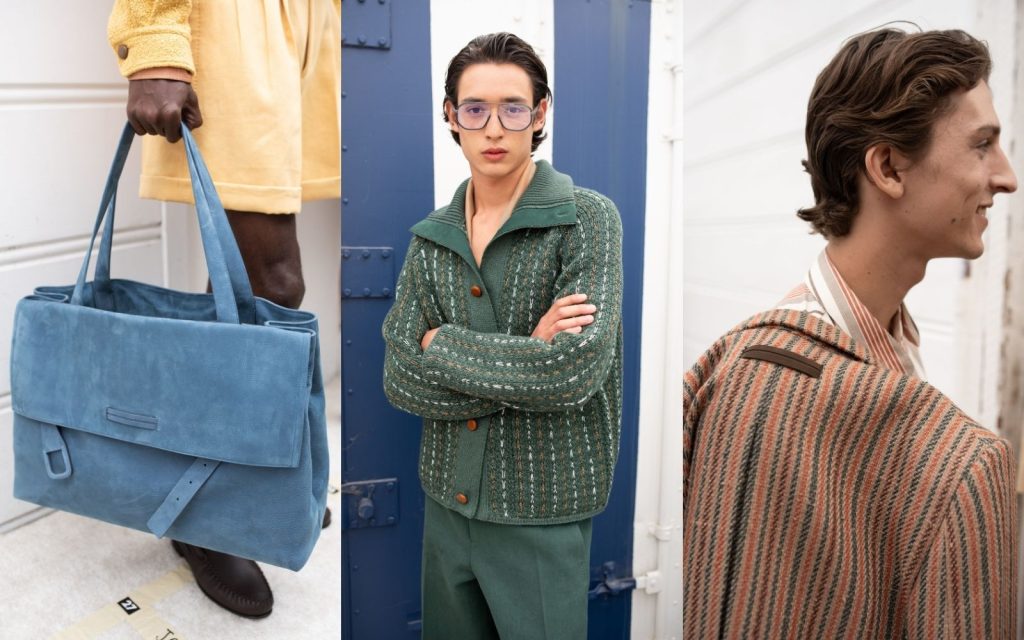
The silhouette of the Summer 2027 collection was straight, relaxed and elegant at once. It moved between loose volumes and slightly shaped forms, always keeping a sense of fluidity and a gentle closeness to the body. Striped suits were paired with shirts in matching patterns, pushing the idea of colour blocking into something more rhythmic than graphic. Shirts appeared in both boxy and flowing shapes, crafted from nappa, nubuck, crocodile or silk. When paired with tailored shorts, they clarified the idea of Villeggiatura dressing: this was not dressing down, but making simplicity feel disciplined, refined and elevated.
Versatility remained one of Zegna’s defining signatures. A single garment was designed to shift between moods, situations and needs. Some shirts came with detachable and interchangeable collars. Blazers featured hidden half-belts that could shape or loosen the silhouette. A double-breasted jacket from a previous season returned, reinterpreted once again. These details show that Zegna is not merely speaking about refinement. It understands that real life requires change. A good garment should not imprison the wearer in a fixed identity. It should give him space to move, adjust and choose his own rhythm.
Across several looks, the atmosphere of a 1970s beach club was translated through Zegna’s lens. Sun-faded stripes looked as though they had been softened by years of light. Terry pullovers, tailored shorts and relaxed trousers were made for moments of leisure without losing composure. A duster coat worn over shorts had an ease that felt almost accidental. A belted safari jacket emerged as one of the key pieces of the collection, also appearing as a short-sleeved overshirt that refined the language of travel and outdoor living. Overshirts were fluid and polite. Knitted jackets felt both sophisticated and elastic. Leather anoraks and intarsia bombers carried traces of the nautical world, filtered through luxury menswear that did not need to over-explain itself.
Small details gave the collection another layer of language: the soft creasing around collars, woven suede, braided textures on bombers and pullovers, and the repeated dialogue between stripes and weaves. The fabric story was especially rich, moving through raw silk gabardine stripes, washed hemp, popeline, Oasi Lino in various structures, striped jacquard, dyed denim, printed silk, French velvet, raw silk canvas, blends of raw silk, wool and paper fibre, textured bouclé with a relaxed terry-like feel, striped seersucker and nappa leather. Together, they made Zegna’s idea of comfort anything but empty. This was comfort considered at the structural level of material itself.
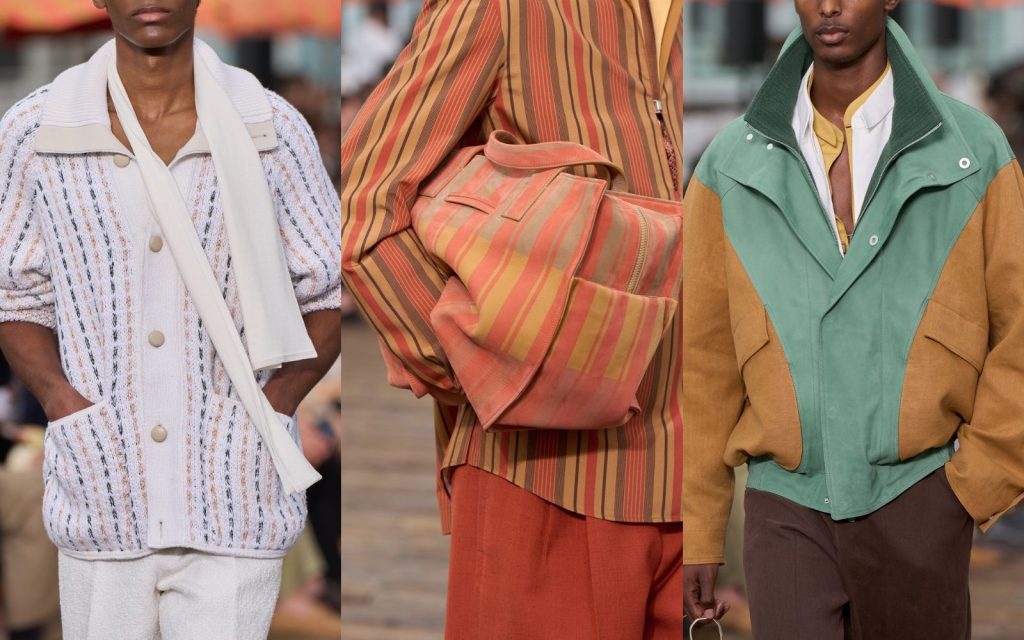
The palette also worked with precision, evoking the atmosphere of poolsides and coastlines. Shades such as Acquamarina, Acqua, Onda, Alga and Marea suggested water as it changes with the light. Boa, Bandiera, Madrepora and Teak brought in the warmth of objects and surfaces around a summer villa. More neutral tones such as Conchiglia, Cima, Duna and Molo acted like sand, shells, piers and earth, calming the collection back down. A touch of muted black prevented all this softness from dissolving too completely into sunlight. Colour here was not decorative. It built an emotional landscape for the clothes.
Even the accessories continued the thought. Soft leather slippers and moccasins made walking feel lighter and more intimate. Duffel bags and totes, in stripes and smooth nubuck, suggested a man who is not simply leaving for a few days but relocating his life somewhere else for a season. Squared sunglasses, silk shawls and knitted silk scarves became details of unhurried living. They did not shout luxury. They quietly announced an understanding of the day’s rhythm.
Another dimension made the show more meaningful than a beautiful fashion moment. Zegna staged the show on Malibu Pier with the support of California State Parks, while also contributing to the conservation of natural public spaces. This gesture connects with the vision that began with the creation of Oasi Zegna more than a century ago: the belief that nature is not merely a backdrop to life, but something to be protected, cultivated and passed on to future generations. In this sense, Malibu was not chosen only because it offered a photogenic setting. It became part of a broader conversation between the world of the brand and the real landscape around it.
This is where Zegna speaks about luxury in a deeper way. Luxury is not only about possession. It is also about understanding environment, time and heritage. In that sense, the phrase “ZEGNA IS A LIVING ITALIAN LEGACY” is more than a beautiful tagline. It describes the house’s identity today. Zegna is an Italian cultural legacy that remains alive. Not a legacy preserved behind glass, not classicism frozen in the past, but a heritage capable of travelling, adapting, absorbing new light and still holding on to its essence, even when the scene shifts from the mountains of Italy to a wooden pier above the Pacific Ocean.
Of course, not every experiment is designed to convince everyone immediately. Some pieces played boldly with the tension between casualness and tailoring. Certain silhouettes, such as the short-sleeved blazer, raised more questions than desire. Yet those small moments of imperfection gave the collection life. They showed that Sartori is still willing to test possibilities within the disciplined frame of a highly refined house. He is not turning Zegna into a fashion brand built only for spectacle or images. He is searching for the space between the reality of clothes and the dream of the runway, between what a man can truly wear and what might make him want to dress with imagination.
There was also an unavoidable business context to the evening. Zegna’s choice of Malibu was not born from romance alone. It reflected the brand’s serious view of the American market. At a time when global luxury faces uncertainty, the United States remains one of the stronger and more resilient markets. Gildo Zegna put it plainly when he said that America is doing exceptionally well. That sentence was more than a compliment to the market. It signalled a direction. Zegna does not see America merely as a scenic location for a show. It sees real clients, real stores and real growth, from Scottsdale to San Diego, from Costa Mesa to Beverly Hills. Gildo’s presence in stores before the show carried meaning beyond executive theatre. When he said, “I act like a customer,” he perhaps explained Zegna’s strength more clearly than any number could. A luxury brand that understands today’s world cannot observe its clients only from a boardroom. It must enter the store, touch the product, try it on and see how real lives move.
Villa Zegna, created around the Chateau Marmont, was therefore more than a pop-up or a decorative prelude to the show. It made the world of the brand tangible before the runway began. The butler, the staged gardener, the striped newsstand and the made-to-measure space where clients could order pieces from the show all carried a theatrical quality. But it was precisely the kind of theatre that luxury can use effectively today. It did not simply say, “Look at what we make.” It said, “Step into this way of living.” Luxury was no longer only about price or rarity. It became the design of a situation in which clients could feel themselves becoming part of a believable universe of taste.
The sight of guests in every possible shade of tan walking across the wooden pier in Zegna Triple Stitch shoes felt both real and faintly amusing. The shoe has become one of the defining symbols of Zegna’s new era because it understands the contemporary man so accurately. He may no longer want formal leather shoes every day, but he does not necessarily want to fall into sneakers that feel too casual either. Triple Stitch sits intelligently between the two. It is the shoe of a man who wants to look relaxed, but still wants that relaxation to have form, value and a language of its own.
At the same time, the reality surrounding the runway made the show even more interesting. Not far from the world Zegna had built for the man who knows how to relax with manners, the real Malibu still existed: board shorts, flip-flops, sweatshirts and locals wealthy enough to wear almost anything without needing to prove anything. The image of those onlookers watching the runway from beyond the show space became an unexpectedly rich cultural dialogue between Italy and America, tailoring and beachwear, polish and ease, those who dress to express taste and those who already belong so completely to the place that they hardly need to dress at all.
Perhaps that was the real challenge of Zegna in Malibu. It was not about making American men dress like Italian men. It was about inviting them to discover that comfort can have more dimensions than they may have imagined. The beach bum can be reimagined not as a figure of abandon, but as a study in disciplined reduction. Softness does not have to become sloppiness. Simplicity does not have to become emptiness. Leisure can still carry an awareness of beauty in every movement.
At a time when so much fashion is preoccupied with images that look good on screen but often feel distant from real life, Sartori’s work at Zegna carries particular weight. He still believes clothes must return to the body. They must walk, sit, breathe, enter restaurants, step into cars, attend meetings and stand by the sea without making the wearer feel as though he is performing a role that does not belong to him. Zegna’s beauty does not lie in escaping reality. It lies in making the reality of dressing more refined.
Malibu may have offered an undeniably Instagram-worthy backdrop, but what made the show memorable was not only the sun, the ocean or the wooden pier at the edge of the evening. It was the way Zegna used that setting to ask a larger question: where does luxury menswear go when men no longer want to be confined by old suit codes, yet still desire elegance, credibility and taste that does not feel superficial? Sartori’s answer was not loud, nor driven by grand spectacle. It revealed itself slowly through fabric, stripes, shadow, light and the movement of clothes that seemed to know the body before the body even wore them.
Ultimately, Zegna in Malibu was not simply a story of Italy arriving in America. It was a story of a historic house understanding that modernity does not require abandoning one’s roots. What the brand did was allow those roots to travel, to meet new light, new air, new clients and new ways of living, and to see how they might continue to grow. At the end of a pier, with the ocean below and the last light of the day crossing the horizon, Zegna did not only reimagine the Malibu beach bum. It reimagined the meaning of a man who knows how to rest without ever losing his elegance.