

Reported by Manit Maneephantakun
In a fashion world where speed has become the dominant language of the age, Hermès continues to speak in a different rhythm. It is not rushed, not loud, and never dependent on overnight spectacle to prove its relevance. Instead, the house asserts itself through something deeper: time, craftsmanship, consistency, and a long-standing relationship with those who understand the value of what it creates. #legendFashion by Manit Maneephantakun @kaimanit reports
The first quarter of 2026 was therefore not merely another business period for Hermès. It was a meaningful test for the French house in a world shaped by uncertainty: geopolitical pressure, currency volatility, shifting tourist flows, and a luxury market that has become more cautious than celebratory. Yet within this landscape, Hermès once again revealed what might best be described as the brand’s quiet force.
In the first three months of 2026, Hermès recorded consolidated revenue of €4.07 billion, or approximately €4.1 billion, representing growth of 5.6% at constant exchange rates compared with the previous year. At current exchange rates, revenue declined slightly by 1.4%, largely due to a significant negative currency impact of €290 million. But the real meaning of these figures lies not in that surface-level decline. It lies in Hermès’ ability to preserve its momentum with calm precision at a time when the global market is not easy for anyone.
Axel Dumas, Executive Chairman of Hermès, noted that in a tense geopolitical environment, the house continues to stay true to its long-term strategy, supported by abundant creativity, uncompromising quality, and the loyalty of its clients. On paper, this may sound like a sentence from a financial report. Read more closely, however, and it becomes something closer to a cultural statement from a house that has never defined luxury through noise or novelty, but through patience, continuity, and conviction.
Viewed by region, Hermès’ first-quarter performance offers a compelling portrait of balance. The Americas emerged as one of the strongest engines of growth, with sales reaching €739 million and rising 17.2% at constant exchange rates. This was an exceptional performance, with balanced growth across métiers in the United States, Canada, and South America. The number tells us more than simply that the American market remains strong. It shows that Hermès is not solely dependent on Asia or traditional tourist-driven luxury consumption, but continues to command desire across major markets with both breadth and depth.
Japan also remained a bright point, generating €404 million in revenue and growing 9.6% at constant exchange rates. Although sales declined 3.9% at current exchange rates due to currency pressure, the underlying picture remained strong, supported by footfall and the loyalty of local clients. The expansion and renovation of the Umeda Hankyu store in Osaka in March was therefore more than a retail update. It reaffirmed Japan’s importance as a market that deeply understands precision, refinement, and the culture of craft.
Europe excluding France delivered €538 million in sales, growing 9.7% at constant exchange rates, supported by local demand. France, the birthplace of the house, recorded €347 million, down 2.8%, affected by a slowdown in tourist flows, particularly in March, linked to the situation in the Middle East. This contrast is important. The softness in France does not suggest a weakening of Hermès’ desirability; rather, it reflects the vulnerability of markets tied closely to international travel. It also underlines a larger shift in luxury today: local clients are becoming increasingly central to sustainable brand strength.
In Asia excluding Japan, Hermès generated €1.881 billion in revenue, growing 2.2% at constant exchange rates despite a 4.6% decline at current exchange rates. Greater China continued to show slight growth, Korea maintained solid momentum, while other parts of the region were more subdued. This may not appear as dramatic as the Americas, but it carries its own significance. In a moment when China and parts of Asia remain cautious, Hermès still managed to grow through local client loyalty and a value-led brand strategy.
The “Other” region, primarily including the Middle East, recorded €160 million in sales, down 5.9% at constant exchange rates and 13.4% at current exchange rates. The area was significantly affected by geopolitical developments from March onwards, particularly in the United Arab Emirates, Kuwait, Qatar, and Bahrain. This helps explain the wider picture: Hermès’ challenges in 2026 do not stem from a weakening brand, but from a complex and volatile external environment.
Yet if geography maps the house’s growth, its product categories reveal where the Hermès universe remains most powerful.
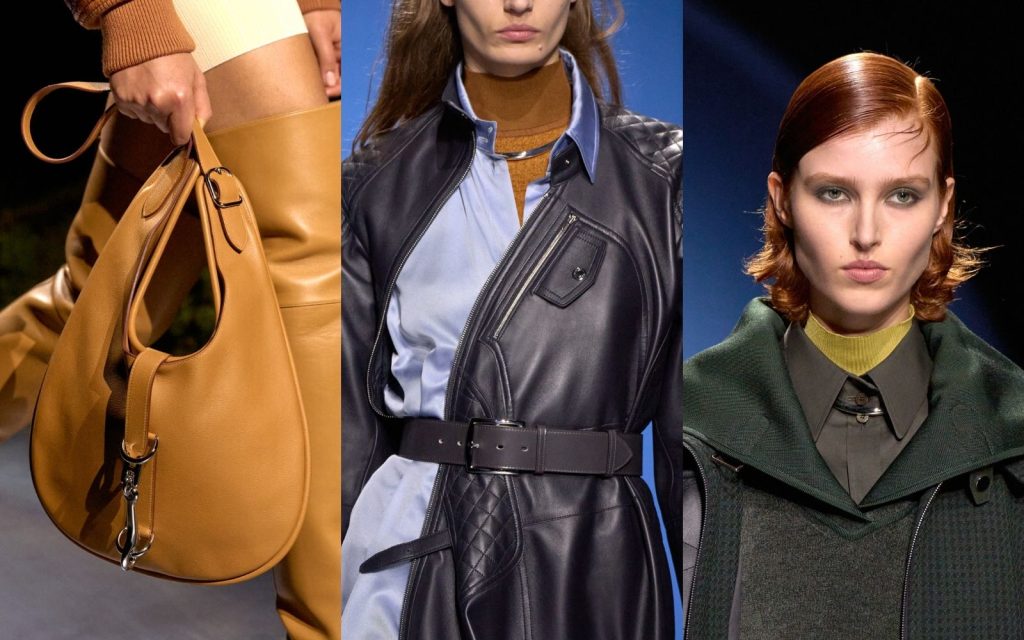
Leather Goods and Saddlery remains, unsurprisingly, the beating heart of the house. The category delivered €1.849 billion in revenue, growing 9.4% at constant exchange rates and accounting for nearly half of first-quarter sales. Its success does not come from demand for bags alone, but from a desire for Hermès objects as living things. The Faubourg Express bag, with its elongated shape recalling travel bags, and the Collier d’attelage bag, with its curved lines, straps, and rings drawn from the equestrian world, both show how Hermès continues to transform its heritage into something contemporary. The past is never treated as a museum piece. It is made to travel forward.
The opening of Hermès’ twenty-fifth leather goods workshop in Loupes, in Gironde, in early April further reveals the nature of the house’s growth. Hermès is not expanding by accelerating production without direction. It is expanding through a disciplined enlargement of its craft ecosystem. The house also plans new workshop openings in Charleville-Mézières in 2027, Colombelles in 2028, and Les Andelys in 2030. These are not merely capacity plans. They are long-term investments in employment, training, and the preservation of craftsmanship in France.
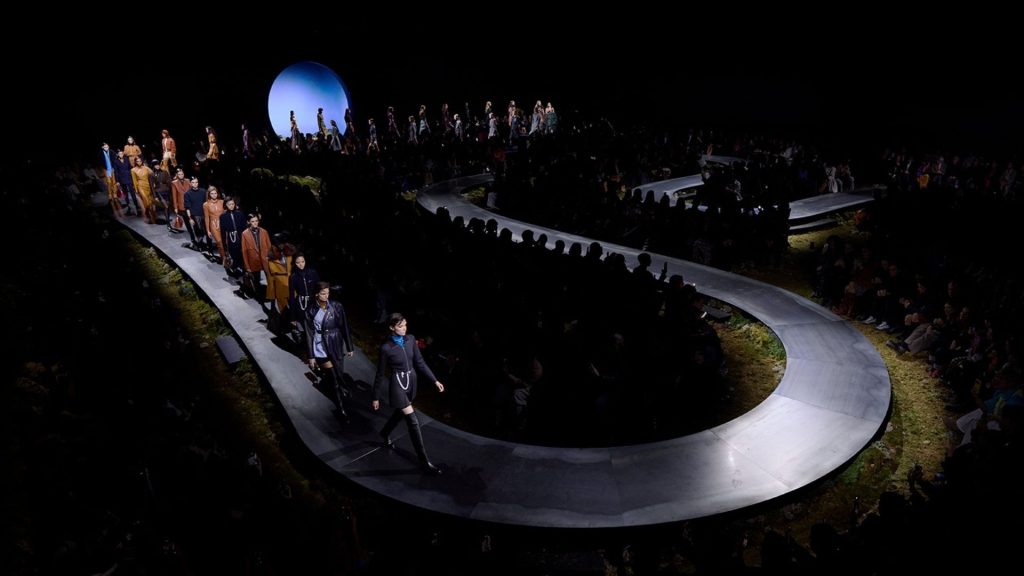
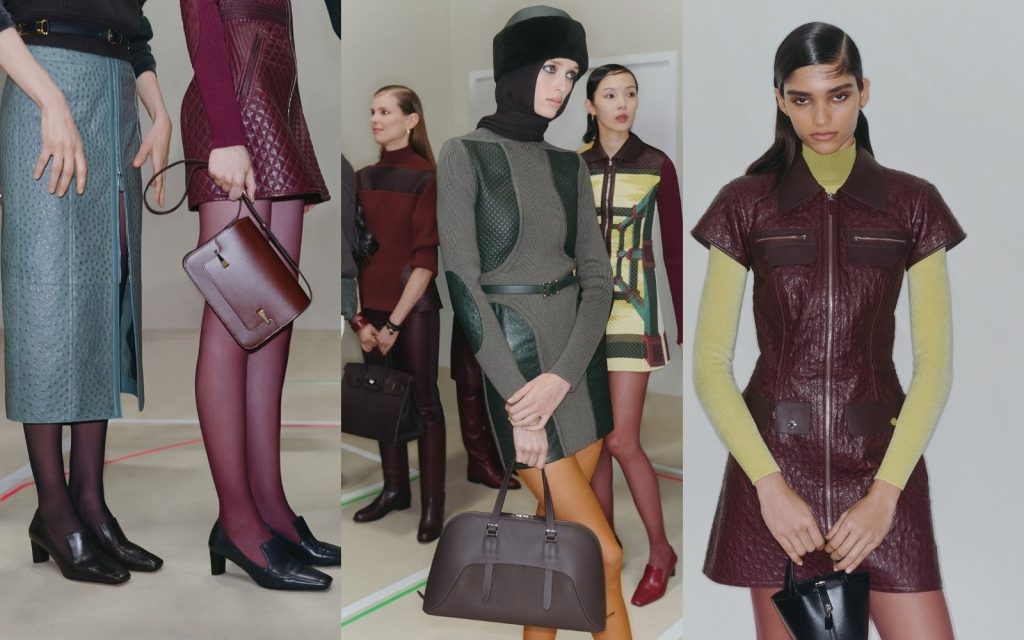
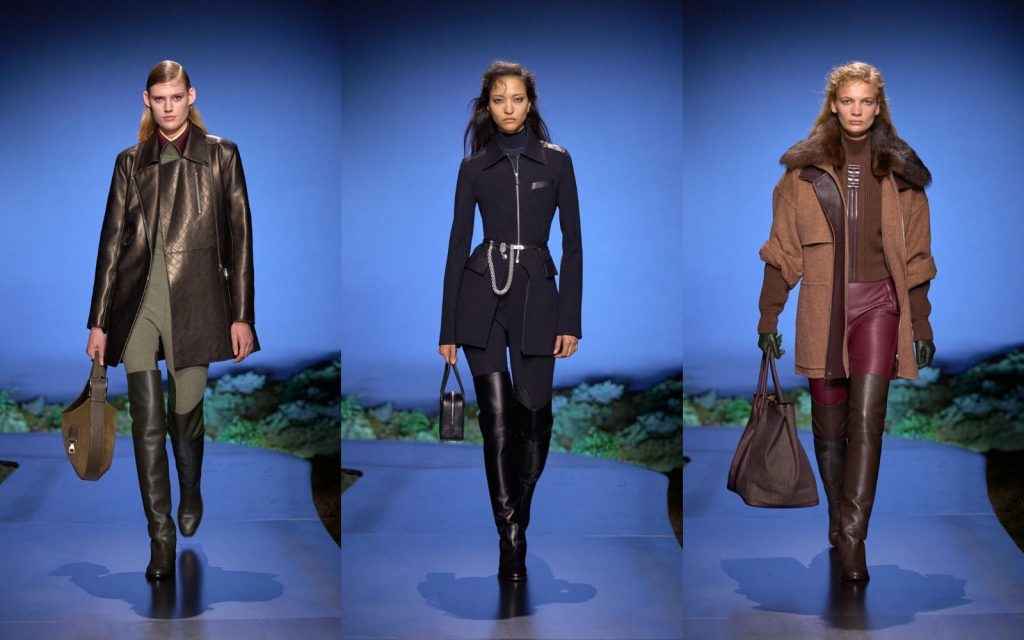
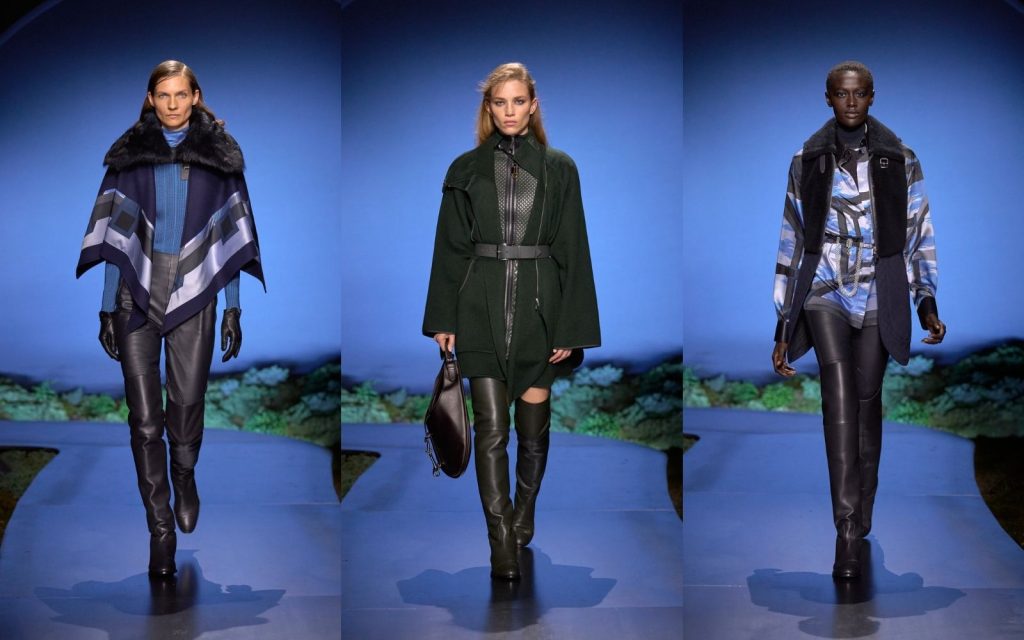
Ready-to-wear and Accessories generated €1.076 billion, remaining broadly stable with 0.4% growth at constant exchange rates, despite a 6.4% decline at current exchange rates. This is a figure that should be read carefully. Stability in this category does not mean creative stillness. On the contrary, the women’s Fall-Winter 2026 runway show, staged at the Garde Républicaine in Paris, was very well received. Meanwhile, the men’s Fall-Winter collection by Véronique Nichanian, first unveiled in Paris in January and later presented in Tokyo in February, created a strong emotional response.
This is where Hermès becomes especially interesting. In a fashion industry where many brands use clothing as a tool for viral moments, Hermès continues to use clothing as a space for character, continuity, and human presence. Véronique Nichanian, Artistic Director of the Hermès Men’s Universe for 37 years, is not merely a designer. She is the keeper of a voice—one that has kept Hermès menswear refined, quiet, assured, and deeply consistent. In an industry where creative directors are often changed almost seasonally, such continuity feels almost radical.
Silk and Textiles recorded €257 million in revenue, growing 7.8% at constant exchange rates. The category may be smaller than leather goods or ready-to-wear, but culturally, silk is one of the most important languages of Hermès. The L’esprit s’envole scarf, echoing the year’s theme of Venture beyond, becomes a symbol of the house’s spirit: light, airborne, and imaginative, yet never detached from its roots. Hermès understands better than most that a square of silk can contain an entire universe of drawing, colour, story, and memory.
Perfume and Beauty recorded €127 million in sales, remaining stable with 0.2% growth at constant exchange rates. The category saw the introduction of Musc Pallida in the Hermessence collection, Un Jardin sous la mer as the seventh creation in the Jardin line, and Plein Air, Hermès Beauty’s first skincare foundation, available in 34 shades. These movements show how Hermès is expanding its beauty universe carefully, not by chasing a mass-market beauty boom, but by bringing scent, skin, and touch into the house’s broader language with restraint and precision.
Watches generated €135 million, declining 3.7% at constant exchange rates and 10.3% at current exchange rates, reflecting a still-challenging watch market. Yet Hermès has not stopped creating. At Watches & Wonders in Geneva, the house presented new timepieces including the Hermès H08 with a skeletonised titanium movement and the Arceau Samarcande minute repeater, a grand complication that reinforces the maison’s view of watches not as accessories, but as objects of time, mechanics, and craft.
Other Hermès sectors, including Jewellery and the Home Universe, generated €540 million and grew 6.8% at constant exchange rates. This reflects the strength of the Hermès universe beyond the wardrobe, extending into the home, the table, jewellery, and a wider art of living. The haute bijouterie event Double Tour, held for the first time in Tokyo in March, was more than a jewellery presentation. It was a narrative of movement, connection, and renewed beauty. The new porcelain service Natures Marines, unveiled in Paris in January, similarly shows how Hermès turns the home into a space of art and daily ritual.
Another dimension that should not be overlooked is Hermès’ model of responsibility, which is not simply a polished phrase in an annual report, but a structure connected directly to the way the company operates. At the beginning of 2026, Hermès distributed €328 million to employees in respect of the 2025 results, including profit-sharing and incentive schemes in France, as well as a €3,000 bonus for all group employees. This number matters because it shows that Hermès does not treat growth purely as a matter for shareholders. It is also a matter for the community of people behind its beauty.
In March, the house published its social policies under the “Hearts & Craft” model, covering diversity, equity and inclusion, wellness at work, health and safety, the development of know-how, and employee dialogue. On the environmental side, Hermès reported that it has achieved 100% renewable electricity and 77% renewable energy globally, while continuing its decarbonisation plans in line with its 2030 targets validated by the Science Based Targets initiative. Its MSCI rating also improved to AA from A, suggesting that Hermès’ artisanal model is not merely romantic, but can be translated into a measurable framework of responsibility.
Looking back at 2025 provides useful context. Hermès recorded annual revenue of €16.002 billion, with 8.9% growth at constant exchange rates. Recurring operating income reached €6.569 billion, representing 41.0% of revenue, while net profit attributable to the group stood at €4.524 billion. The house also had 26,494 employees. These figures make the first quarter of 2026 more meaningful. Hermès did not begin the year from a weak base. It began from a position of considerable strength, and is now proving that it can sustain momentum without diluting its identity.
What matters most in this report, then, is not simply the word “growth,” but the question of how that growth is achieved. Hermès grew exceptionally in the Americas, with quality in Japan and Europe excluding France. It held its ground in Asia excluding Japan despite a difficult market, and addressed pressure in France and the Middle East with clarity. On the product side, Leather Goods remains the central engine, but Silk, Home, Jewellery, Beauty, and Watches all contribute to a universe that expands without becoming scattered.
This is the difference between a brand that has many products and a brand that has a world of its own.
Hermès is not expanding simply to become larger. It is expanding to make its world more complete. That is the subtle intelligence that continues to give the house its cultural authority in fashion.
In a year when Hermès has chosen Venture beyond as its theme, moving forward does not mean abandoning its roots. On the contrary, it means allowing those roots to travel into new landscapes: a bag that recalls the romance of travel, a scarf that lets imagination take flight, a fragrance that leads us to a garden beneath the sea, and new workshops that remind us craftsmanship still has a future.
Hermès in the first quarter of 2026 is therefore not merely the story of €4.07 billion in revenue. It is the story of a fashion house that still knows what should be accelerated and what should be allowed to take time.
And in a world where everything is being made faster, easier, and louder, the ability to move slowly with confidence may be the highest form of luxury today.