
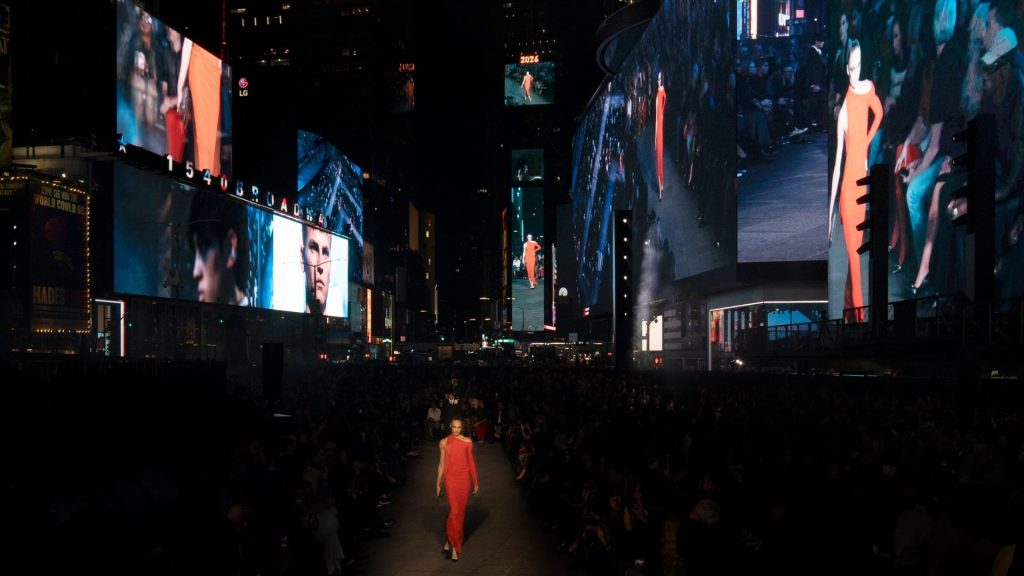

There are certain nights in fashion that are not created for us to remember the clothes, but to remember the feeling of a world constructed around them. Gucci’s first Cruise show under Demna, staged in Times Square, was one of those nights, a moment where fashion did not unfold on a runway, but embedded itself into the very infrastructure of a city already designed to sell everything.
At exactly 8:30 p.m., as if choreographed to the pulse of New York City, dozens of towering LED screens, machines of capitalism in their purest form, shifted their function. They stopped selling products, and began selling a world that does not exist.
Gucci water
Gucci chocolate
Gucci pets
Gucci airplanes
Even “Gucci Life”
These images were not mere gimmicks. They pushed the logic of luxury to its outermost edge. If a brand can sell identity, aspiration, and social status, then what exactly is left that it cannot sell?
A silky voiceover drifted above the crowd:
“Because you want to drive the narrative.”
Or, more plainly:
because you want to be the one who defines the story.
That may well be the core of this entire show.
Demna himself addressed the idea with striking clarity:
“I like the kind of absurdity, the annoying interruption of the beautiful vision of the world by advertising something that you don’t have to sell.”
“I like that kind of absurdity, the irritation of a beautiful vision of the world being interrupted by advertising something you don’t even need to sell.”
This was not simply an aesthetic statement. It was a worldview. In Demna’s universe, purity no longer exists. The world is already saturated with commerce, and instead of resisting it, he chooses to speak its language fluently.
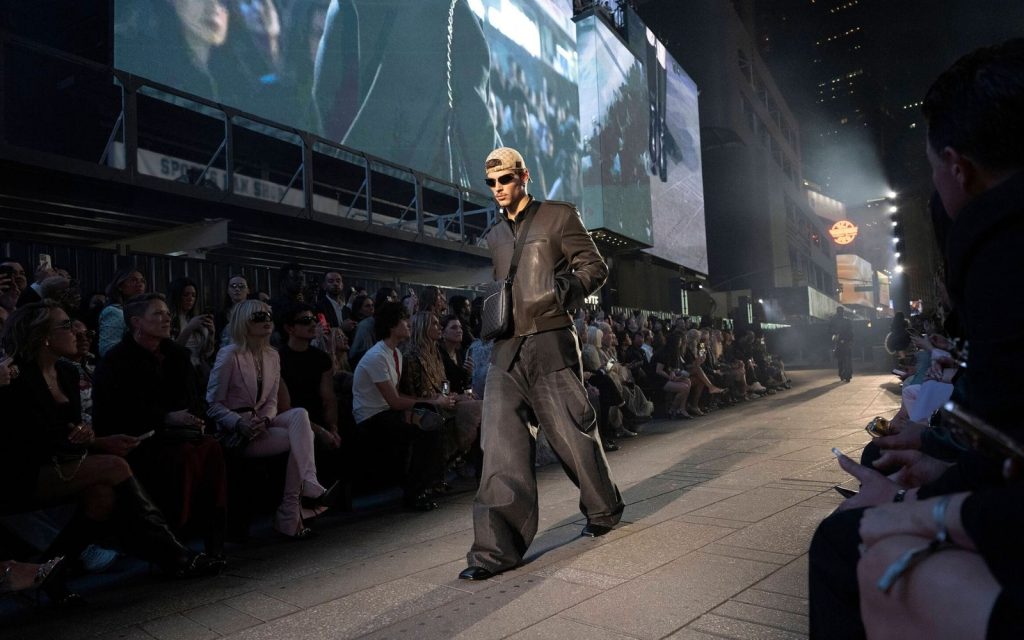
And while the screens above were selling the unreal, what stepped onto the street below was perhaps the most sellableversion of Gucci in recent memory.
The show opened with razor-sharp tailoring, a deliberate homage to Tom Ford’s era. Slim, sculpted suits. Strong shoulders. Flared trousers pressed to perfection. Silhouettes that projected power with unapologetic clarity, echoing a time when Gucci’s identity was built on desire as a form of authority.
But the narrative soon shifted.
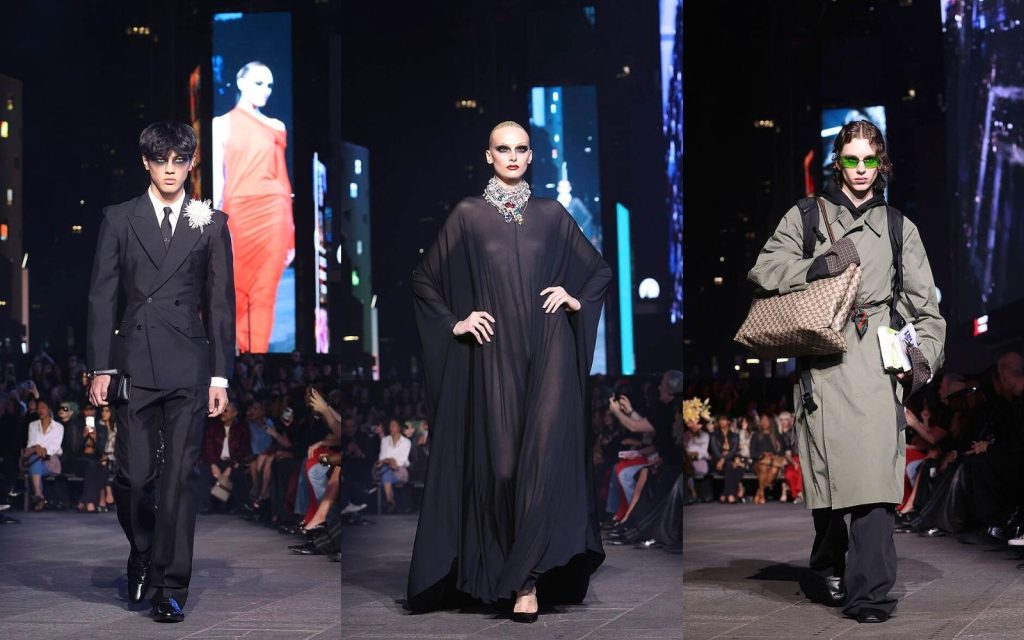
Demna moved Gucci away from nostalgia and into his own territory, through the distortion of the familiar.
Bourgeois chemisiers that bordered on parody.
Mock-couture dresses that felt like memories that never quite existed.
Oversized shirts that seemed borrowed from the morning after.
Leather jackets cut so close to the body they almost imposed themselves upon it.
These were not radical garments. They were ordinary clothes, re-coded into luxury.
Demna described it as:
“a permanent wardrobe grounded in pragmatic, wearable pieces that are unmistakably Gucci.”
And then, more candidly:
“This is probably the most commercial collection I’ve ever done.”
Here, “commercial” is not an apology, it is a declaration.
At a time when Gucci is navigating an ongoing identity question, returning to the “core” may seem like the most logical move. But what Demna proposes is not a return to purity. It is a redefinition of what “core” even means.
Not heritage.
Not craftsmanship.
But what can be consistently sold, and instantly recognized.
GucciCore is not just an aesthetic.
It is a business model.
This became even more evident through casting, which functioned as another layer of narrative.
Cindy Crawford appeared as a feathered grande dame, an embodiment of enduring, classic luxury.
Tom Brady walked in full leather, closer to a constructed character than a real man.
Paris Hilton returned as both herself and a knowing exaggeration of her own image.
In between, there was a gallery of “characters”, figures who seemed real, yet stylized into representations of the city itself.
“I wanted to show the collection on the kind of people you might pass on the street, individuals with their own way of wearing clothes,” Demna explained.
And yet, the irony is unmistakable.
In the world of GucciCore, individuality itself is designed, styled, and ultimately, sold.
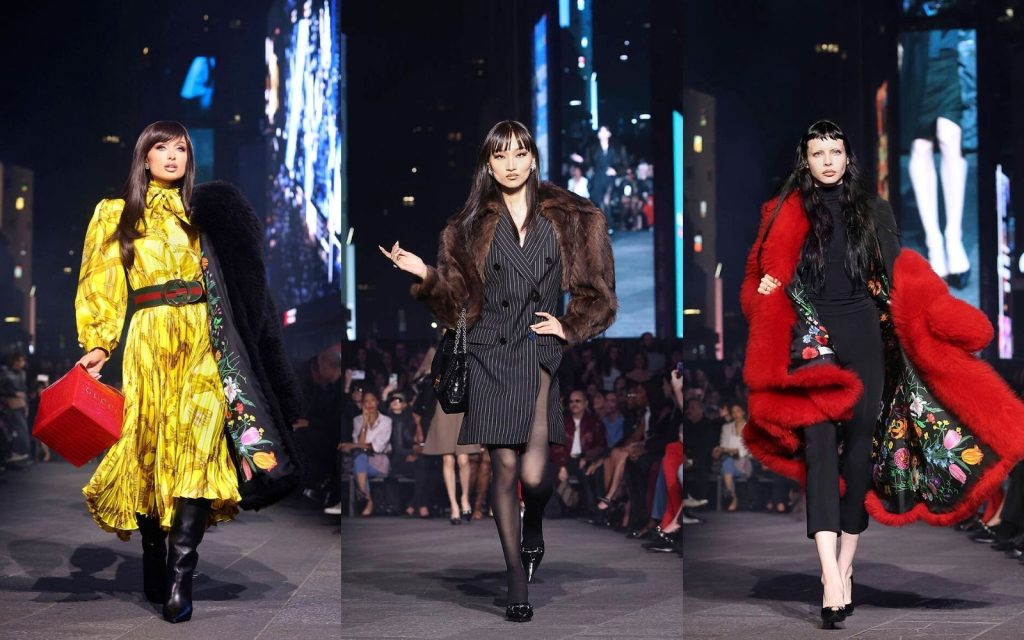
Times Square, that night, was no longer just a location.
It became the most precise metaphor for Gucci today:
a world where everything is image,
every image is advertising,
and every advertisement is trying to become reality.
Seated beneath the towering screens were Kim Kardashian, Mariah Carey, and Shawn Mendes, not just spectators, but participants in the same ecosystem, where visibility is the ultimate currency.
And when the runway dissolved back into the city, what lingered was not just the image of the clothes, but a question.
Is Gucci, under Demna, creating fashion?
Or is it constructing an increasingly perfected system of products?
Because while the collection felt more complete, more wearable, and undeniably more desirable, something else remained.
A lingering sensation, not unlike a looping advertisement in Times Square.
You see it.
You remember it.
But you’re not entirely sure you feel it.
It is impactful.
It is clear.
It sells.
But in a world where everything can be replaced within seconds, the real question may no longer be: Who will buy it?
But rather:
Who will remember it, once it disappears from the screen?
Perhaps this is exactly what Demna understands best.
“I believe in manifestation, and I wanted this show to be about that, what Gucci can become.”
“I believe in manifestation, and I wanted this show to reflect that, what Gucci can become.”
Not what it was.
But what it can be.
And in the world of GucciCore, that future may no longer belong to fashion alone.
It becomes a one-stop universe of ambition,
a world where everything, from clothing to life itself, can be designed, sold, and realized.
Even if it exists only as a dream, endlessly replayed across giant LED screens,
perhaps that is enough.
Because in Gucci’s world today,
what matters is no longer what you wear,
but which version of yourself you choose to buy.