


Reported by Manit Maneephantakun
A rented house may seem, at first glance, like a temporary place in someone’s life. But for certain relationships, the same house can become a silent witness to marriage, shared dreams, unfinished conversations, expanding silences, and cracks that no one quite knows whether to repair or leave behind as part of memory.
In the spoken stage play “ONCE AGAIN”, this rented house becomes the emotional ground on which the love stories of three couples from different periods of time are layered together. There is a husband and wife forced to confront the wounds left behind after their hopes collapse; two close friends beginning to question the fragile line between friendship and love; and an undefined relationship between two people who are unsure whether staying together is a cure for loneliness or another scar waiting to be remembered.
For Noon Siraphun Wattanajinda, returning to the stage is not entirely new. Yet “ONCE AGAIN” still feels like another challenge for an actress who has built her career through emotionally demanding work, and who continues to choose projects that bring her into unfamiliar territory.
When asked how many stage productions she has performed in throughout her career, Noon laughs before answering casually. Counting both large and smaller theatres, this should be her sixth stage play. “But for Rachadalai,” she says, “this is my second.”
What makes “ONCE AGAIN” different from her previous theatre experiences is not the size of the stage or the spectacle of the production. It is the courage to place ordinary human life at the centre of the performance.
“In the past, stage plays usually needed something very dramatic to make them interesting,” Noon explains. “If it wasn’t murder, it was ghosts, mystery, or fantasy. But this story is highly human. It is about conversations inside a home, inside a family.”
That may be the key to “ONCE AGAIN.” The play does not ask the audience to escape from real life. Instead, it invites them to return to what may have happened in their own homes, their own relationships, or a particular memory they have never fully understood.
For Noon, what makes the project so compelling is the way it dares to take conversations that may sound familiar, words we might have heard inside a home, in a marriage, or in a close relationship, and place them on stage. At the same time, the play brings six characters from different periods of time into the same theatrical space.

“To take conversations that feel like something we have heard before and put them on stage, while telling the story through six people from different time periods, is very interesting,” Noon says. “That made the project feel challenging.”
In the play, Noon portrays Napa, a lawyer who is logical, rational, structured, and guided by a clear sense of order. Napa is the wife of Thana, a young architect played by Boy Pakorn. Together, they begin their married life in the rented house with a shared hope. But when life fails to unfold as they imagined, the warmth of their love is forced to face a difficult question: when hope collapses, can two people still look at the same wound in the same way?
“Napa is a lawyer,” Noon says. “She has logic, reason, and a certain system in her thinking. Then she becomes life partners with Thana, played by Boy. He is an architect, so their characters are quite opposite.”
Yet difference does not always begin as conflict. At the beginning of a relationship, difference can be attraction. It can be the thing one person brings into another person’s life. Napa may be structured and rational, while Thana brings brightness, gentleness, and a certain artistic sensibility that she does not naturally have.
“Deep down, I feel that he fills in something she does not have,” Noon says. “A kind of brightness, and a certain gentleness.”
But when love enters marriage, romance alone is no longer enough. For Noon, the story of Napa and Thana is not simply about two people who love each other and encounter problems. It is a reflection of married life as an ongoing process of adjustment.
“Marriage is not about getting married and then living happily ever after,” she says. “It is about constantly adjusting. When a turning point happens in life, it depends on how each person sees the problem. People have different ways of solving things, or different ways of moving on.”
This is where “ONCE AGAIN” quietly cuts deep. Many times, love does not fail because people stop loving each other. It fails because two people handle the same wound differently. One may want to talk, while the other chooses silence. One may want to fix things immediately, while the other may need time to understand their own pain.
Noon’s own experience of married life allows her to approach Napa with greater nuance. Not by imposing her personal life onto the character, but by using real understanding to open emotional doors and make the character more alive.
Working opposite Boy Pakorn, who is making his stage debut in this production, Noon never saw his lack of theatre experience as an obstacle. Instead, she noticed his dedication from the first reading.
“Boy is very committed,” she says. “At the first read-through, he came in with so much energy that I had to raise my own inner level to match his. Otherwise, it would have felt like playing ping-pong with two different levels of energy.”
Her comment reveals something essential about theatre. Acting is not about standing out alone. It is about passing energy back and forth between performers, especially when playing a married couple whose journey moves from sweetness and hope to the moment when dreams begin to break.

Noon says she and Boy talked extensively throughout rehearsals, discussing the inner thoughts of their characters, the emotional intention behind certain lines, and the small details that make a marriage on stage feel truthful.
“Boy and I talked a lot,” she says. “I shared certain experiences with him. Since P’Top is also a designer in real life, there is a little bit of that architect’s feeling I could draw from. I would share that, for a line like this, maybe this is what the inner feeling might be.”
Even something as simple as hanging a picture in a house can become a meaningful detail. For someone with a design background, beauty may be understood through a different kind of logic. Noon brought those observations into rehearsal, helping shape Napa and Thana’s relationship with greater specificity.
“Even with something like putting a picture on the wall, a designer or an artistic person might see beauty in one way, while another person might see it differently,” she explains. “So I shared those things, and Boy took some of them into his performance.”
Noon does not see Boy’s lack of personal experience in marriage as a limitation. Acting, after all, is about helping each other fill in the spaces one person may not have lived through, and building a shared truth on stage.
“Even though Boy has never been married, it is not an obstacle,” she says. “It is more like we help fill in what the other person needs.”
Alongside Napa and Thana, “ONCE AGAIN” also presents two other relationships that bring different emotional textures into the same house: close friends who may be falling in love, and a relationship without a name, caught somewhere between attraction, loneliness, and ambiguity. Noon speaks warmly of the younger actors in the production, especially their naturalness and courage.
“I really like watching the younger actors,” she says. “Sometimes I sit there and think, they are really good. The script gives each couple their own language. Once that language fits their characters, it does not look like acting. It feels like they really are friends.”
In Noon’s eyes, the younger generation of actors has the courage to express opinions and try things they believe in. As a senior performer, she does not see herself only as someone guiding them. She also learns from their energy and instincts.
“Younger actors today are brave in expressing their ideas,” she says. “They are brave enough to try what they believe in. In the end, I feel like I learn more from them.”
After years of taking on many different roles, Noon describes her work today as becoming increasingly “crafted.” She no longer chooses projects only because they offer a character she wants to play, or because they take her somewhere she has never been before. Those things still matter, but as time passes, she is looking more closely at the value a project can deliver to its audience.
“In the past, I chose roles based on spaces I had never entered, characters I had never played, or approaches I had never tried,” she says. “But as I get older, beyond those factors, it becomes about value.”
For Noon, acting should not stop at entertainment. It should not only give audiences a momentary sense of satisfaction. The characters she chooses must offer something that allows viewers to understand human beings more deeply, to understand life more fully, or at least to feel something shift inside them after the performance ends.
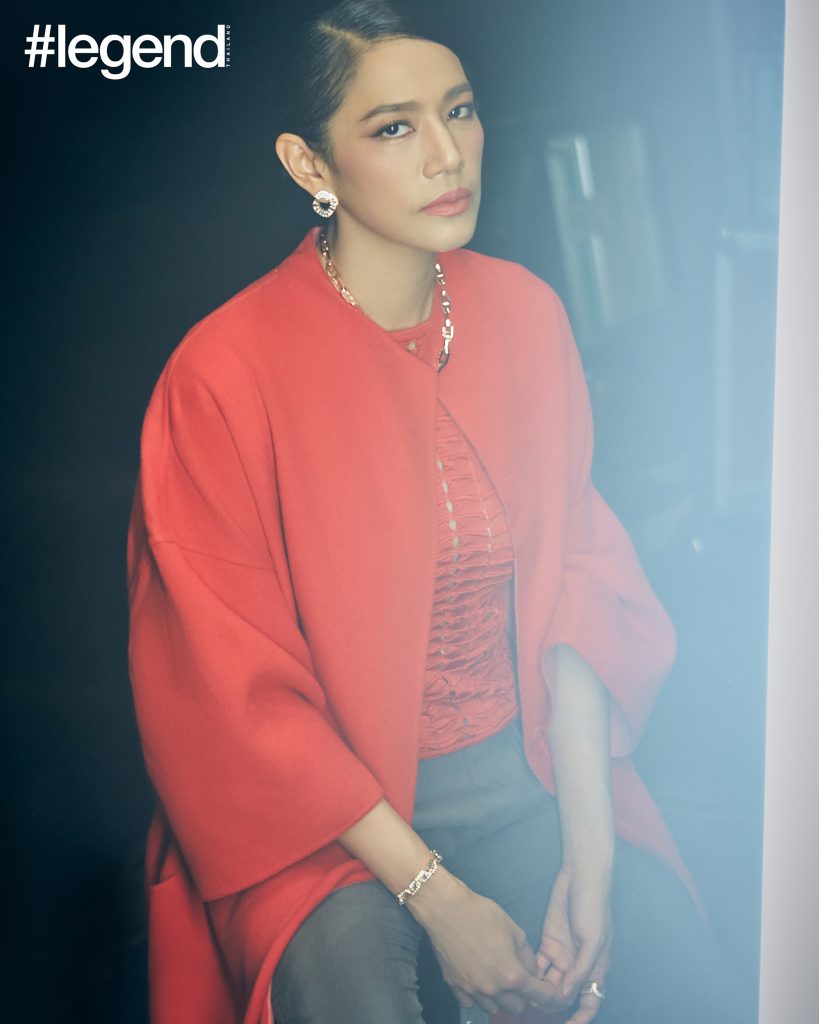
“I want to deliver some kind of value to the audience,” Noon says. “I want them to experience something beyond entertainment. So each character I choose has to offer value. It has to help people understand human beings.”
Perhaps this is why audiences continue to believe in Noon Siraphun in almost every role she takes on. Yet she herself does not speak of her career as though she has already reached the summit.
When asked whether she feels she has achieved her goals as an actress, Noon answers with striking honesty.
“I do not feel that I am good,” she says. “I feel that I still have a lot to improve. In every project I have done, there are still things I could have done better.”
Her answer does not come from insecurity. It reflects the seriousness of someone who has not stopped learning. She admits there was once a time when she wanted to prove herself, to overcome certain words and expectations. But today, that need has softened.
“There was a time when I wanted to prove that I could do it,” she says. “I wanted to overcome words and many other factors. But today, it is no longer necessary to win over anyone, and I do not need to prove myself to anyone.”
What remains is not competition, but the desire to choose work that still excites her, still teaches her, and still carries meaning.
“When I feel ready, and when there is a role that can deliver some kind of value, then I am okay with it,” she says.
If audiences were to remember an actress named Noon Siraphun, she does not want to be remembered simply as someone “talented.” More than that, she hopes to be remembered as someone serious about the art of acting.
“I want people to feel that I am someone who is serious and attentive to the craft of acting,” Noon says. “That is all. I do not need them to remember me as being good, because I feel I am not there yet.”
What she wants to achieve in every role is to make each character she receives truly alive, with real feelings, so that the audience forgets they are watching Noon perform.
“I want every character whose life I take on to feel truly alive,” she says. “I want them to have real feelings. I do not want the audience to feel, this is Noon acting. I want them to see the character and believe.”
Beyond the stage and screen, Noon’s life today has entered another kind of question, one that is not only about fame or professional achievement, but about how to make the best use of herself.
She says that, at this stage of life, she has begun asking herself again what she wants to do next. Many things she once wanted to do have already happened. Some dreams she once considered the highest points in her heart may already have been reached. What she is searching for now is not simply another job, but a deeper sense of value that cannot always be measured.
“Deep down, I want to make myself as useful as possible,” she says. “Not just to have enough money to support myself until I grow old.”
That answer connects closely to the sustainability and social enterprise work she has done with her husband, Top Pipat Apiraktanakorn, for almost two decades. More recently, Noon has found a new kind of happiness in serving as an advisor and mentor, using the experience she has accumulated, including both successes and failures, to support others.
“At the moment, I am an advisor for a programme that develops social leaders,” she explains. “I work almost like a mentor, going into communities and sharing advice on how to develop communities or environmental work sustainably. I bring the knowledge, experience, and even the failures I have had, and share them. I feel happy doing that.”
She smiles when speaking about a form of happiness that cannot be measured in money, numbers, or followers.
“It has value,” she says. “I have only recently begun to understand when adults say life needs to have value. Some kinds of value cannot be touched. They cannot be measured in money or followers. But they feel good.”
In the same conversation, Noon also speaks about married life with maturity and honesty. She does not present marriage as something flawless or free from conflict. Arguments happen. Disagreements happen. Especially when two people work together and spend almost all their time together.
But what allows the relationship to continue is communication, reason, and the willingness to return again and again to the understanding that family matters most.
“We have gone through many things through communication and reason,” Noon says. “He has his reasons, and I have mine.”
She explains that when work-related conflicts arise, or when emotions are still heated, each person must sometimes step away to manage their feelings first. Only later, when things have cooled down, can they sit together and talk about what caused the anger, what each person felt, and what the solution should be.
“In the end, we feel that we choose family,” she says. “The heart of both of us is that our family life is important. So whatever the work problem is, we sit down and talk about it after each of us has dealt with our own emotions.”
That lived experience gives her role as Napa in “ONCE AGAIN” even greater emotional weight. Noon understands that love is not merely a feeling. It is the intention to keep making a relationship work, even through misunderstanding, difference, and moments when both people are vulnerable.
“Deep down, we intend to make our married life work,” she says. “That is the foundation. Ego and other things eventually come back to the fact that we still want this to be a family life.”
When asked about the “once again” moment in her own life, the moment she looks back on as an important door, Noon does not choose the moment many might expect, such as her work in Dear Dakanda. Instead, she points to a turning point that changed the direction of her life: entering the Dutchie Boy & Girl 2004 contest.
“That contest changed my life,” she says. “Without that stage, there would be no Noon Siraphun.”
Before that, Noon knew she wanted to be an actress. She wanted to act seriously. But she did not come from a path that made entering the industry feel easy. She studied in a different field, came from the provinces, and never saw herself as someone beautiful or star-like in a conventional sense.
“I knew I would never have had the courage to come to Bangkok and submit myself for casting on my own,” she says. “So that stage was an important door in my life. I thank myself for not closing that opportunity, and I thank the adults who gave me that chance.”
Another work that continues to travel across time to younger audiences is Dear Dakanda, the film that made her character Dakanda one of Thai pop culture’s most enduring figures. Noon speaks about the film’s timelessness with humility and clarity. For her, what makes it last is not any one actor, but the script and the emotional core of the story.
“For me, something classic means it does not become outdated,” she says. “It is not about trends. It is something fundamental to people, something they can understand and feel.”
Noon believes that the script is the foundation of every piece of work. If the writing is strong, the story will be remembered, even if other elements are not perfect.
“For every project, the script is the heart,” she says. “If the script is good, even if some other elements are not perfect, people will still remember the story.”
That belief reflects back beautifully on “ONCE AGAIN.” This stage play places its weight on dialogue, relationships, and the humanity of its characters, rather than dramatic spectacle. At its centre is a simple question with no simple answer: if we had the chance to go back once more, would we repair the relationship that broke, or accept that the cracks were part of the lesson that helped us grow?
For Noon Siraphun, returning to the stage in “ONCE AGAIN” is not only about playing Napa. It is about exploring what acting means at a point in her life when she chooses work for its value, chooses characters for their ability to help audiences understand human beings more deeply, and uses her own life experience to make each character feel real.
In the end, perhaps love is not beautiful because it never breaks. Perhaps relationships are not meaningful because they are free from cracks. And perhaps starting again does not come from forgetting the past, but from looking at it honestly enough to understand what should be repaired, what should be released, and what should be remembered as the lesson that made us more human.
“ONCE AGAIN” stars Boy Pakorn, Noon Siraphun, Euro Yotsawat, Tonkhao Chayut, Aim Phumipat, and Perth Veerinsara. Presented by Muangthai Rachadalai Theatre, the spoken stage play invites audiences back into one rented house to revisit love, pain, and the question at the heart of memory: if life gave us one more chance, would we choose the same pain, or begin again?
“ONCE AGAIN” runs from 15 June to 5 July 2026 at Muangthai Rachadalai Theatre.