

Reported by Manit Maneepantakul
The sea breeze of Biarritz in late April doesn’t merely sweep across the sand, it carries with it overlapping layers of past and present, rising once more into view. It tells the story of a young woman who stood here in 1915 and chose to see the world differently. That woman was Gabrielle Chanel, and the world she created would come to be known as the Chanel style.
More than a century later, Matthieu Blazy returns to the same coastline, not simply as a successor, but as a conversationalist with the past.
He used to play on this very beach as a child. “My father’s family were in the Pyrenees, so we would come down here to swim every summer,” he recalls. That personal memory isn’t used for sentimentality, but as a point of departure for interpretation, because now, he finds himself “playing” with Chanel’s seaside legacy, overlooking the same shore.
The Cruise 2026/27 show by Chanel is not merely a fashion presentation in a meaningful location, it is a dialogue between a designer’s identity and a house’s enduring spirit.
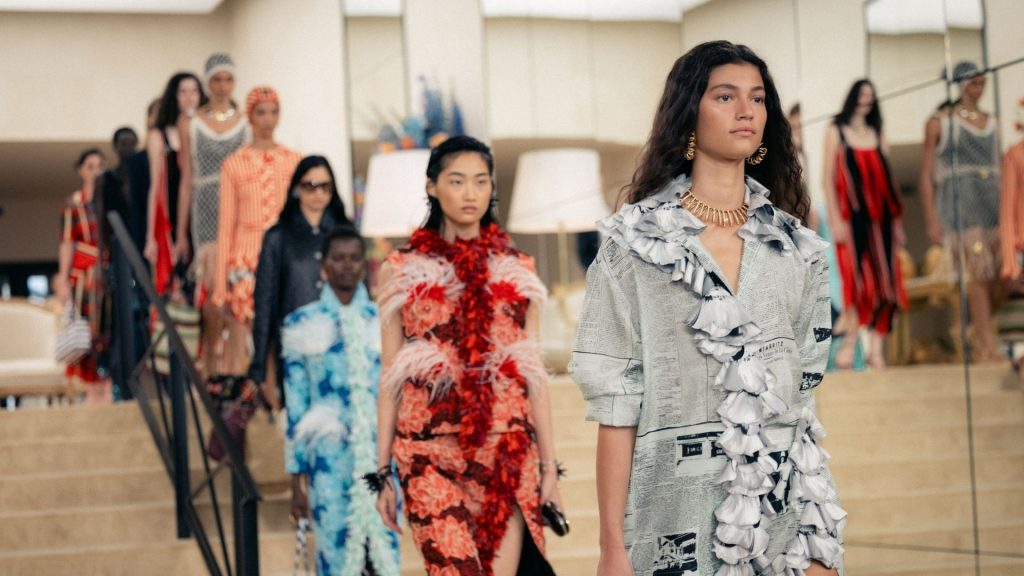
Inside the Art Deco seaside casino, the set dissolves the boundary between salon and shore. A beige carpet mimics sand, as though Parisian elegance has gently spilled out onto the beach, into the very space where Chanel once reimagined fashion itself.
Under light reflected through mirrored columns, every step feels slowed, elongated. The sound of shoes brushing the “sand” creates a sensation that is both real and imagined. It’s as if the audience is seated in a place that is neither entirely salon nor entirely beach, but somewhere in between.
Sunlight doesn’t simply illuminate, it animates. The spring of tweed, the fluidity of silk, the tremble of raffia: fabrics don’t just appear, they move, breathe, and shift with each step.
“This is where she discovered new ways of being, seeing, moving, of freedom,” Blazy explains. “It’s a place that offers the perfect balance between function and fiction.”
In Biarritz, there were no rigid hierarchies. Artists, workers, sailors, aristocrats, all occupied the same space. And this, precisely, is what Chanel transformed into fashion.
She didn’t merely design clothes, she reorganized the structure of society through them.
Jersey, once reserved for underwear, became dresses. Linen and cotton, materials of simplicity, were elevated into effortless elegance, worn day and night, indoors and out. Lightness, movement, and simplicity became the house’s foundational codes.
Blazy does not imitate these codes, he reanimates them.
The collection opens with the Little Black Dress, a piece once considered revolutionary and now marking its 100th anniversary.
“I think it might be the first revenge dress,” he notes.
Originally inspired by the uniforms of maids, the black dress inverted social hierarchies, transforming something utilitarian into an object of desire for the elite.
Revisiting the original at The Met, Blazy discovered an overlooked detail: a large bow at the back, absent from early published sketches. He transforms it into a clutch concealed within the bow, a subtle yet telling gesture.
For him, the past is not something to preserve intact, but something to transform.
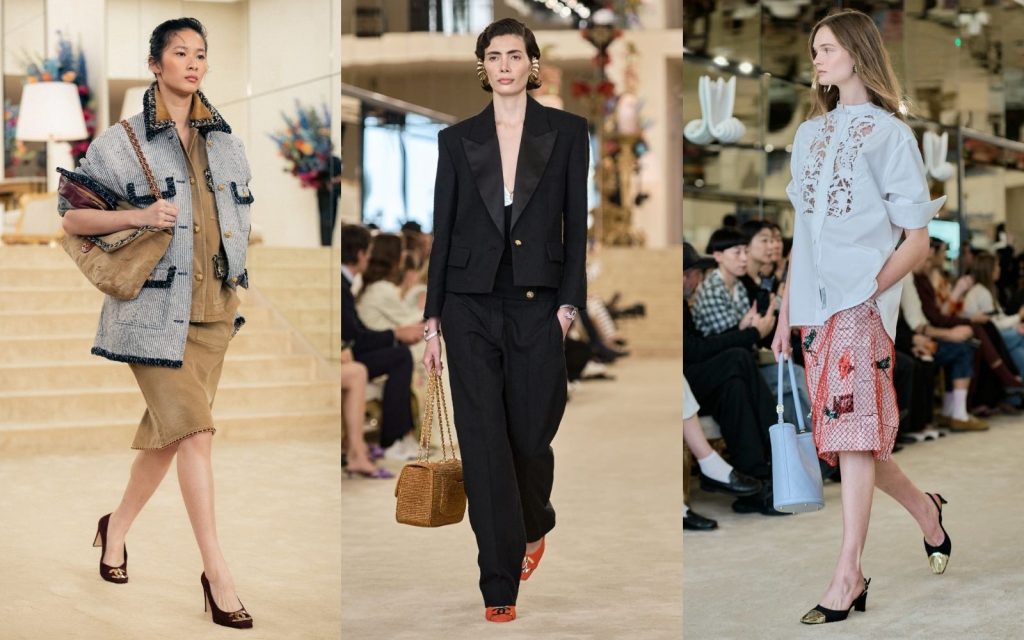
Basque stripes, drawn from traditional linens, run throughout the collection like a thread connecting workwear, leisurewear, and couture. The sailor’s marinière appears as a quarter-zip sweater, Blazy’s own personal uniform.
“There was always this idea of borrowing,” he says.
But borrowing here is not imitation, it is reinterpretation. It is the act of taking something real and giving it new meaning.
This is why the clothes feel deceptively simple.
A slightly slouched tweed suit. Trousers cut with quiet precision. A striped shirt that feels almost ordinary. Together, they redefine luxury as something lived-in, something immediate.
“It’s about making the most luxurious clothes look the easiest to wear.”
Yet beneath this ease lies tension.
As patterns, prints, and embellishments begin to layer, scarves, stripes, embroidery, the collection edges toward excess.
“Someone told me, ‘It’s too much,’” Blazy admits.
But then came the image of an early 20th-century beach, crowded with striped tents in chaotic harmony.
“It was such a beautiful mess… so I thought, let’s go.”
In that moment, excess becomes intentional.
Not a flaw, but an acknowledgment: the real world is never minimal.
At the same time, Blazy injects fiction into function.
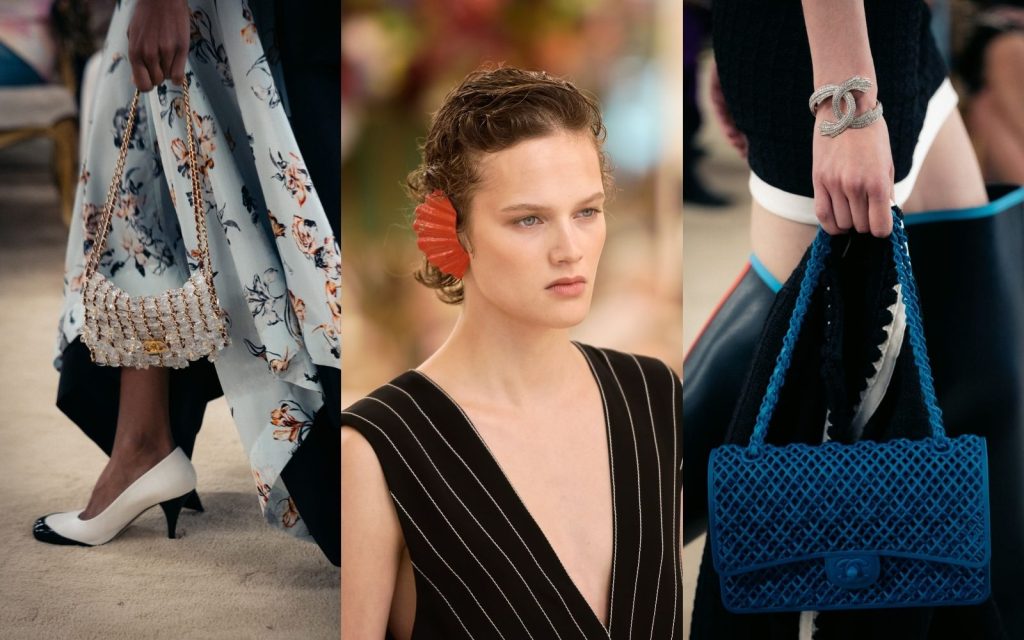
Mermaids appear in turquoise sequins. Seashells cling to ears. Coral and starfish become braiding. Shoes reduce themselves to mere heel caps. The boundary between clothing and fantasy is stretched, tested, redefined.
“From the reality of the black dress to the fantasy of the mermaid, this is a new Chanel folklore.”
Even a quilted bag in sea-blue resin is waterproof.
“You can swim in it,” he says, smiling.
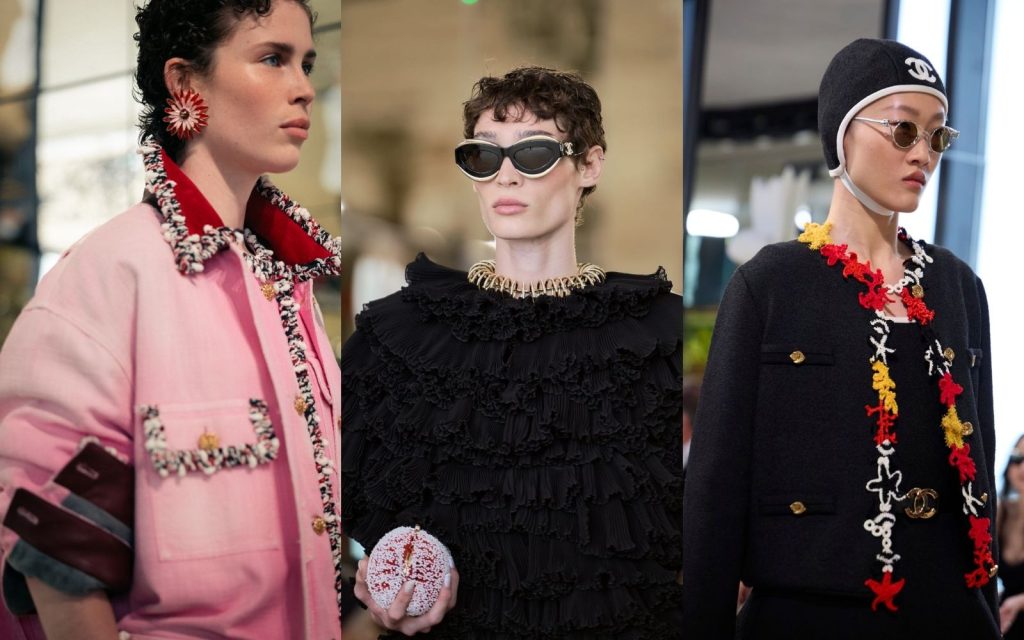
Elsewhere, Blazy revisits archival pieces almost unchanged, what he calls “blast from the past.”
“Some things are so good, you don’t need to do anything.”
And yet, he insists, his role is not to mine the archive endlessly.
“It’s a starting point. Then we add layers of fantasy. It’s not just by the book.”
This is not nostalgia, it is transformation.
At a moment when fashion oscillates between the restraint of quiet luxury and a craving for something more expressive, this collection offers a third path.
Not simplicity as silence, but simplicity with life.
Not excess for spectacle, but excess with meaning.
Blazy doesn’t reject luxury, he lets it breathe again.
As “Emmenez-moi” by Charles Aznavour swells for the finale, models emerge into a flood of light. The audience rises, applauding, not just the clothes, but the feeling.
In a world still marked by uncertainty, fashion here affirms something essential: the joy of being alive.
“It’s kind of overwhelming,” Blazy admits. “We’ll talk about it in 10 years. It’s a marathon, not just one drop.”
On the shores of Biarritz, where it all began,
Chanel is not returning to the past.
It is rewriting it,
with the rhythm of the same waves,
and the vision of a new generation.
Because in fashion,
what feels most contemporary
is not always what is new,
but what has never truly been understood before.