

Reported by Manit Maneephantakun
There are garments in fashion history that are more than clothes. They become cultural events. Le Smoking by Saint Laurent is one of them.
When Yves Saint Laurent introduced the black tuxedo suit for women in 1966, it was not simply an act of borrowing the masculine wardrobe and placing it onto the female body. It was a disruption of social codes, of who was allowed to dress in what way, and what that meant. Women who wore Le Smoking in those years did not merely appear elegant. They seemed to be reclaiming something: space, authority, confidence, and the freedom to define themselves.
Legend has it that when Françoise Hardy arrived at the Paris Opera in the late 1960s wearing a Smoking suit, the reaction was immediate. People shouted. They protested. It was considered scandalous.
Yet it was precisely that scandal that transformed the suit into a symbol. Sixty years later, for Fall/Winter 2026, Anthony Vaccarello returned to this foundational icon, not as a nostalgic tribute, but as a way to prove that Le Smoking still has a pulse in contemporary fashion.
The show opened in near silence.
No bursts of color. No decorative excess. No attempt to seize attention through theatrical spectacle. Instead, what appeared on the runway was simple and stark: black trouser suits.
One look.
Then another.
And another.
By the end of the show, fourteen of them had passed.
It was an act of confidence that required no announcement.
Vaccarello understands that the house he leads carries a formidable legacy. Rather than avoiding the shadow of the past, he chose to step directly into it. Backstage, he explained that the starting point came from his latest men’s tailoring, particularly the softly sloping shoulder line. Translated into womenswear, however, the suits were stripped of rigid structure.
Instead of traditional, heavily constructed tailoring, everything was made fluid, light, and largely unlined.
The result was tailoring that retained its sharpness but moved freely with the body. A balance between discipline and sensuality. Between structure and release.
As the repetition of black suits continued down the runway, the eye naturally shifted toward other details.
Hair was side-parted, slicked down with gel and pulled back into tight chignons. Faces were sculpted by Pat McGrath with smoky shadow, sharply contoured cheekbones, and glossy dark red lips.
The effect recalled the photography of Helmut Newton from the 1970s and 1980s, images of women in Saint Laurent suits who appeared powerful, seductive, and faintly dangerous all at once.
A kind of dangerous chic.
Yet Vaccarello did not stop at the Smoking.
The other half of the collection unfolded in an entirely different register.
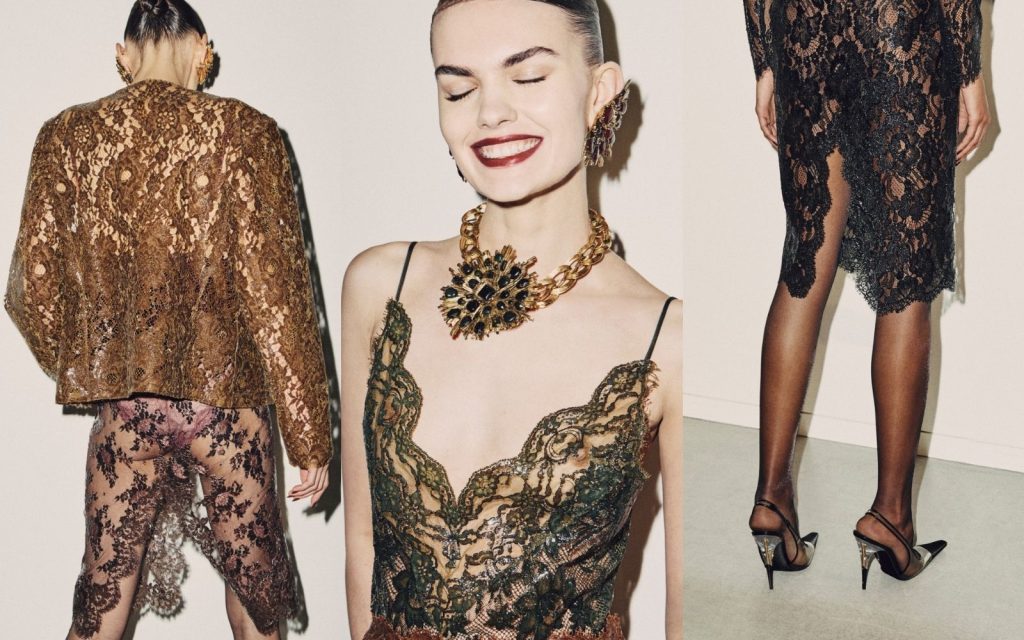
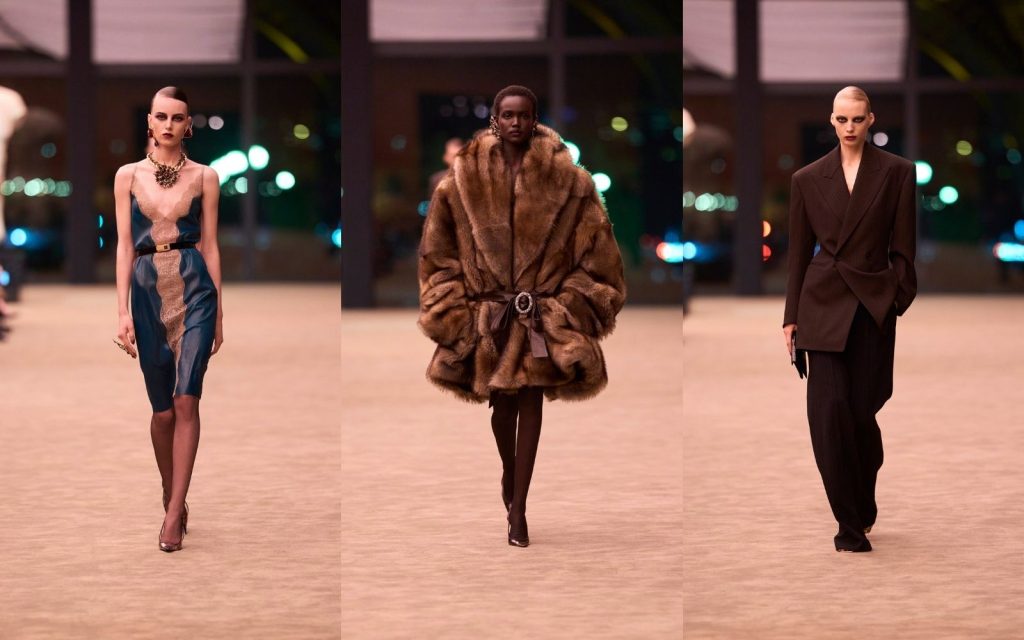
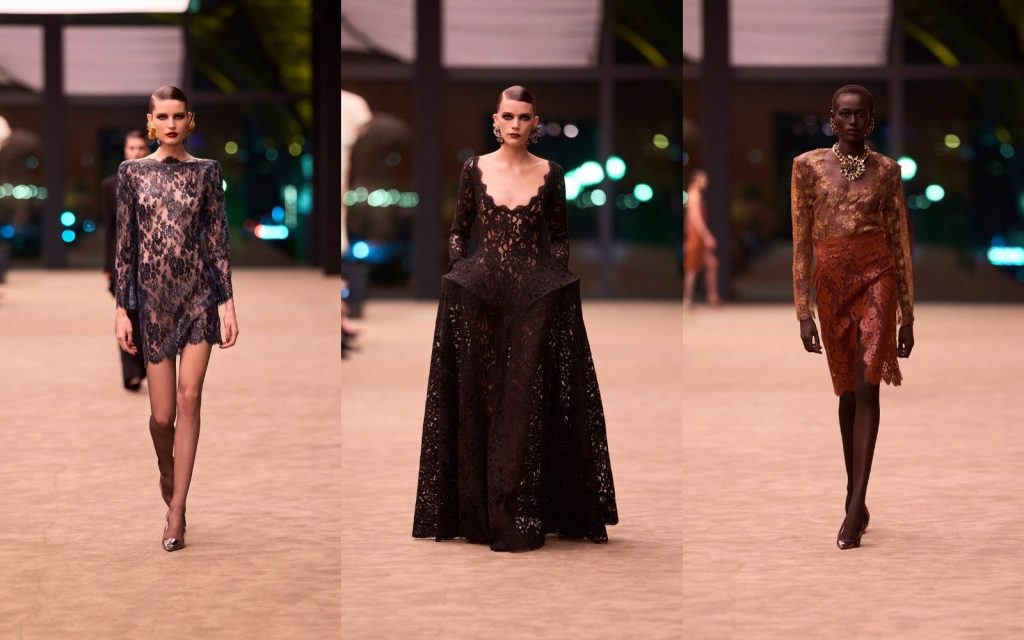
Lace dresses resembling lingerie were hardened with silicone and latex, creating surfaces that gleamed under the lights. Fragility transformed into armor. Softness reinforced with a thin shell.
It was a study in contradiction.
Between vulnerability and strength.
Between romance and fetish.
Some looks appeared beneath glossy rubber raincoats; others were enveloped in enormous shearling furs that amplified their drama. Altogether, the mood felt unmistakably cinematic, like stepping into the shadowy atmosphere of a European thriller from the 1970s.
Vaccarello himself referenced Romy Schneider in Max and the Junkmen (1971), where the actress plays a sex worker often dressed in delicate lace dresses. At one moment during the show, the soundtrack shifted to Barbra Streisand singing the theme from Eyes of Laura Mars, another thriller from the same decade, centered on a serial killer who hunts fashion models.
The references created an atmosphere that was both seductive and unsettling.
In this world, fashion was not simply decoration. It became a stage where desire, power, and darkness intersect.
At a moment when contemporary fashion often seems cautious about overt sensuality, this collection made a clear statement:
Sex is back on the fashion agenda.
But not in a simplistic way.
The sensuality here was complex, shadowed, and faintly fetishistic, qualities that have always existed within the DNA of Yves Saint Laurent.
This season also marks a personal milestone for Vaccarello himself. He is entering his tenth year as creative director of the house.
He revealed that he had already begun working on tuxedo suits for the collection before realizing it coincided with the 60th anniversary of Le Smoking.
“This house has a past that haunts me a little,” he said with a smile backstage. “I feel it’s an obligation to stay connected to the history of the house. But at the same time, I try to move beyond nostalgia and make it contemporary.”
Alongside evening tuxedos, he introduced daytime versions cut from fluid pinstripe fabrics, retaining the same elongated silhouette and plunging neckline.
Lace, meanwhile, was given new structure, transformed into cardigan-like jackets and straight skirts, their delicate patterns reinforced with latex.
Even as countless fashion brands now produce tuxedo-inspired suits, Vaccarello believes a Saint Laurent Smoking remains unmistakable.
“Because it’s better cut,” he said simply.
“You can recognize a Saint Laurent jacket immediately, especially the sleeve. On the street I often see copies of Saint Laurent, but I can tell you it’s not the same.”
And what gives the original that elusive quality?
He smiled.
“It’s the house secret.”
Perhaps that is the most accurate answer.
Because in an era when fashion circulates at high speed through social media and rapid production cycles, there are still things that cannot easily be replicated: the precision of a certain line, the weight of a certain cut, the feeling that occurs when a woman slips into that black tuxedo suit.
Just as it did sixty years ago.
Because Le Smoking never made women look like men.
It made them look more powerful than ever.