
Reported by Manit Maneephantakun
In a season when Milan is crowded with questions about “brand identity,” Bottega Veneta answered in a language that didn’t need to shout. This was not a rebrand, not a sudden swerve, but a reaffirmation of what this house has always believed: that craftsmanship can become the language of luxury.
Louise Trotter’s Fall/Winter 2026 collection was staged at the brand’s headquarters in Palazzo San Fedele, a historic building set between La Scala and the Duomo in the heart of Milan. The location wasn’t chosen only for its architectural beauty; it functioned as a quiet declaration that the British designer has made Milan her home, and is now beginning to read the city’s rhythm from the inside.
After a year in Milan, Trotter told journalists backstage that what fascinates her most is a hidden tension embedded in the city itself. “I started with this idea of Brutalism and sensuality, because for me it really sums up the feeling that I have. Milan is this sort of very Brutalist city, with a sensuality that’s a little hidden,” she said. It was a line that felt like the key to the entire collection, and it echoed another observation she offered just as clearly: that Milanese people still “dress for each other.” “It’s a long time since I’ve seen that,” she noted with a smile. From those brief remarks, the collection began to unfold like an evening walk through the city.
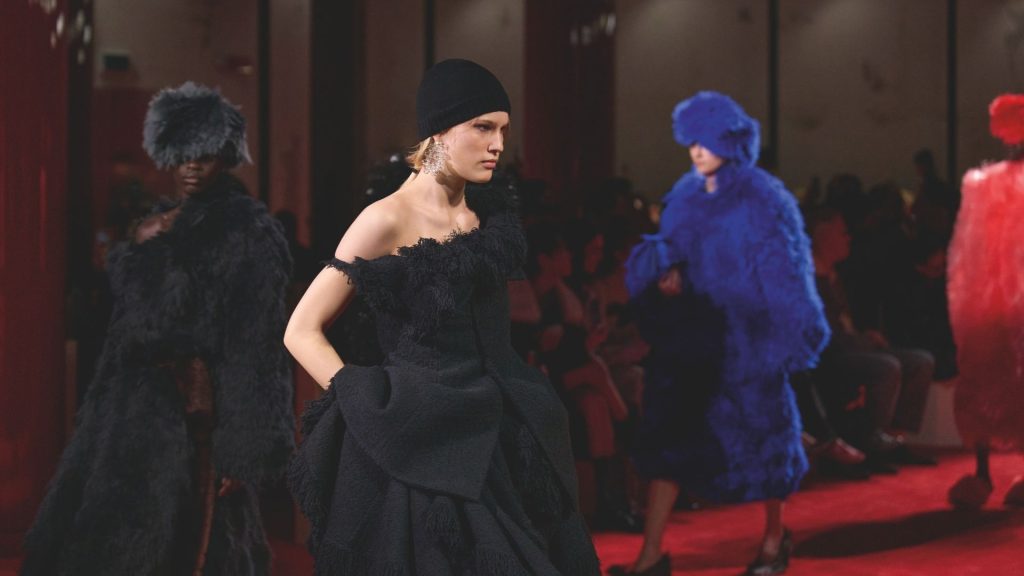
The runway opened with tailoring that carried the presence of sculpture. Jackets were designed with shoulders slightly more rounded than last season’s, a subtle response to the feedback she received after her debut. Trousers were roomy and built for movement, or sometimes replaced by wrap skirts suspended from sturdy leather belts. Trotter admitted the skirt idea came from bag construction, the way leather is folded, pulled, and structured to create strength. It was Bottega Veneta thinking at its most instinctive: here, clothing is never separated from leatherwork. And soon, the show’s focus shifted from structure to surface, from form to touch.
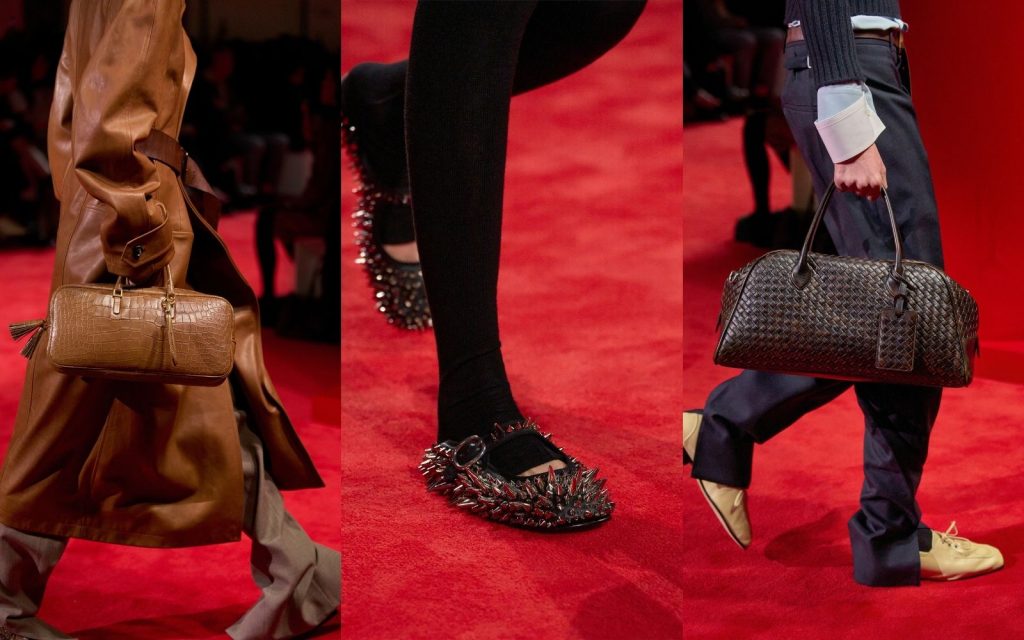
If Trotter’s first collection for Bottega Veneta paid homage to Intrecciato, the house’s signature leather weave, her second turned toward what she called “hairy textures.” The runway gradually became a laboratory of materials. The peacoat returned, but now rendered in matte crocodile. Some appeared in Intrecciato with furry fringe sprouting from the weave. Others looked like astrakhan, only to reveal themselves as velvet carved to mimic fur. Many viewers found themselves playing a guessing game, because what you saw often wasn’t what it was. Silk threads were engineered to ripple like shearling; real shearling was brushed to resemble fox; and recycled fiberglass, a standout in her first outing, returned in bubblegum pink, grazing the ankles. It was an experiment between nature and invention, and a demonstration of the artisans’ capabilities at the heart of this house.
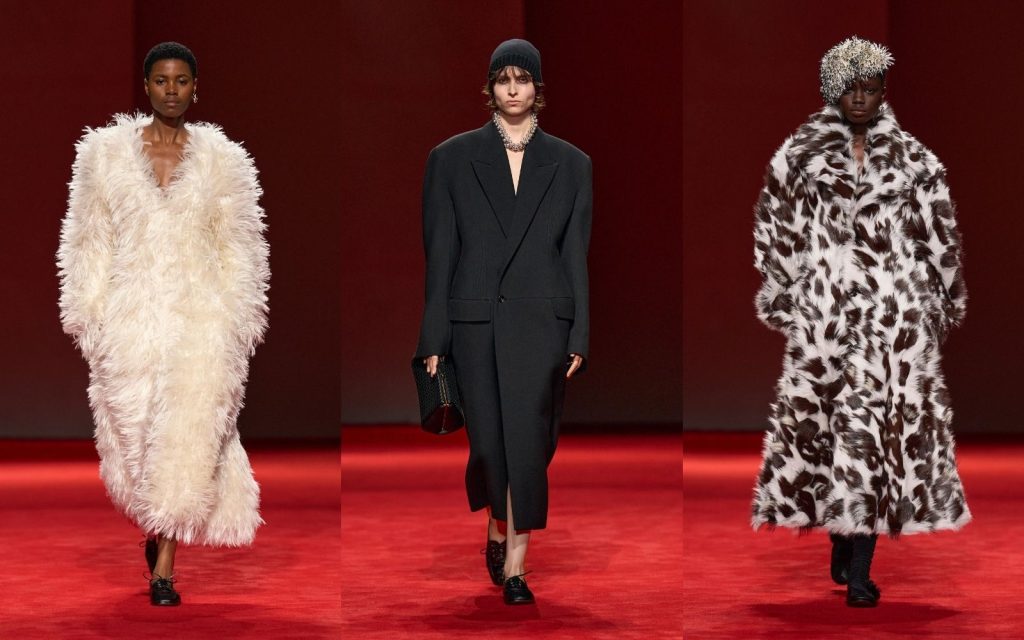
Trotter spoke of her atelier with unmistakable seriousness: “I work with the most incredible artisans, and the pursuit of craft is central to everything that we do.” The range of textures on the runway felt almost excessive, spilling beyond what the eye could catalog. One enveloping coat had a bristled surface that resembled thousands of blown-out matchsticks. A leather trench appeared tightly ridged, like licorice. From neatly shorn and polished to wildly unkempt, even Chewbacca-level unruliness, every register of “hairiness” was explored.
Yet amid the spectacle of materials, the most intriguing question was silhouette. While Demna, her fellow Kering creative, has recently stepped away from oversized proportions at Gucci, moving toward shrunken, clinging shapes, Trotter chose the opposite direction. She continues to amplify volume: jackets lengthened, shoulders broadened, sleeves filled out. Some were engineered to flare open like petals, revealing short skirts or mannish trousers beneath. When a reporter asked whether these clothes might “swallow” women, Trotter replied directly: “We spent a lot of time and care to have structure and form and curve without the heaviness. I was very attentive to that this season.” She insisted many pieces were light as a feather, even if, visually, the eye sometimes read them as weighty.
The show was also styled with theatrical cues. Nearly every look came with a hat: some simple knit beanies, others jaunty fringed caps that recalled Franco Zeffirelli’s 1968 Romeo & Juliet. Tunic-length dresses were worn bare-legged or with sturdy leggings, creating a romance laced with rawness. And it didn’t feel incidental that the venue sat only steps from La Scala. When asked about references, Trotter name-checked Maria Callas and Pier Paolo Pasolini, the operatic diva and the brutal poet of cinema, two cultural poles of Italy: elegance and intensity, beauty and bite. The collection lived in that same tension.
Even so, within the density of detail, the show offered a moment of striking restraint: an asymmetrical black-and-white fringed skirt spiraling down the legs, topped with a simple knit tank. It suggested that sometimes, luxury is achieved not through accumulation, but through reduction, doing more with less.
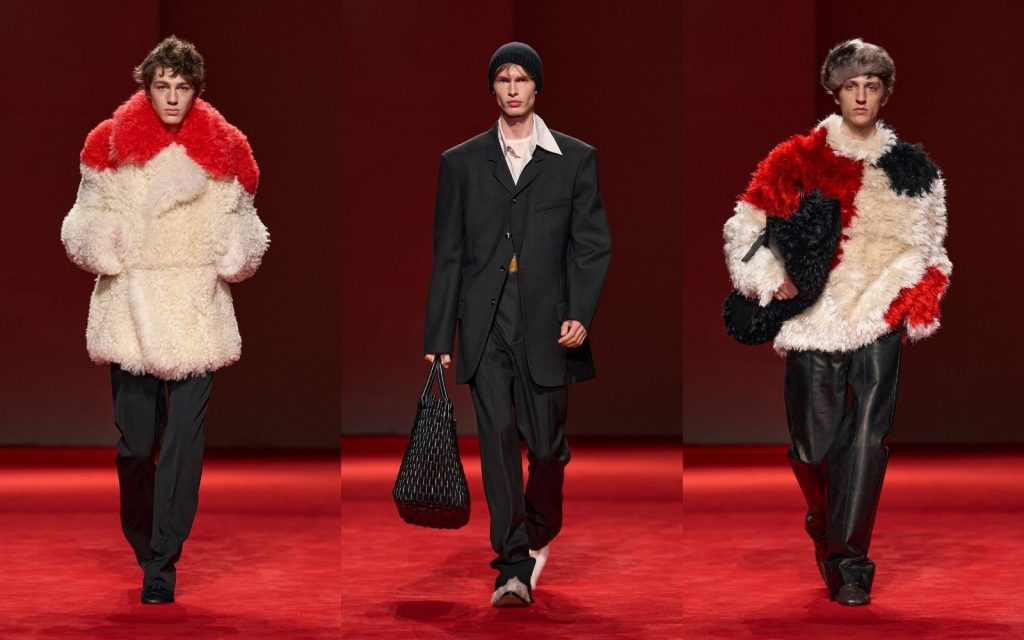
On the menswear side, the collection felt more balanced. Tailoring was relaxed yet still slender. There were plush peacoats, vaguely military sweaters with leather shoulder patches, and a gently padded leather officer’s coat that looked like it cost a million bucks. The clothes carried a confidence that made the menswear feel like it had a clearer future, perhaps a direction Bottega Veneta could explore further.
Of course, craftsmanship at this level is never cheap. Trotter revealed that one curly shearling swing coat was composed of more than 2,000 shearling elements. But that still might not be what ultimately fuels the brand. In Bottega Veneta’s world, accessories drive sales, and that reality gives ready-to-wear an unusual freedom: it can be fantasy. Fashion here doesn’t always need to be “practical.” It can be a stage for craft, indulgence, and dream-making. In that sense, this collection read like a poem about Milan.
A brutalist room flooded with deep red carpeting. Eighty models moving at near-storm speed. Surfaces catching light, bouncing, flicking, fluttering, turning texture into motion. Together, it created a portrait of a city with two faces: one hard, one soft; one severe, one seductive. Perhaps that is the best way to describe Milan. And perhaps it is also the clearest description yet of Bottega Veneta in the era of Louise Trotter.