

Reported by Manit Maneephantakun
On a morning during Paris Fashion Week that felt suspiciously like early spring, sunlight poured over the Tuileries Garden so brilliantly that it was easy to forget this was the unveiling of Dior’s Fall/Winter 2026 collection, not a spring show.
At the center of the historic garden, once a pleasure ground for the French royal court, the great basin had been transformed into a pond scattered with artificial water lilies floating quietly across its surface, as though lifted from a painting by Claude Monet. A narrow bridge stretched across the water for the models to traverse, while a vast glasshouse structure had been erected beside it to host the audience. Framed between views of the Louvre on one side and the obelisk of the Place de la Concorde on the other, the scene felt less like a runway set and more like a visual poem about Paris itself, retold through clothing.
Jonathan Anderson stood looking at the setting shortly before the show began and offered a remark that sounded less like a declaration of triumph than a quiet exhale.
“I feel relieved,” he said. “Because it’s proven it’s working in the stores.”
The sentence may have sounded simple, but within the context of Dior it carried enormous weight. Few roles in fashion come with expectations as immense as being the creative director of one of the world’s most powerful luxury houses.
A Lighter Dior
One of the most difficult tasks at Dior is preserving what might be called the house’s archetype of femininity, a silhouette defined in 1947 with Christian Dior’s revolutionary New Look: cinched waists, sculpted jackets, and full skirts structured like architecture.
Anderson has not attempted to dismantle that legacy. Instead, he has done something far subtler.
He has made it lighter.
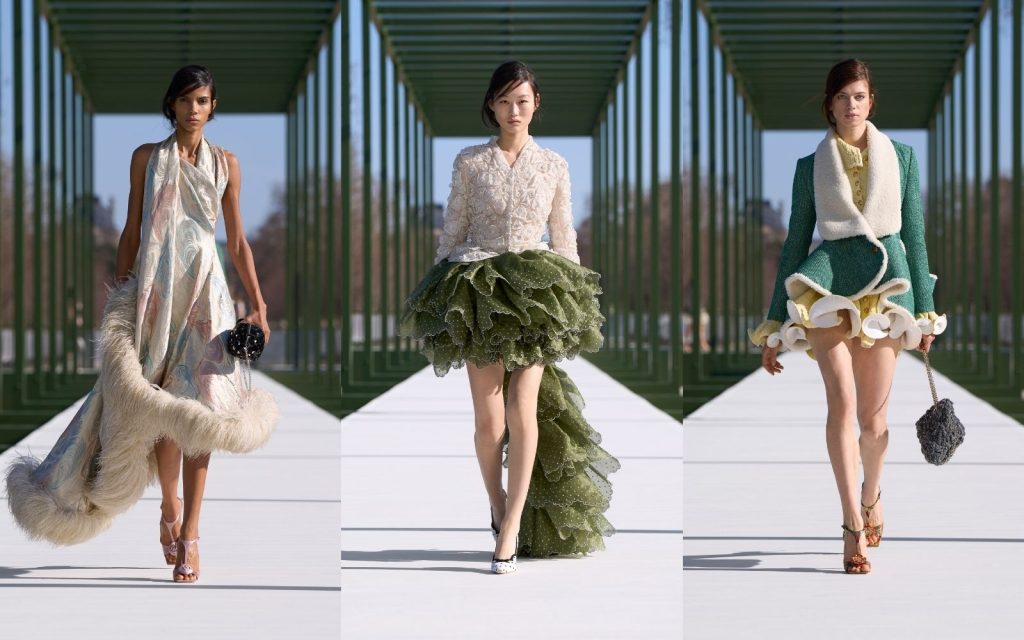
The opening look of the show reimagined Dior’s iconic Bar jacket. Rather than the sharply structured form of the original, Anderson softened it into a shrunken grey knit cardigan. Its scrolling peplum floated gently above a multilayered tulle skirt trimmed with scalloped edges, a small train trailing behind in the breeze.
It felt less like structure and more like breath.
“We’ve taken all the structure out,” Anderson explained. “It’s light.”
That idea of lightness became the central thread of the entire collection.
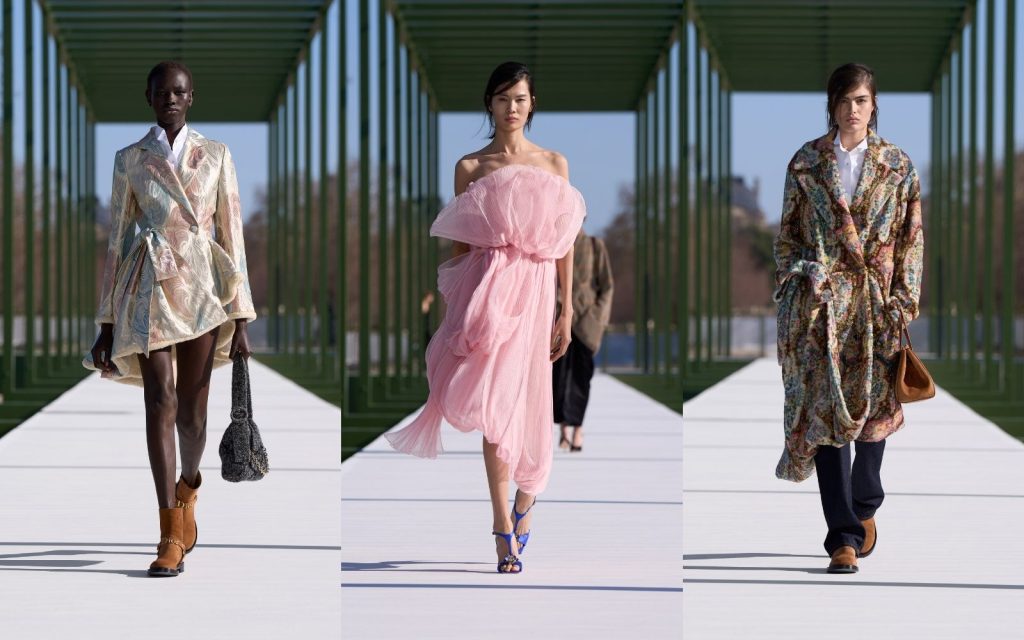
Menswear checks appeared not as heavy tailoring but as prints on delicately pleated silk, turning what looked like a trouser suit into something as effortless as a shirt and pants. Coats wrapped loosely around the body like dressing gowns, while traditionally weighty fabrics, tweed, jacquard, metallic brocades, seemed to float rather than sit heavily on the body.
When History Becomes a Detail
Though the collection felt airy and contemporary, Anderson’s Dior remains layered with historical references hidden quietly within its details.
The Bar jacket appeared in multiple variations, none corseted or restrictive. One version, made in gilded lamé, looped up on one side and trimmed with shearling, was paired with pale denim embroidered with a silvery scalloped motif.
The equation felt unmistakably Andersonian.
The designer, long celebrated for his instinctive use of denim, combined jeans with a reference to Christian Dior’s legendary Junon ball gown of 1949. Yet the reference was fleeting rather than reverent.
Instead of treating the past as sacred, Anderson seemed to treat it as a passing conversation, a nod rather than an homage.
Poiret, the 18th Century, and Monet’s Garden
Other ghosts of fashion history drifted through the collection almost imperceptibly.
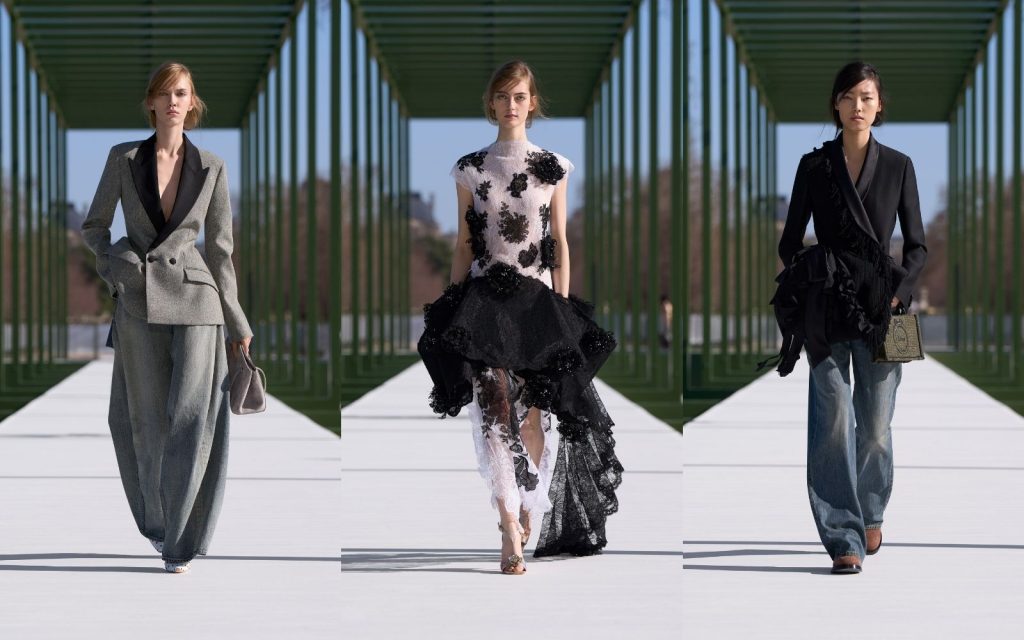
Balloon-shaped trousers and floral lamé fabrics echoed the spirit of Paul Poiret, the early 20th-century designer who liberated women from corsetry. At the same time, Anderson continued his long fascination with 18th-century frock coats, which appeared here with dramatic waterfall collars in shearling or rendered entirely in crisp lace.
And then, of course, there were the water lilies.
Dior himself had always loved flowers, but Anderson approached them from a different angle. The lilies floating across the Tuileries basin became motifs throughout the collection, appearing as raffia flowers blooming across asymmetrical lace dresses and as whimsical lily-pad details on thong sandals.
In the brilliant sunshine, the effect was quietly mesmerizing.
Paris as the Stage of Fashion
What made the show especially resonant was not only the clothing but its location.
The Tuileries Garden is far more than a public park. Commissioned by Catherine de’ Medici in the 16th century and later redesigned for Louis XIV, it became a place where Parisians gathered to see and be seen.
In other words, one of the earliest stages of fashion itself.
The models crossing the bridge over the lily-filled pond felt like a subtle return to that history, when dressing well was a form of social ritual.
“It’s a promenade,” Anderson said simply. “The idea of people dressing up to walk in the park.”
Fashion in a Seasonless World
The unusual warmth of early March in Paris also raised an inevitable question: do seasons still matter?
Anderson acknowledged that the clothes will begin arriving in stores as early as June. The collection, he explained, was conceived as a transitional wardrobe, pieces designed to move easily between seasons.
“You’re trying to show clothing that works between seasons,” he said.
Dior After the Luxury Boom
Another of Anderson’s remarks sounded almost like a quiet confession about the state of the luxury industry itself.
“We’re going to get some things right, some things wrong,” he said. “But whatever works, we just keep building on top of it.”
In the years following the pandemic boom, luxury prices soared dramatically. According to a Bain–Altagamma study, roughly 50 million aspirational consumers have since exited the market.
The question facing fashion houses now is unavoidable:
Should luxury retreat toward the one percent,
or attempt to reopen its doors?
Anderson’s Dior
What appeared on the runway this season was not a definitive answer, but it was a signal.
A new silhouette is beginning to emerge: Bar jackets that are longer and looser, denim refined in proportion, and fabrics so light they seem almost airborne.
Yet Anderson insists Dior under his direction will never settle into a single formula.
“It’s never going to be a one-look brand,” he said. “I don’t believe in that.”
The show closed with a stark black cashmere coat finished with a draped satin shawl collar, more austere than much that had come before it, as if hinting that Dior’s next chapter may move in yet another direction.
On that unusually warm day in the Tuileries Garden, sunlight shimmered across the lily-filled pond. Dior’s Bar jacket felt lighter than it had in decades. The artificial flowers floated quietly on the water.
And Paris once again became the stage for fashion.
Perhaps that is what Jonathan Anderson is doing with Dior.
Not reinventing it.
Simply allowing it
to breathe again.