

“Where Do We Go From Here?” Jonathan Anderson’s Dior and the Rewriting of Couture
Reported by Manit Maneephantakun
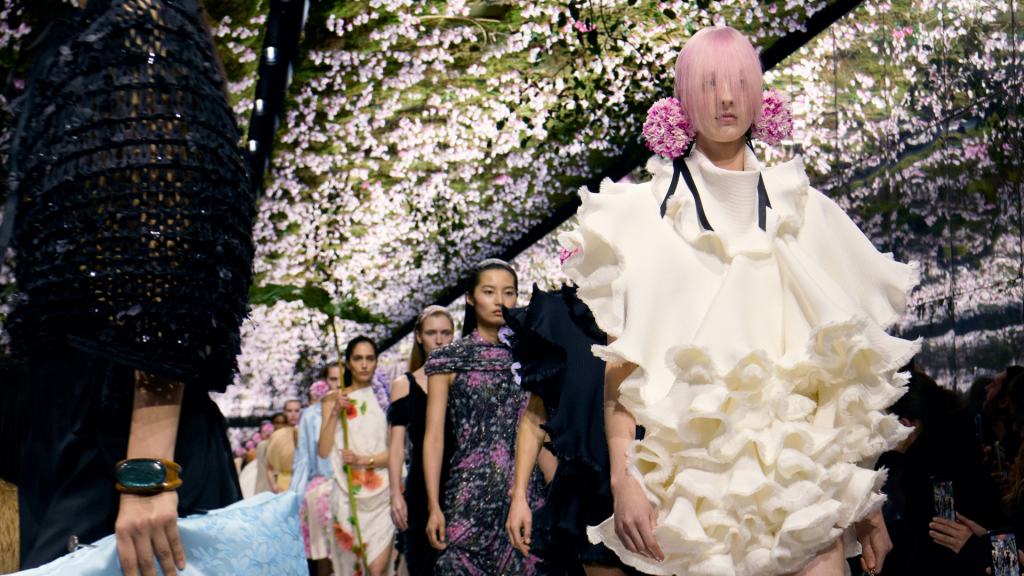
Dior Haute Couture Spring/Summer 2026 by Jonathan Anderson is not merely the couture debut of a new designer, nor is it simply a “first collection” in the technical sense of the fashion system. It is a cultural event, one that forces the entire industry to pause and rethink why Haute Couture still exists, and where Dior should stand in the contemporary fashion world.
This was not a show designed to be “still” in the sense of classical luxury, nor was it a show built to be “loud” through disruption, provocation, or visual shock. Instead, it was a show that felt full, full of energy, full of meaning, full of intention, and full of convergence. A convergence of everything people now long to see from Dior in the 21st century: heritage, craftsmanship, art, beauty, humanity, brand power, cultural depth, and the economic architecture of luxury (not to mention the many visual memories drawn from Jonathan Anderson’s own past work).
Even before the show began, the Musée Rodin space functioned as a philosophical prelude. The ceiling was transformed into a lush green meadow, covered in blooming cyclamen, not a romanticized garden, but a living one, humid, organic, breathing with the presence of real nature. Beneath it, the chrome parquet floor reflected the audience and the lights like a mirror, evoking a world of precision, construction, and human engineering. These two worlds did not clash, they coexisted in balance, forming a quiet but powerful metaphor for the present: beauty is not born from nature alone, nor from technology alone, but from the relationship between the two.
And within this space, half natural, half industrial, Jonathan Anderson began to tell a new Dior story.
The narrative did not begin with silhouettes or archives, but with memory. A young Irish boy once searched for the name “John Galliano” in the Yellow Pages, called in hopes of asking for an internship, and reached a taxi service instead. This is not a cute anecdote; it is a symbolic image of an era of fashion when designers were cultural heroes, embodiments of dreams, beauty, and imagination, not simply job titles within corporate structures. Years later, that boy becomes Creative Director of Dior, while John Galliano sits in the front row of his first couture show, offering him a bouquet of cyclamen. The image is not just beautiful, it is a symbolic passing of the torch, a transmission of fashion heritage itself.
Galliano told him: “The more you love the brand, the more it will give you back.”
Jonathan Anderson does not interpret this as ritual loyalty or blind obedience to the past. He understands it as a structural relationship: working with a heritage brand is not about preserving everything unchanged, but about understanding the past deeply enough to transform it without destroying it.
He once said of Galliano: “For me, in the modern-day world, John is Dior. He did a longer period than Christian Dior himself.” This is not mythologizing, it is recognizing Galliano as a foundational structure of modern Dior thinking, where couture is not simply beauty, but a cultural system.
And when Anderson speaks about couture, he does not romanticize it as fantasy luxury. He reframes it plainly: “By Dior doing couture, it’s like protecting an endangered craft.” And he continues: “When you go into the atelier and see there are no sewing machines, you suddenly understand why clothing can be magical.”
These are not poetic slogans, they are the intellectual framework of the collection. Couture is not luxury fantasy; it is a system for preserving human knowledge.
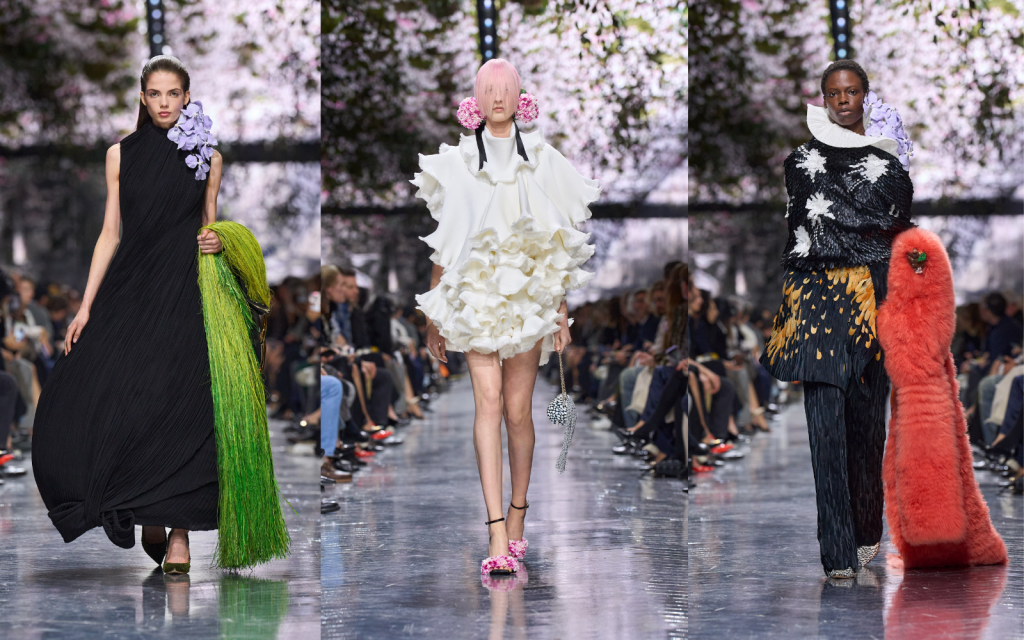
The opening three looks, inspired by the vessel forms of Magdalene Odundo, function not as visual art references but as conceptual architecture for the entire collection: restraint, balance, stillness, depth, and meaning without ornament. Silk georgette is ruched into fine lines creating a cloud-like effect, weightless in appearance, yet heavy with craftsmanship in every seam.
In Anderson’s couture, structure does not come from corsetry. He states directly: “People say if it’s not corseted, it’s not couture, and I completely disagree.”
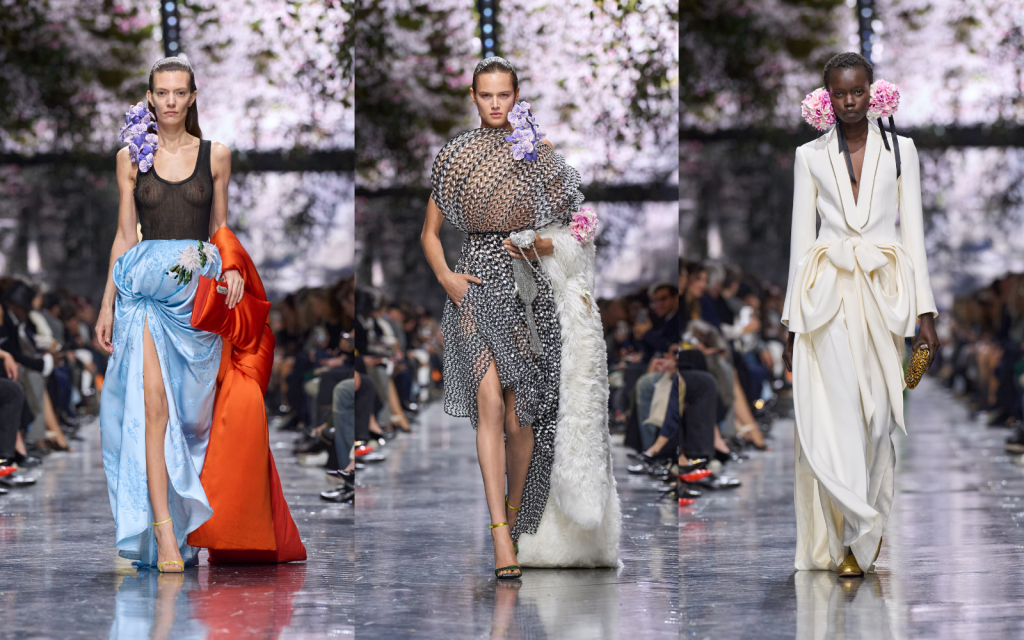
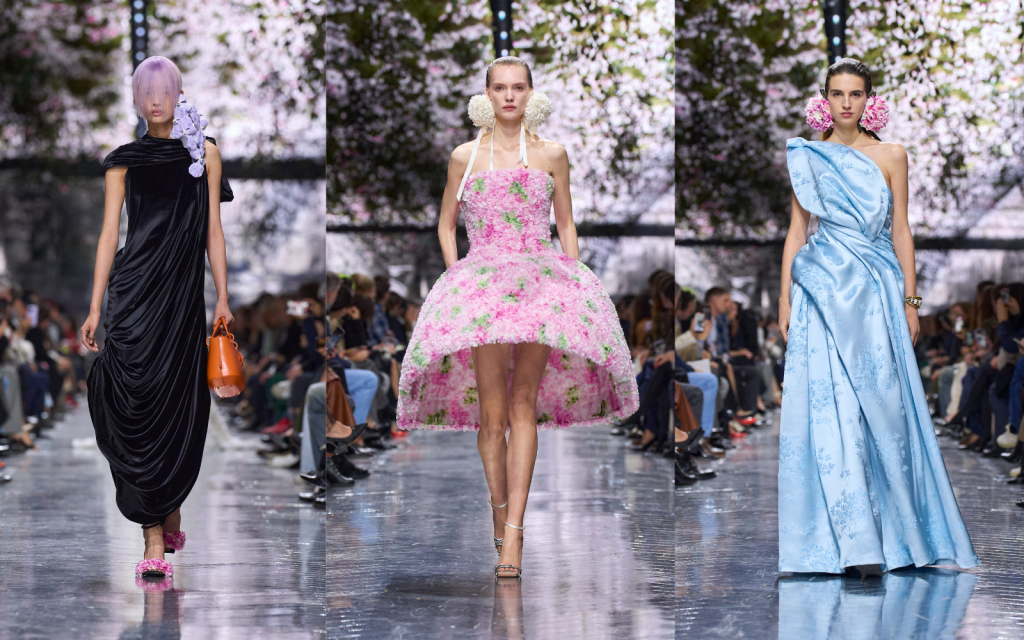
Instead of constructing structure through bodily restriction, he builds structure through material logic: knit couture, ruched tulle, silk georgette, organza, alpaca, silk satin, gazar. Everything functions as soft architecture. Hourglass and Bar silhouettes appear without mechanical rigidity.
Flowers in this show are not decorative language, but conceptual language. Dior’s femme fleur is rewritten as something biological, surreal, and contemporary: pressed flowers, fabric petals, butterfly wings enlarged into abstraction, lily-of-the-valley, nasturtiums, datura-like godets, gunnera leaf parasols, and a gazar bridal gown trailing petals. Nature becomes meaning, not ornament.
Accessories reveal Anderson’s magpie sensibility in full. A modern Wunderkammer emerges: 18th-century French textiles, Rosalba Carriera miniatures, meteorites, fossils, Victorian silver chains, hand-painted aluminum jewelry. These are not superficial luxury objects, but living cultural artifacts, wearable history, circulating meaning.
Anderson defines couture with clarity and gravity: “It should be about buying something for an emotional purpose.” And even more crucially: “Ultimately, the reason couture should exist is to protect something that could disappear from the world.”
What gives this show power beyond beauty is its openness. Couture is not locked inside elite ritual, it is opened to the public through the Musée Rodin exhibition, shown alongside works by Christian Dior and contemporary artists. Couture becomes public culture, not private ceremony.
The front row: Brigitte Macron, Bernard Arnault, Jeff Bezos, Lauren Sanchez, John Galliano, and Hollywood A-list, did not turn the show into spectacle. The show did not depend on celebrity for meaning. It stood on narrative, craft, depth, and cultural weight.
Dior Haute Couture SS26 was not “quiet,” and not “loud.” It was dense, dense with thought, dense with meaning, dense with craftsmanship, dense with narrative, and dense with vision.
Jonathan Anderson did not create couture to show skill, prove himself, or compete with history. He created it to redefine what Dior means. And in a fashion world saturated with speed, noise, chaos, and spectacle, a show that can unify heritage, contemporaneity, art, business, culture, and humanity into a single coherent language, without fragmentation, becomes the strongest structure of meaning.
Dior Haute Couture Spring/Summer 2026 is not simply a debut.
It is the opening chapter of a new Dior era: an era where couture is no longer the pyramid’s peak of luxury, but the heart of the brand’s meaning system, and a space where Dior speaks to the world not just to sell dreams, but to build shared cultural meaning.
Perhaps the question in the soundtrack Where Do We Go? already contains its own answer. Because Dior, and Jonathan Anderson, have already begun the journey.