


Shortly after its release, The Art of Sarah, the latest original series from Netflix, shot to No. 1 in Thailand and swiftly climbed to fifth place worldwide. Audiences did not binge all eight episodes merely because the plot grips and refuses to let go. The series also confronts viewers with a disarming question: just how far can a lie take us? And if we begin with deception, can we ultimately transform it into truth?
*This analysis contains partial spoilers.

If you are drawn to dramas and films that explore the construction of identity through falsehoods—such as ANNA (2022) or Inventing Anna (2022)—then you would do well to add The Art of Sarah to your watchlist. The central premise may feel familiar, yet the series distinguishes itself in a compelling way. Sarah Kim, played with striking nuance by Shin Hye-sun, does not merely spin lies to survive; she attempts to will them into existence, whatever the cost.
“A business magnate or a con artist—it’s all much the same. Only one thing sets them apart: even if they begin with deception, they must not end with it.”
This early line, delivered by Hong Sung-shin (portrayed by Jung Jin-young) encapsulates the drama’s moral tension. A middle-aged entrepreneur operating in the grey fringes of respectability, he prompts both the audience and Sarah herself to interrogate the ethics of ambition. As one of the first figures to exert a profound ideological influence over her, he does more than advise; he ignites the spark that propels her transformation.
If a lie becomes truth, does it remain a lie?
Although The Art of Sarah unfolds through a fractured timeline—opening near the end before gradually retracing its steps to the beginning, at times deliberately disorienting the viewer—an attentive audience can follow the thread. From the outset, we learn that our protagonist was not always “Sarah Kim”. Indeed, by the final episode we still do not know her original name. “Sarah Kim” is a constructed identity: the woman she chooses to become.
In reality, she begins as an ordinary young woman determined to live fully. Yet fate seems to mock her at every turn, confronting her with hardship after hardship until her life spirals downwards. Ultimately, she resolves to abandon it altogether, longing simply for everything to end.
Here lies the drama’s decisive turning point. Having cast off her former self to the current, she glimpses, almost miraculously, a new path. It is as though she is reborn. From that moment, she resolves to fashion a new identity—one that will grant her entry into the rarefied world of the ultra-wealthy on her own terms.
It is then that Boudoir is born: an ultra-luxury handbag house, purportedly more than a century old, serving exclusively European royalty and the world’s most powerful 0.1 per cent—presided over by Sarah Kim herself.
Boudoir may rest on fabrication, yet it also embodies relentless ambition. Sarah does not merely invent a heritage; she works tirelessly to make the brand worthy of belief. By the series’ conclusion, Boudoir has achieved extraordinary success. Each handbag commands prices in the millions. In remarkably short order, the label becomes a marker of elite social status.
The series presses its central provocation even further. When a brand triumphs so spectacularly, who pauses to question its origins? Does anyone truly ask whether its founding myth was a deception, whether its carefully curated story exists solely to manufacture value? And if that story did indeed begin as a lie, would we even wish to uncover the truth—particularly if that truth unsettles not only our own convictions, but those of the wider world?
In posing these questions, the series shifts the focus from the morality of a single woman to the complicity of an entire society. It asks not merely whether Sarah lies, but whether we, too, consent to believe.

If we cannot tell the fake from the real, can we still call it fake?
Another of the series’ most resonant lines centres on the distinction between authenticity and artifice. From the outset, Boudoir—the ultra-luxury handbag house at the heart of the narrative—functions as a social filter, separating VVIP from mere VIP. The brand’s mythology becomes its currency. Yet if no one can conclusively verify the provenance of that mythology, on what grounds can we dismiss it as false? And would we readily accept that what we have long revered as “the real thing” might, in fact, prove hollow and contrived?
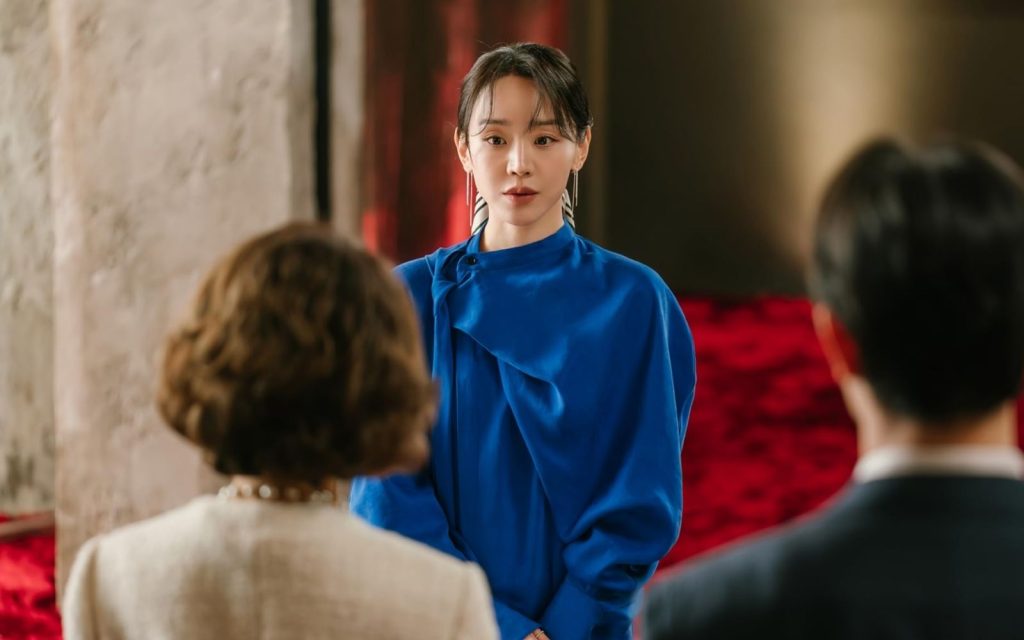
The question extends beyond the brand to the woman who embodies it. Sarah Kim emerges as an object of fascination and envy: poised, intelligent, impeccably educated, and the sole custodian of an ultra-luxury empire in Asia. Many would relish the chance to inhabit her life, if only briefly. But if only insiders know what the “real” Sarah looks like, and another young woman happens to resemble her so closely as to be almost indistinguishable, how can outsiders possibly discern who truly holds the name?
Here, the drama sharpens its blade. Identity becomes performance; authenticity becomes consensus. If society accepts the façade, does the façade not acquire a kind of legitimacy?
By posing these questions and presenting more than one possible interpretation of its conclusion, the series leaves a lingering unease. It prompts us to interrogate our own assumptions. Had we chosen to believe differently from the characters, would the ending itself feel altered? If placed in similar circumstances, what would we decide? And if we genuinely cannot distinguish the authentic from the counterfeit, may we declare both authentic—or both counterfeit?
Perhaps, in the end, the series suggests something more disquieting still: that the boundary between real and fake does not reside in the object before us, but in the conviction within us. Authenticity, it implies, may depend less on origin than on belief.
The story depends on who tells it
What lends The Art of Sarah its particular allure is the way the narrative emerges through testimony. We piece together the plot from the statements of those who claim to have known Sarah Kim. Yet certainty forever eludes us. Each witness speaks from a position shaped by personal interest, resentment, admiration or self-preservation. No account stands untouched by perspective.
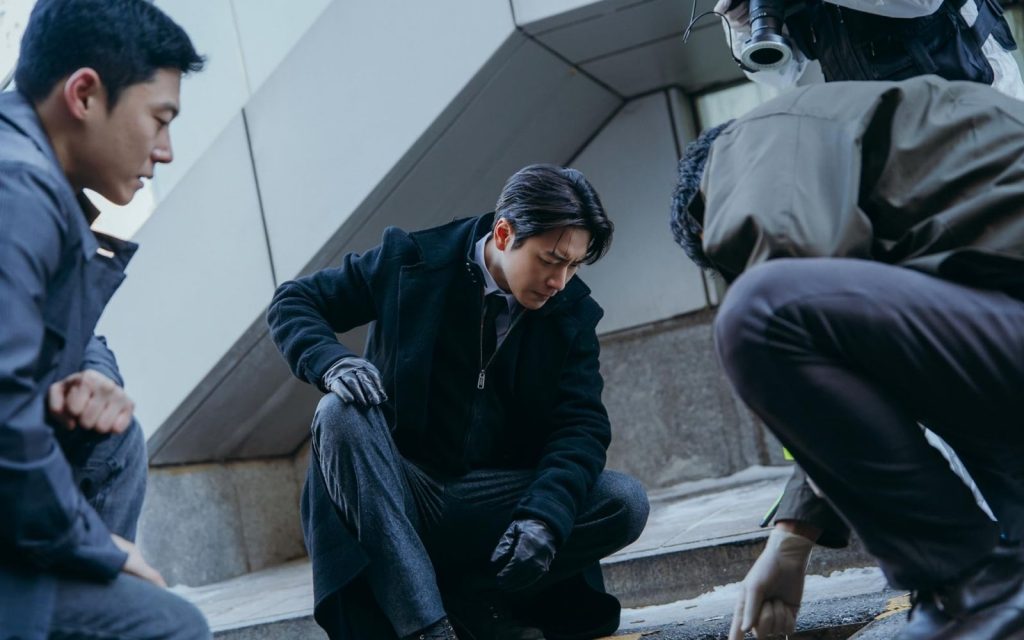
This is precisely why Mu-hyok—played with steely restraint by Lee Joon-hyuk—must do more than collect evidence. As the detective leading the investigation, he must dissect each version of events, identify where stories converge or diverge, and ask not only what is being said, but why it is being told that way. In this drama, truth is not uncovered; it is negotiated.
The importance of the “storyteller” crystallises in the final revelation concerning the young woman found murdered in a drainage tunnel. In a decisive act, the heroine informs the police that she is Kim Mi-jeong—the woman who had long attempted to imitate Sarah Kim—and that she herself killed the real Sarah. This confession reshapes the entire case Mu-hyok has painstakingly constructed. Every piece of evidence aligns seamlessly with her statement.
With that, the deeper truth about Sarah Kim’s identity—and the origins of the Boudoir brand—vanishes from the official record. The case closes neatly and without blemish. Kim Mi-jeong goes to prison. Boudoir ascends, unblemished, into the pantheon of elite luxury houses. Society receives a resolution it can comfortably accept.
In truth, Mu-hyok comes perilously close to cornering her. Yet his inability to draw a definitive distinction between Sarah Kim and Kim Mi-jeong creates the very fissure she exploits. By inhabiting the ambiguity he cannot resolve, she seizes control of the narrative itself. Through testimony alone, she directs the outcome, edits the past, and authors the version of reality that will endure.
The series leaves us with an unsettling recognition: facts may exist, but stories determine which facts survive.
Picture credit: imdb.com