

Reported by Manit Maneephantakun
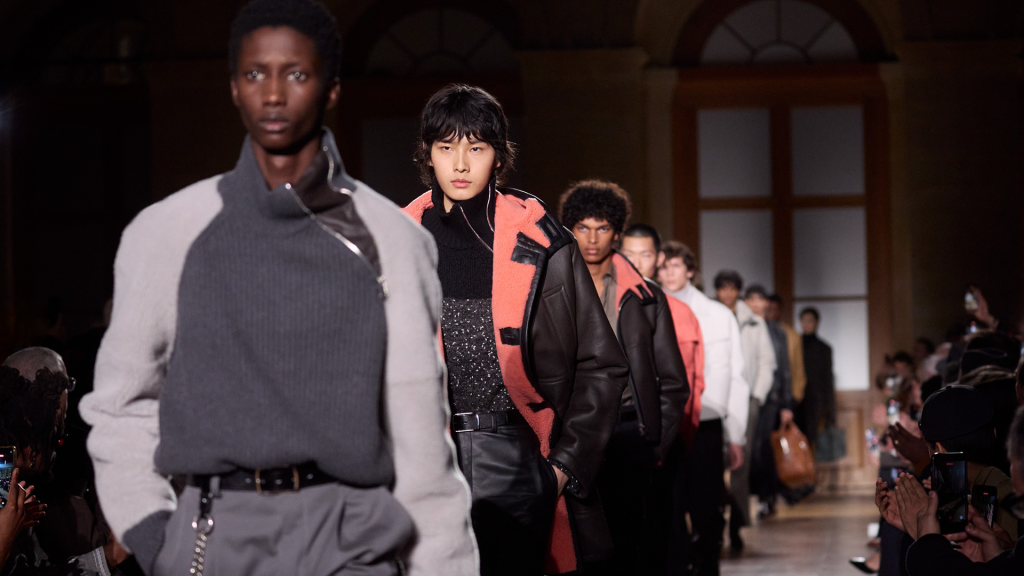
Hermès Men’s Winter 2026 does not feel like watching a fashion show.
It feels like stepping into a historical moment, a moment in which fashion no longer functions merely as a visual system or a beauty industry, but as a language of life: a structure of thought, a value system through which human beings organise their world.
This is not a show that seeks excitement.
Not a show built for viral moments.
Not a show designed for spectacle.
And not a show that wants to be “remembered for its noise.”
It is a show that wants to be remembered for its stillness.
Winter 2026 is the final collection of Véronique Nichanian as menswear designer of Hermès, after 37 years at the house, a period that did not merely produce collections, but built an entire system of thought for the Hermès man. A language of dressing independent of seasons, trends, and algorithms, grounded instead in time, craftsmanship, and the relationship between human beings and clothing.
In an era where fashion accelerates endlessly: rebranding, repositioning, resetting, restarting, and reprogramming itself almost every season, Hermès under Nichanian has become a rare space where continuity becomes cultural capital, and slowness becomes a new form of power.
The final runway image is a model in a long dark crocodile coat, its surface glossy and monumental, worn with slim black silk trousers and a high-neck sweater. There is no ornament, no decoration, no excess, no performative gesture of identity. Only structure, line, material, and stillness. The look requires no explanation and no definition, because it is Hermès in its purest form: luxury that does not need to be explained, wealth that does not need to be displayed, and confidence that does not need to be proven.
As screens around the venue began showing archival footage of Véronique Nichanian taking her runway bows across decades, and she walked out for the final time, the entire room rose to its feet almost instinctively. The applause was not one of grief, but of recognition, recognition of long work, of discipline, of honesty, and of continuity.
After the show, she spoke calmly:
“I’m happy. And I’m proud of myself. I can say that because I work very hard, and I work with passion.”
It did not sound like ego, but like peace, the voice of someone who no longer needs external validation, because she knows she has built something meaningful. She defines herself simply:
“I make the style of the Hermès man, which is a simple line. I never change my mind. I’m straight to the point.”
And that is the core of Winter 2026:
a collection that does not try to be “new,”
does not try to be “loud,”
does not try to be “fast,”
and does not try to “change,”
but instead makes its identity clearer.
The entire show weaves past and present seamlessly. Nichanian brings back pieces from her own archives not as nostalgia, but as proof of a philosophy: that good clothes should not have an expiration date. She states this clearly:
“Just to prove how it lasts. And I love the idea that you mix the things with old collections.”
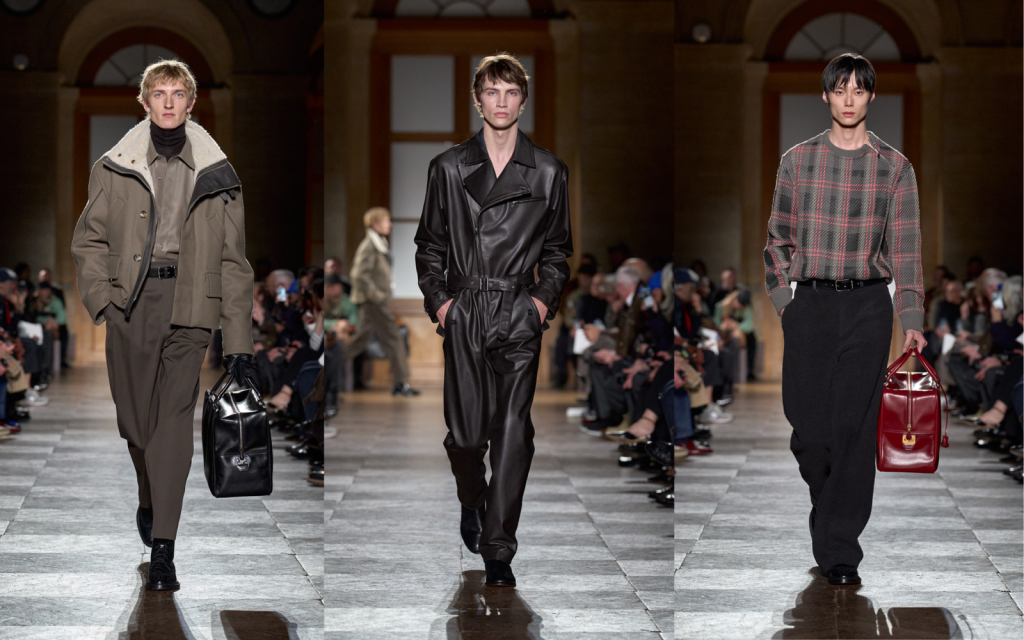
Pieces from 1991, 2001, 2003, and 2004 reappear, biker leather jumpsuits, shearling blousons, suede deerskin aviators, pinstripe leather suits, and even a suitcase-shaped bag sculpted in leather like a late-80s boombox. These do not function as emotional memory objects, but as intellectual evidence: proof that time does not age clothing: it verifies value.
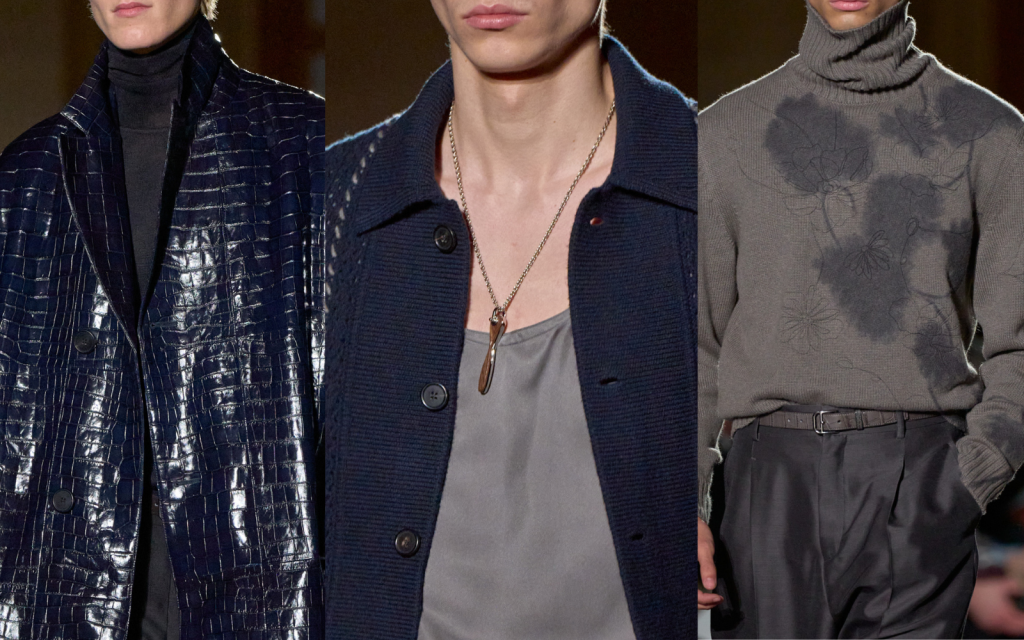
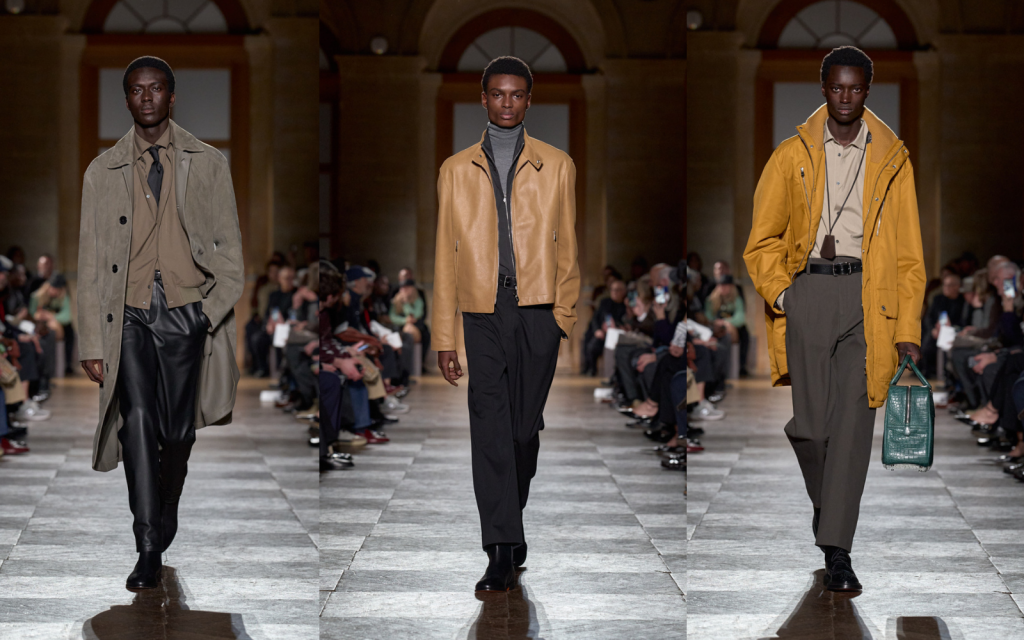
At the same time, she introduces new classics quietly: coral-pink shearling coats, stripe-embroidered overshirts, orange-soled ankle boots, crocodile suits for the holiday season, retro aviator silhouettes, shearling bombers, leather military onesies, and boxy overnight bags in sky blue, olive, and brown. None of these are designed as trend items. They are designed as objects of life.
At the heart of Nichanian’s philosophy is the idea of clothing as objects, not outfits. She once explained it plainly:
“I wanted to make the clothes as an object. I just wanted him to fall in love with this sweater, this jacket.”
Hermès clothing has never been a tool for constructing new male identities. It functions instead as a structure of life, things men choose to live with, not costumes that transform them into brand images.
When asked why she chose to step down, despite Hermès asking her to stay, she answered simply:
“I took the decision for myself. I want to travel, to go and live somewhere else. There are many things to do in life.”
Hermès Men’s Winter 2026 therefore does not function merely as a collection, nor simply as a farewell show. It functions as the conclusion of a system of thought built continuously over nearly four decades, a system not designed to compete with time, but to exist with it.
Véronique Nichanian has never created fashion as something that must be fast, new, or constantly changing. She has created clothing as life structures, things men live in, grow with, and build relationships with over time. As she defines herself:
“I make the style of the Hermès man, which is a simple line. I never change my mind. I’m straight to the point.”
That is exactly what Winter 2026 expresses: it does not try to be new, loud, fast, or disruptive. It affirms continuity, clarity, material honesty, and structural longevity.
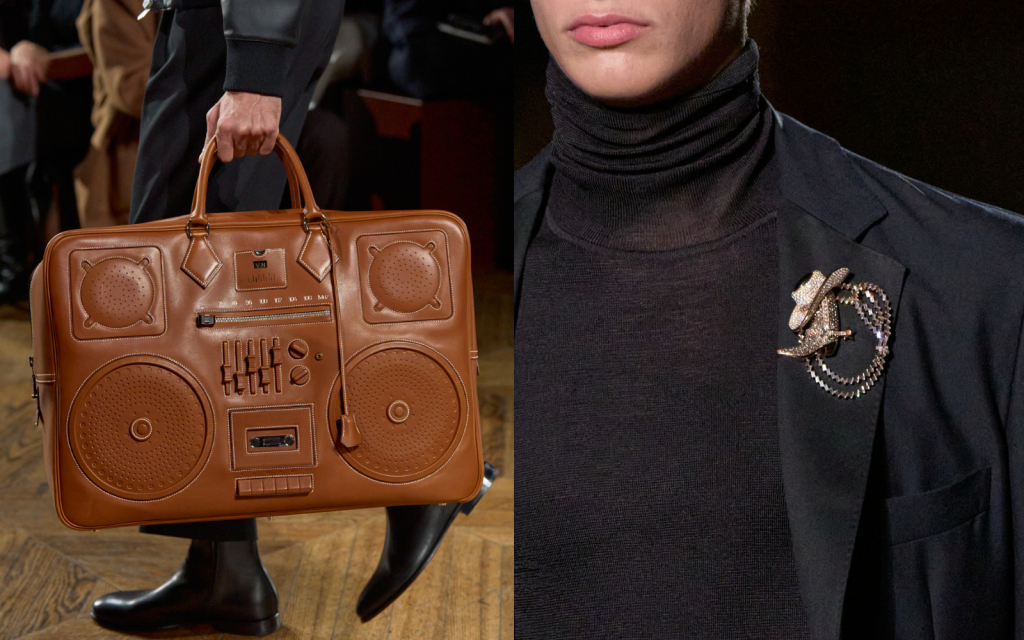
Reusing archival pieces is not emotional nostalgia, but philosophical proof. She says it directly:
“Just to prove how it lasts.”
And when asked for her final advice to the fashion industry today, she offers only one word:
“Slow down.”
Not as sentiment, but as philosophy.
The voice of someone who works with time, not against it.
Hermès Men’s Winter 2026 is therefore not an ending, but an affirmation:
an affirmation of identity,
an affirmation of philosophy,
and an affirmation of continuity.
After the show, she said simply:
“I’m happy. And I’m proud of myself.”
Not because of this show,
but because of a lifetime of work.
And that is what Véronique Nichanian leaves to Hermès, not merely clothes, not merely collections, and not merely archives, but a structure of luxury thinking. A form of luxury not measured by novelty, not measured by speed, and not measured by noise, but measured by one thing only:
the ability to exist with time.
Still. Clear. Enduring. And stable.
In the language of Hermès.