


When Fashion Learns to Read Again: Dior Book Tote “Book Covers” and the Reclaiming of Cultural Capital in the Age of Speed
There are moments when luxury fashion appears forced to speak a single global language, the language of speed. Content must be consumed instantly, logos must be “read” in a split second, and objects must go viral before they are allowed to carry any real meaning.
This season, however, Dior chooses to speak another language, one that moves more slowly and demands attention: the language of literature.
With the launch of the Dior Book Tote in its new iteration, “Book Covers,” the House transforms classic literary book covers into intricately embroidered surfaces. This gesture is not merely aesthetic. It is a deliberate statement that luxury can still function as a space for thought, memory, and cultural reference, not just visual consumption. Reported by Kai Manit
What makes this project particularly compelling is that Dior does not treat books as a floating symbol or decorative metaphor. The Book Tote itself has always been conceptually tied to books, designed, quite literally, to carry them. “Book Covers” therefore does not borrow literature as ornament. Instead, it returns an icon to its original logic and rewrites it with intention and grace.
1) “Book Covers” Is Not a New Pattern, but a New Positioning
For years, the Dior Book Tote has been one of the most visible It-Bags of the image-driven era: easy to photograph, instantly recognizable, practical, and endlessly shareable.
With “Book Covers,” Dior shifts the role of the Book Tote from a visual object to a narrative object.
Once a bag becomes a “book cover,” it no longer signals fashion taste alone. It carries cultural taste alongside it: reading, literary memory, and a relationship with the history of language and art.
This is the core proposition of the collection: luxury is not defined by price alone, but by what you choose to reference and how you choose to tell the story.
2) The Books Dior Chose: Cultural Languages, Not Decorative Classics
According to the press text, “Book Covers” is conceived as a poetic tribute to literature, presenting embroidered interpretations of iconic literary covers. The selected titles reveal that Dior’s choices are driven by meaning rather than visual appeal.
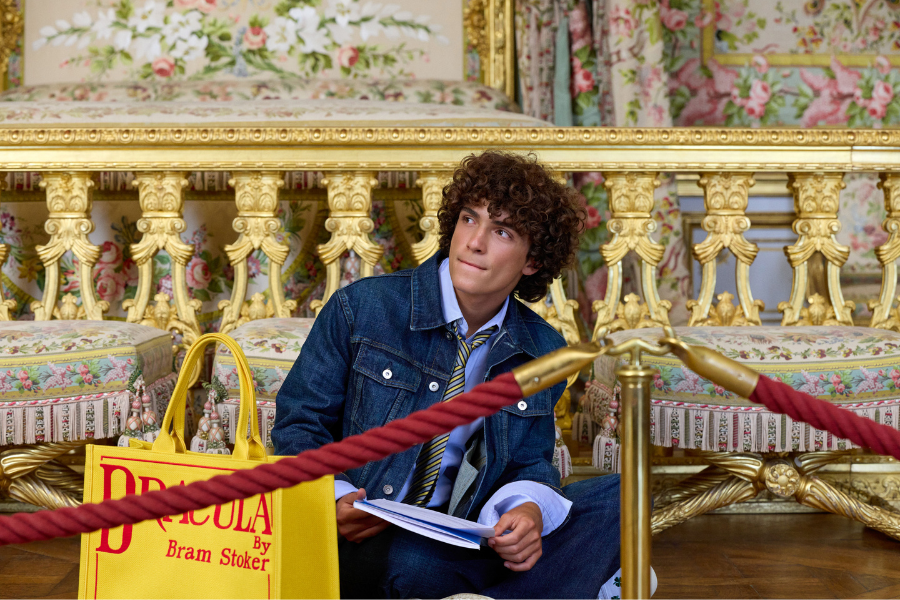
Dracula – Bram Stoker: Gothic Darkness as Aesthetic Power
The first model pays homage to 19th-century Gothic fiction, featuring Dracula rendered in a striking, bright yellow. The juxtaposition is intentional: darkness is not softened, but sharpened through light.
Gothic literature often explores fear, desire, and suppressed identities. By placing it on a luxury bag, Dior elevates darkness into a subject of aesthetic dialogue rather than something to conceal.
Ulysses – James Joyce: Difficulty as Intellectual Prestige
Choosing Ulysses—famously challenging in form and language, is a statement in itself. Dior aligns with a work that demands time, patience, and cultural literacy.
Rather than avoiding complexity, the House reframes difficulty as a quiet form of sophistication.
In Cold Blood – Truman Capote: Truth, Narrative, and Belief
Occupying the space between journalism and fiction, In Cold Blood demonstrates how reality gains power through storytelling.
Its inclusion reflects Dior’s understanding that contemporary luxury does not win through materials alone, but through narrative, stories people believe in, inhabit, and carry with them.
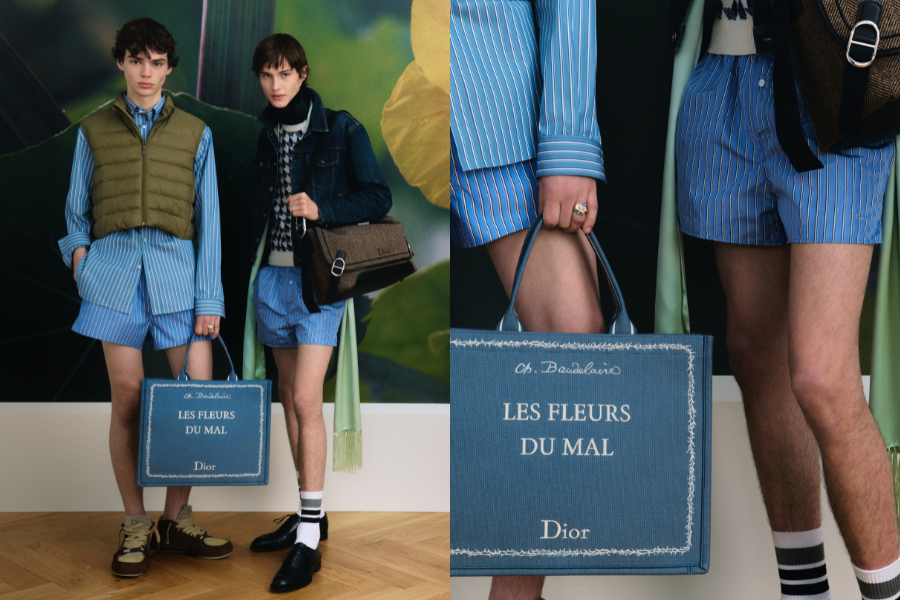
Les Fleurs du Mal – Charles Baudelaire: Beauty Without Purity
Baudelaire’s poetry rejects the idea that beauty must be clean, obedient, or easily consumed. By referencing Les Fleurs du Mal, Dior reclaims a more complex vision of luxury, one that embraces contradiction, melancholy, and emotional depth.
Taken together, these titles confirm Dior’s position: the House still seeks a role within the worlds of art and intellect, not merely within consumption.
3) Dior, Jonathan Anderson, and a Cultural Geography of Literature (Ireland–France–United States)
The press materials note that these book selections celebrate the shared love of Dior and Jonathan Anderson for art and literature, tracing a cultural journey from Ireland—the Creative Director’s birthplace, to France and the United States.
This framing turns “Book Covers” into a cultural map rather than a universalized reference set:
- Ireland: Literary roots and linguistic experimentation (Joyce), intertwined with Anderson’s creative identity
- France: Dior’s home and the intellectual core of modern aesthetics (Baudelaire)
- United States: Narrative power, media culture, and mass storytelling (Capote)
At the level of brand storytelling, Dior constructs a world, not just a product, anchored in geography, history, and intellectual movement.
4) Craftsmanship: When Letters Become Texture
“Book Covers” emphasizes the exceptional craftsmanship of the Dior Ateliers, translating printed book covers into embroidered surfaces. This is not simple reproduction; it is translation: from print culture to fashion, from text to textile.
In an era where craftsmanship is often reduced to a marketing phrase, this task is demanding. Typography, proportion, graphic structure, and the emotional tone of printed matter must all survive the shift into texture.
Here, craftsmanship becomes more than technique, it becomes the ability to carry meaning on material.
5) Practical Luxury: Designed for Real Life (Large / Medium / Mini)
The collection is offered in three refined sizes: large, medium, and mini.
- The large version features a magnetic closure, securing everyday essentials.
- The medium and mini sizes come with detachable, adjustable nylon shoulder straps, offering multiple ways of carrying and freedom of movement.
- Each piece is finished with a delicately embroidered Dior logo on the front.
These details prevent “Book Covers” from drifting into conceptual abstraction. Dior insists that narrative and utility can, and must, coexist. Contemporary luxury, after all, must still function within real lives.
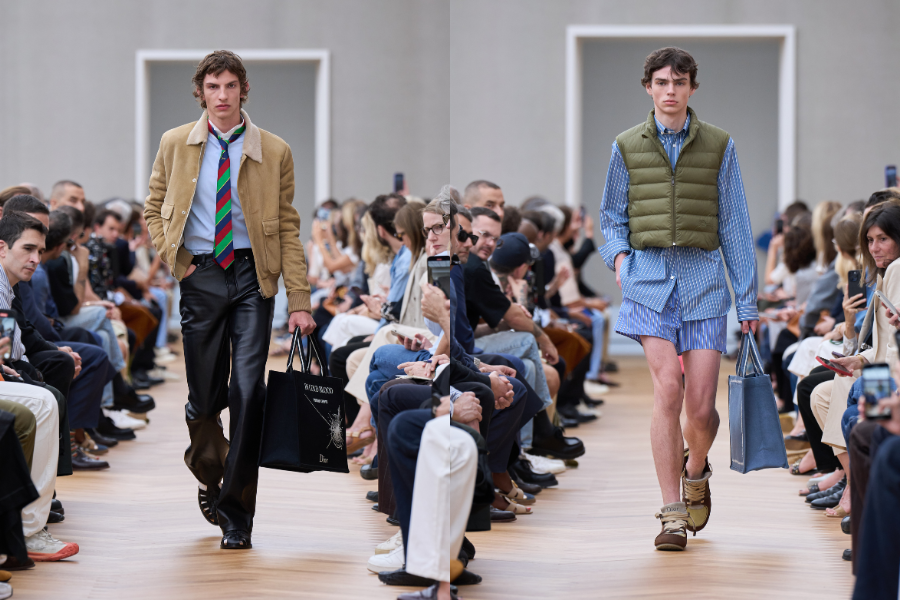
6) Why Book-Cover Bags Matter in Today’s Luxury Industry
Viewed more broadly, Dior is doing three things at once:
- Shifting from logos to cultural capital
As consumers grow fatigued by repeated logos, literature offers a new form of luxury, one rooted in meaning rather than visibility. - Reframing the It-Bag as a narrative product
Where past It-Bags won through form and marketing, today’s icons must win through stories people want to own and explain. - Reconnecting fashion with serious cultural dialogue
This is not a trend-driven artistic collaboration, but a positioning of Dior as a House fluent in cultural language and unafraid of depth.
7) “Narrative Pieces” and the New Language of Luxury
Dior describes these bags as “fascinating narrative pieces”, a phrase that reveals the project’s true ambition. The House is not selling bags alone, but storytelling.
By choosing literature, objects with age, density, and historical weight, Dior distances itself from short-lived trends. The result is a quieter, deeper form of luxury that resists the speed of the fashion cycle.
8) Closing the Book: The Luxury of Reading Deeply
Dior Book Tote “Book Covers” arrives in stores on January 2, 2026. Symbolically, it opens the year by opening a new chapter, one in which fashion does not need to shout to be heard, but can whisper through art and literature, allowing meaning to unfold over time.
In a world obsessed with speed, perhaps the most luxurious act is not having more, but staying longer with something until it matters.
Dior reminds us that a bag may not be just an accessory.
It can be a chapter, one you carry with you.