

Reported by Manit Maneepantakul
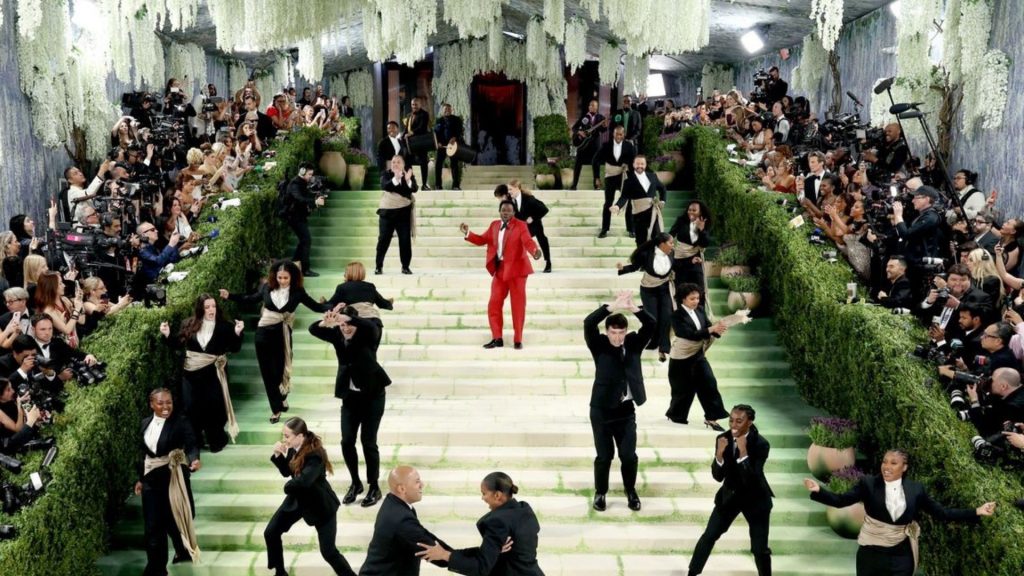
There are certain nights when fashion does not simply dress itself to be seen, but dresses itself to declare something about the age it belongs to. Met Gala 2026 was unmistakably one of those nights. At first glance, it had everything the world expects from the first Monday in May: the flashbulbs, the red carpet, the global celebrities, the couture gowns that took months to construct, and the guest list that still makes the world wonder who was granted access to the room. Yet beneath the beauty so carefully arranged, this year’s Met Gala revealed something far more complicated. It was no longer merely a night in which fashion attempted to prove its legitimacy as art. It was a night in which fashion, having finally achieved that status, had to confront a harder question: where does it stand in a world shaped by inequality, billionaire power, and a public gaze that no longer looks at fashion with innocent admiration alone?
Across nearly three decades under the influence of Anna Wintour, the Met Gala has never been just the annual fundraiser for the Costume Institute at the Metropolitan Museum of Art. It has gradually become a cultural stage on which fashion negotiates its place within the art world. Wintour transformed what was once a society benefit for New York’s elite into a global phenomenon where museum culture, Hollywood, athletes, artists, designers, business figures, and luxury houses meet in a single evening. This year, that long effort seemed to reach a defining point with the opening of the Costume Institute’s new permanent home inside the museum: the Condé M. Nast Galleries, a 10,000-square-foot space near the Great Hall. More than simply another exhibition area, it felt like a symbolic announcement that fashion was no longer standing temporarily at the museum’s door. It now had a home inside the institution itself.
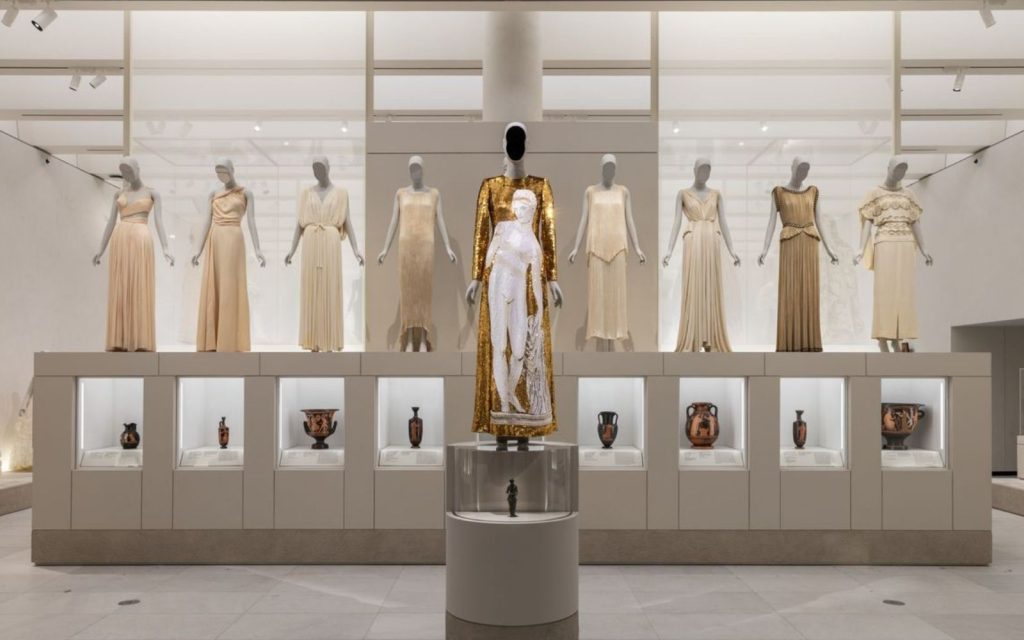
This year’s exhibition, “Costume Art,” became perhaps the most literal answer to the question fashion has long been asked: can clothing be art? Instead of answering through theory, the exhibition answered through placement. Garments were positioned alongside artworks that also speak to the human body in its many forms. A gauzy Maison Margiela gown was shown beside Rafaello Monti’s Veiled Woman, exploring the classical body. Vivienne Westwood’s “Martyr to Love” jacket was paired with Albrecht Dürer’s Man of Sorrows in the anatomical body section. A Burberry coat made for Sinéad Burke, who has achondroplasia, was placed next to a 17th-century sculpture by Leonhard Kern, expanding the meaning of the disabled body as a body that deserves to be seen rather than erased from the history of beauty.
Andrew Bolton, the Costume Institute’s curator in charge, captured the spirit of the exhibition when he said that fashion is art not despite its closeness to the body, but because of it. The sentence matters because it reverses the old logic that once kept fashion below other artistic disciplines. For years, fashion’s intimacy with the body, its functionality, and its connection to outward appearance were used as reasons to classify it as applied art, decoration, or industry. “Costume Art” argues the opposite. These qualities are precisely what give fashion its artistic force. No other art form comes closer to the human body than clothing. Nothing else touches the skin, moves with the muscles, wraps itself around vulnerability, and changes the way a person is seen so directly.
But while the museum’s interior was celebrating fashion’s intellectual victory, the outside world was asking a much heavier question. This year, the Met Gala raised a record $42 million, reaffirming its power as one of the most formidable fundraising machines in the art world. That figure not only sustains the Costume Institute, but also suggests that the Gala has become an economic structure of its own. There is now even discussion of a quasi-endowment, built from years of Gala proceeds, that could allow the Institute to become self-sufficient by 2030 or sooner. In other words, what was once a glamorous society evening has become a crucial mechanism for securing the financial future of fashion within a major museum.
Yet the $42 million did not shine without shadow. This year’s Gala was surrounded by intense backlash over the roles of Jeff Bezos and Lauren Sánchez Bezos as sponsors and honorary chairs. Their presence was not read merely as philanthropic support for the arts, but as a symbol of the increasingly intimate relationship between fashion, cultural institutions, and the power of tech billionaires. In a moment when many people are facing rising living costs, inflation, and economic insecurity, the decision to give such a prominent role to one of the world’s wealthiest couples at an event known for its exclusivity and opulence inevitably became a political and cultural flashpoint.
The resistance was not confined to the internet. It appeared on the streets of New York. Activist group Everyone Hates Elon called for a boycott, plastered posters across the city, and projected slogans onto buildings associated with the Bezoses, including the line: “If you can buy the Met Gala you can pay more tax.” At the same time, labour groups and Amazon workers staged “The Ball Without Billionaires,” offering a counter-image to the Gala’s splendour. Together, these moments made clear that Met Gala 2026 was not only about who wore what. It became a question of who gets to buy cultural space, who gets elevated through art, and whether luxury can still appear untouched in a world increasingly unwilling to separate beauty from structures of power.
That tension became even sharper with the absence of New York City Mayor Zohran Mamdani, who chose not to attend and said he was focused on affordability. His absence was not simply a social scheduling choice, but a political gesture. It reminded everyone that the Met Gala does not exist above the city that hosts it. New York is not merely the backdrop to the red carpet. It is a city of billionaires, tenants, workers, artists, service staff, and people struggling with everyday costs. When such extreme luxury is staged in the middle of that city, it cannot avoid the gaze of those looking in from outside the museum.
And yet, the backlash did not stop the event. If anything, it increased its visibility. The protests may have shaped the conversation in the weeks leading up to the Gala, but on the night itself, their sound was largely drowned out by the cheers of spectators waiting outside to see the celebrities arrive. This is the strange contradiction of the Met Gala. The more it is criticised, the more it is watched. The more it is questioned, the more impossible it becomes to ignore. The Met Gala does not sell beauty alone. It sells participation in a phenomenon. Even those who reject it often cannot resist looking at the image it produces.
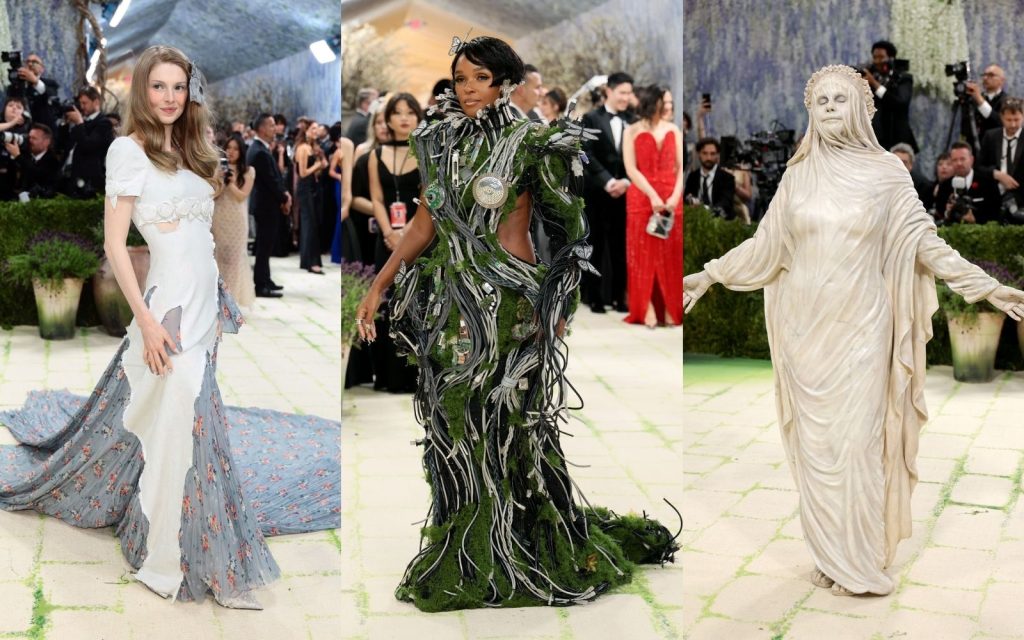
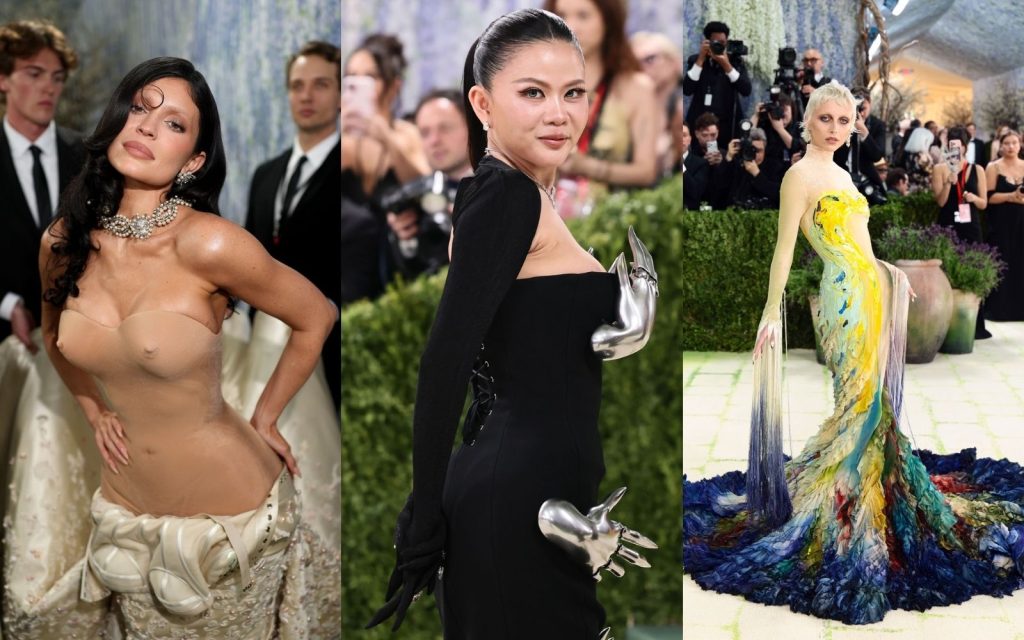
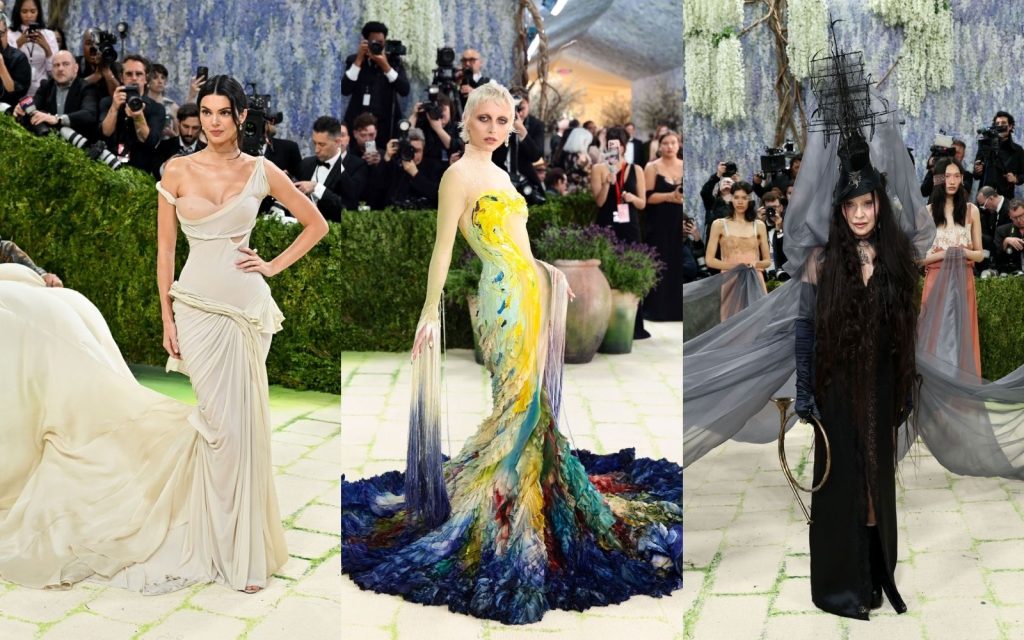
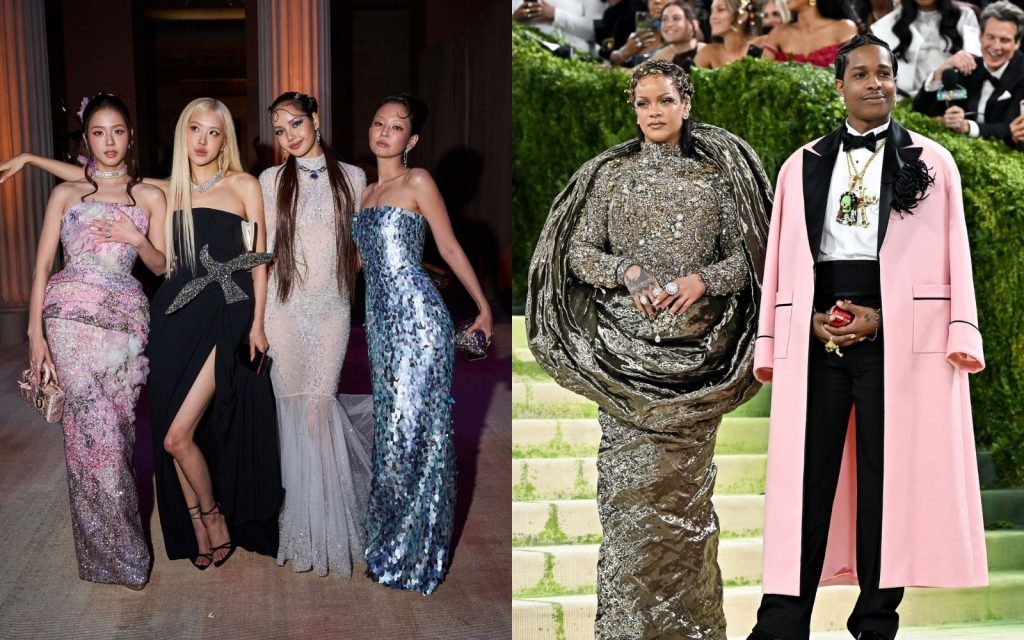
On the red carpet, the theme of “Costume Art” was translated into the language of the body in all its forms. Many designers looked directly into the museum’s galleries for inspiration. Robert Wun dressed Blackpink’s Lisa, Jordan Roth, and Thai fashion figure Nichapat in structures that pushed the body beyond its normal boundaries, turning arms, backs, and sculptural extensions into territories of imagination rather than anatomy. Gap Studio by Zac Posen dressed Kendall Jenner in a twisted gown inspired by the sculpture of Nike, goddess of victory, at the Louvre. Rihanna’s Maison Margiela look, inspired by Belgian medieval architecture, made her body feel almost like a moving building rather than simply a figure wearing a dress.
Madonna arrived in Saint Laurent, accompanied by Anthony Vaccarello with an expression somewhere between composure and negotiation. Her look referenced Leonora Carrington and came with six assistants, making the outfit feel less like something she wore and more like a performance piece: not leaving, not ending, not finished, not done. Cardi B, in Marc Jacobs, embraced a vast and distorted silhouette inspired by Hans Bellmer, turning the body into sculpture, dream, and discomfort all at once. Venus Williams’s Swarovski look connected to Robert Pruitt’s portrait of her. Lauren Sánchez Bezos’s Schiaparelli gown nodded to John Singer Sargent’s Portrait of Madame X, which was fitting in its own uneasy way, since that painting itself is a history of beauty, scandal, social status, and the gaze placed upon women of high society, even if, standing as a co-host welcoming guests, the look still carried a certain “what exactly is she doing here?” energy.
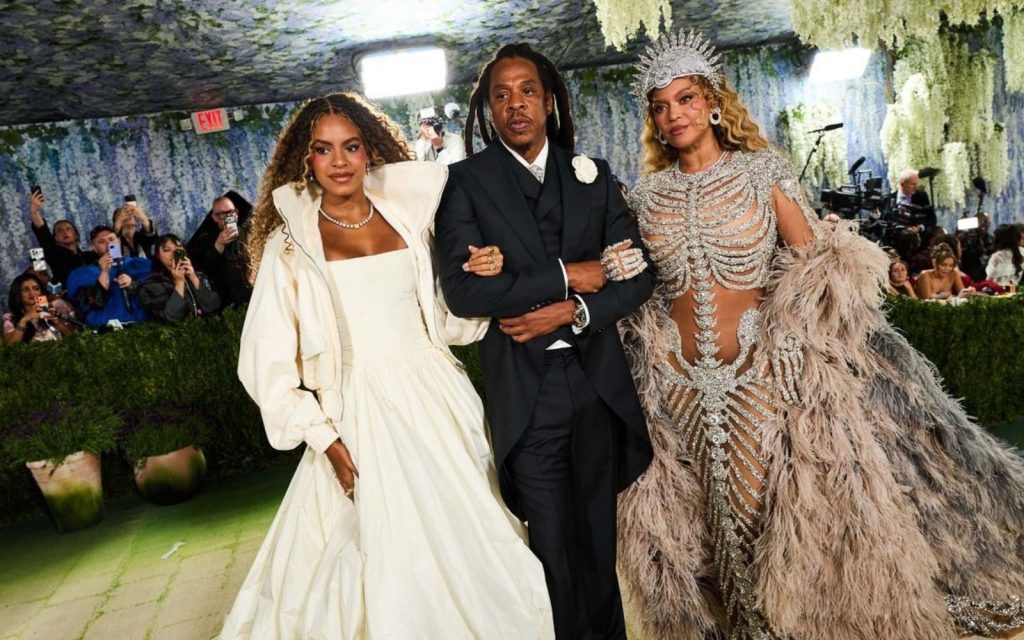
Thom Browne, one of the key supporters of the Costume Institute this year, used the red carpet as an extension of the exhibition itself. Lindsey Vonn, Olivia Wilde, and Adut Akech appeared in looks that moved through the ideas of the classical body, the abstract body, and the pregnant body, as if the red carpet were not separate from the galleries but a continuation of them. Beyoncé’s embellished skeletal gown by Olivier Rousteing sharpened the theme further. She was not simply wearing beauty. She was wearing the body’s structure, bringing what is usually hidden inside into the field of visibility. Even after a decade, even with her daughter grown and her husband smiling nearby with visible concern, there was still no convincing her to choose a look that felt radically new or unexpected.
One of the clearest visual memories of this year’s carpet was the return of torso chic: the body, the chest, and the semi-real, semi-illusory state of undress becoming a dominant red-carpet language. There were faux nipples, metal nipples, sequined nipples, and trompe l’oeil gowns that blurred the line between the real body and the body drawn, stitched, or simulated. Sabine Getty wore a custom Ashi Studio couture gown that resembled an oil painting of a woman’s torso. Jeremy Pope wore an archival Vivienne Westwood corseted jacket beaded with a muscular male torso. Kylie and Kendall Jenner arrived in corseted looks with fake nipples. Alex Consani in Gucci and Doechii in Marc Jacobs played with exposure in deliberate ways. This was not merely the return of the naked dress. It moved toward a larger question: if the body is art, is revealing the body still provocation, or is it simply an acknowledgment that the human form has always been art’s original subject?
Heidi Klum, in a Greco-Roman statue-like look by Mike Marino, may have been the most extreme example of that idea. She did not arrive simply as a woman in an evening gown, but as a statue that seemed to have stepped out of a gallery, complete with a latex veil and deliberately artificial body details. The result may well become one of the defining images of the night by default, Halloween coming early, as only Heidi could deliver. Janelle Monáe, in Christian Siriano, used metal plates across the chest in a look suspended between nature and machine. Chase Infiniti’s Thom Browne gown, covered in 1.5 million sequins, created the illusion of an abstract nude, turning the surface of fashion into another kind of skin. Together, these looks made clear that the red carpet was not simply speaking about nudity. It was speaking about the design of visibility: which bodies are allowed to be seen, how they are seen, and who gets to interpret them.
From a brand perspective, this year’s Met Gala also reflected a shift in luxury strategy at a time when the industry is under pressure from slowing sales. Brands did not simply try to flood the carpet with as many looks as possible. Instead, many chose to dress a smaller number of people who could tell their story more precisely. Gucci dressed only a few names, including Alex Consani, who was connected to the promotional video for La Famiglia, Demna’s first collection for the house. Louis Vuitton dressed ambassadors and talents who reflected the brand’s new world, including Alysa Liu, Tyriq Withers, and Jay-Z. Saint Laurent, this year’s catalogue sponsor, emerged as one of the most visible brands of the night through figures such as Zoë Kravitz, Hailey Bieber, Connor Storrie, and Kate Moss.
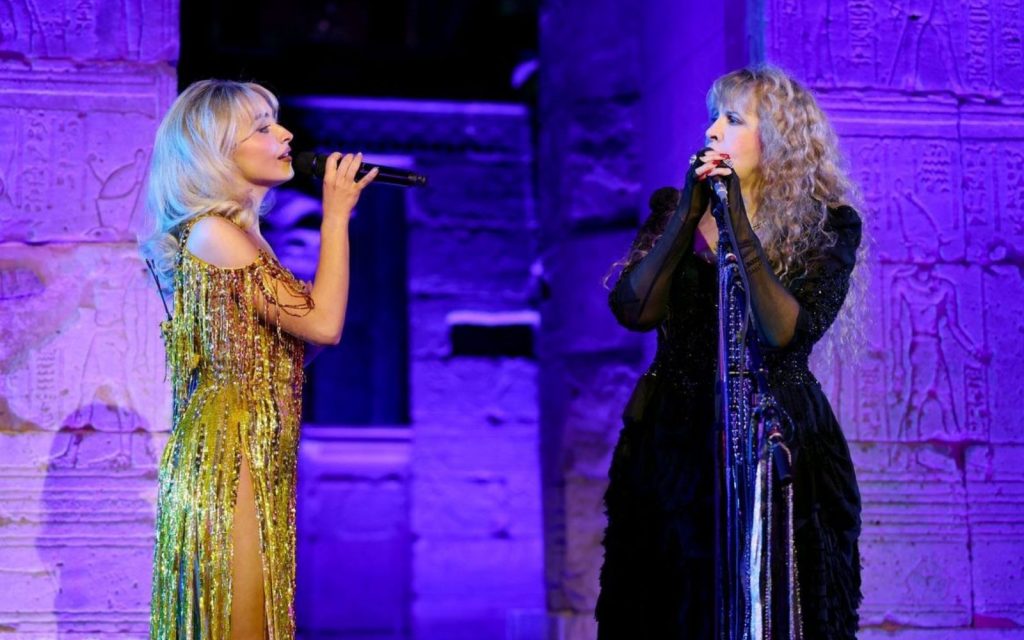
Chanel and Dior used the carpet to present their new directions in particularly interesting ways. Nicole Kidman in Chanel stood beside her daughter Sunday Rose Kidman Urban in Dior, forming an image of two major houses separated yet in conversation within the same frame. Bhavitha Mandava wore a Chanel couture version of the denim and quarter-zip look in which she had made history as the first Indian model to open a Chanel Métiers d’Art show, though it also left one urgent question hanging in the air: what exactly was this look doing here, at this event, in this form? Ayo Edebiri, Gracie Abrams, and A$AP Rocky, all Chanel ambassadors, offered different versions of a house trying to stand between classic codes and newer pop culture. Dior, meanwhile, had Karlie Kloss in a bulbous couture runway gown and Sabrina Carpenter in a custom gown made from film strips of the movie Sabrina, a clever play on identity, name, and cinema.
Another notable moment was the arrival of John Galliano’s Zara on the Met steps. Stevie Nicks wore a taffeta gown by the label, while Bad Bunny appeared in a black suit with makeup that made him resemble an old man. It was a reminder that the Met Gala red carpet is no longer reserved solely for haute couture and traditional luxury houses. It is becoming a stage where high fashion, mass fashion, and celebrity image can create a new conversation, provided the narrative is strong enough.
At the same time, smaller and independent designers found their way onto the carpet through partnerships with technology platforms such as Instagram, eBay, and ShopMy, which helped connect designers with talent. Dao-Yi Chow of Public School, who collaborated with eBay to dress Wisdom Kaye, explained the opportunity well: the commercial realities of building a business do not always allow designers to flex their conceptual abilities, but the Met Gala gives them a grand stage to show what they represent. That statement captures the truth of the modern red carpet. The Met Gala is not only a platform for visibility. It is a site of identity construction. Brands do not merely want their clothes to be seen. They want their worldview to be understood through the clothes.
Even as the red carpet tried to preserve its dream, the real world still entered through the details of several looks. Louisa Jacobson of The Gilded Age wore a Dilara Findikoglu dress inspired by Joan of Arc and spoke about armour as an intersection of form and fashion, adding that right now, we all seem to need armour to deflect both literal and figurative weapons. Her words turned the dress from a historical reference into a language for contemporary political feeling. Sarah Paulson, in Matieres Fecales, was one of the few to confront the billionaire controversy directly. Her voluptuous dress critiqued the ultra-wealthy, and with a dollar-bill mask over her eyes, she named the look “The One Percent.” In doing so, she turned the carpet itself into a space of sharp satire.
What made the year even more intriguing was that although this was widely framed as the Bezos Met Gala, Jeff Bezos himself did not appear on the red carpet. He slipped quietly into the event, leaving Lauren Sánchez Bezos to fulfil the honorary chair duties under the full glare of public attention. Mark Zuckerberg and Priscilla Chan also attended but avoided the carpet. This was deeply telling. It reflected a new kind of behaviour among tech billionaires who want access to fashion’s cultural capital while avoiding the direct gaze of journalists, photographers, and the public. They want to be in the room, but not questioned at the door. They want the status that culture can confer, but not necessarily the risks of visibility that come with it.
By contrast, Sergey Brin and Evan Spiegel did walk the carpet, perhaps because both seem more accustomed to the publicity system of fashion. The difference reveals something about the present moment. Tech billionaires are no longer merely behind-the-scenes patrons. They are learning how to move inside the image culture of fashion. But not all of them are equally willing to accept the consequences of being looked at.
And this is what makes Met Gala 2026 more than an annual fashion event. It was a night in which everything converged with unusual intensity: fashion and art, body and museum, beauty and marketing, brand and celebrity, billionaires and protest, fantasy and public discontent. None of these elements stood apart. They existed within the same frame, on the same staircase, at the Metropolitan Museum of Art.
On the surface, this could be seen as a year of triumph for the Costume Institute: a new permanent gallery, a record-breaking fundraising total, the return of Beyoncé, and a carpet filled with memorable looks. But looked at more deeply, this was the year the Met Gala was forced to mature into a more difficult phase. It moved beyond the old question of whether fashion is art and entered the far more challenging question of how fashion-as-art can live with the real world, when that world is no longer quiet, no longer politely waiting outside, and no longer willing to let beauty erase questions of power so easily.
Perhaps the answer lies in the body, which the exhibition placed at the centre of everything. The body is not merely something that wears clothing. It is a site where history, power, class, gender, disability, desire, and the gaze collide. Fashion is not art because it escapes the body. It is art because it never can. And Met Gala 2026 is much the same. It cannot escape the body of the world it inhabits. It cannot escape a city shaped by inequality. It cannot escape the money that sustains it. It cannot escape the gaze of people who are fascinated and critical at the same time.
In the end, the Met Gala still won in its own way. Whether praised, criticised, boycotted, or mocked, it once again made the world look. But this year’s victory was not pure or seamless. It was fractured, contradictory, and all the more compelling because of it. The best fashion has never been merely about beauty. It is a record of how a moment feels.
And in 2026, that feeling was unmistakable.
We remain seduced by beauty. But we can no longer look at it without asking who owns the stage, who pays for it, who is invited inside, and who remains outside the door. This year’s Met Gala did not simply tell us that fashion is art.
It told us that fashion is power, body, money, memory, spectacle, and sometimes, contradiction.
And perhaps that is exactly why the world has never stopped looking.
Photo credit: vogue.com