


The final fragrance in the Les Essences de Diptyque collection, Lazulio is a tribute to the striking and enigmatic beauty of a peacock feather. The nose behind the creation, Quentin Bisch talks to Stephenie Gee about capturing the intangible
Close your eyes and picture a peacock feather, its colours rippling – indigo deepening to lapis, emerald breaking into threads of gold – as if light itself were woven into each strand. Now, try to imagine what this might smell like.
This is the question that underpins Diptyque’s latest creation, Lazulio. Composed by French perfumer Quentin Bisch, the eau de parfum follows the theme of others in the Les Essences de Diptyque collection (a poetic olfactory tribute to nature’s scentless treasures, like previous starting points of coral, mother-of-pearl, bark, water lily and desert rose) by taking the visual splendour of the feather – and the lapis lazuli it resembles, hence the name Lazulio – and translating it into a perfume to behold.
“With Lazulio, my task was to extend this journey by giving an olfactory voice to the brilliance of the peacock feather, which has no inherent fragrance but carries a strong image of majesty and elegance.” explains Bisch. To do so, he approached it as both a visual and tactile exercise, first by observing peacock feathers and focusing on the vivid contrasts of their colours. The feathers’ brilliant juxtaposition of blues, greens and golden tones, as well as their softness and grace, became a map for building contrasts in the fragrance. The goal was not to recreate a colour or image, but to invent an accord that was radiant and sparkling, then bring it into conversation with warm, textured materials, just as a feather feels both luminous and soft.
“My process always begins with intuition and spontaneity,” he continues. “I often start by exploring raw materials freely, combining them as one might take brush and ink and begin painting. Inspiration often comes when I allow myself that freedom. Then comes the stage of patience and refinement, where I let the accords evolve over time, adjusting them until the balance is found. It is both an instinctive and a meticulous process, where emotion guides me as much as technique.”
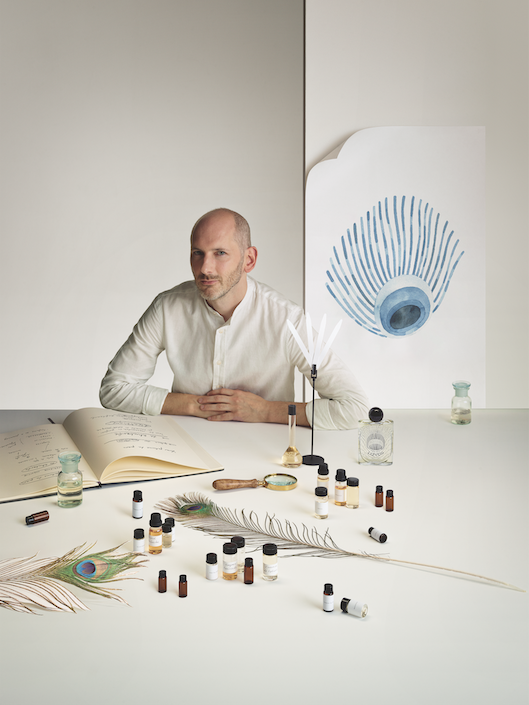
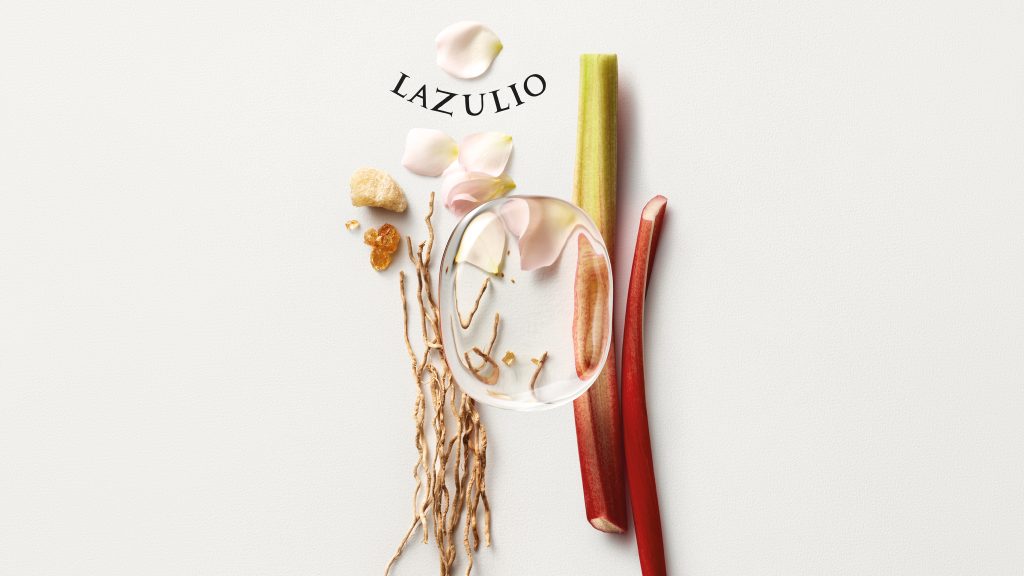
The result is a composition that captures the emotional impact of seeing a peacock feather for the first time, opening with the sparkling, tangy brightness of rhubarb that evokes the dazzling green iridescence of the feather. Haitian vetiver then provides crystalline structure and light with woody and citrus nuances, while a touch of rose adds a layer of refinement and elegance, echoing the shifting hues of the peacock feather that inspired the scent. Finally, reflecting the amber hues, benzoin brings depth, its rich, syrupy texture serving as a bridge – a link that unites the tart brightness and comforting warmth into one seamless flow. Together, these notes mirror the feather’s duality: luminous yet soft, brilliant yet caressing.
“When one imagines a peacock, the image is often luxurious and opulent, so I was expecting a dense, intense scent. But when I actually smelled it, the freshness that first emerged was such a beautiful surprise,” he says. “That sense of surprise is exactly what I intended. After the bright, refreshing notes fade, you’re drawn into a deeper, more mysterious world. This interplay between lightness and depth invites new discoveries each time you wear it – a fragrance that never ceases to captivate. It is my poetic interpretation of the feather’s shifting light and colour.”
Bisch’s greatest challenge was finding balance. Alone, rhubarb was too sharp and fluorescent, and benzoin too round and enveloping. Together, they seemed opposed, almost contradictory, at first. The work was to find the point where they begin to illuminate one another. After many trials, that harmony appeared: the energy of rhubarb brightening the golden warmth of benzoin, and the caress of benzoin softening the intensity of rhubarb. “That moment of balance was when Lazulio revealed itself,” he says.
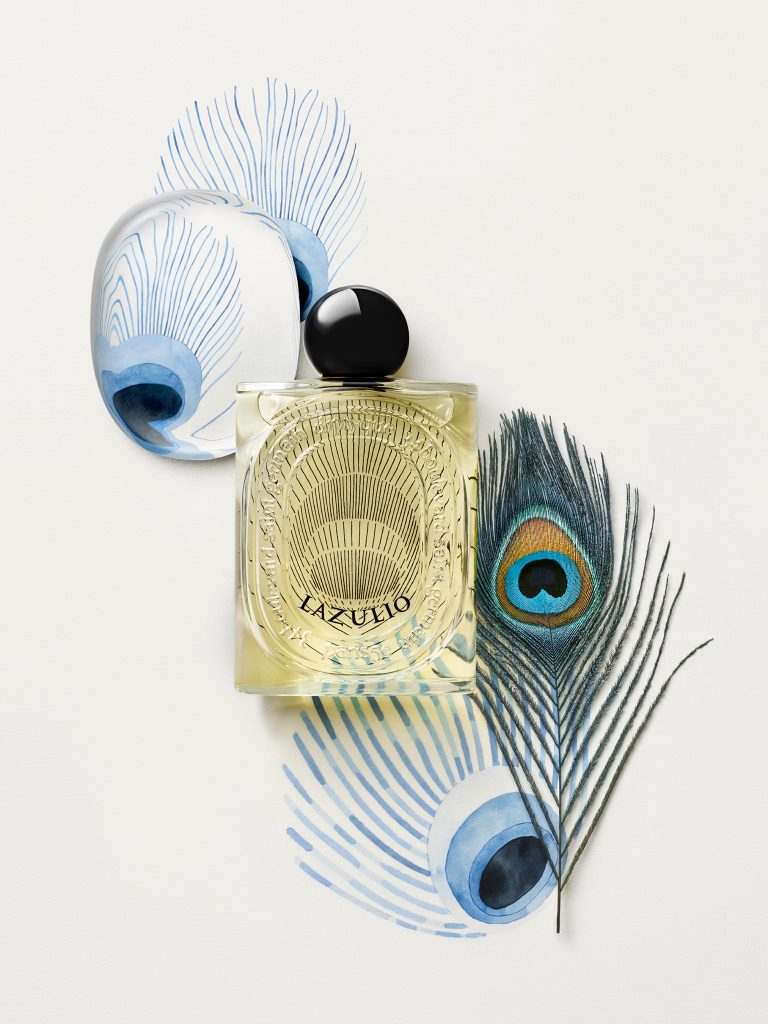
As with all Diptyque creations, Lazulio is designed as an object of desire. Its refillable bottle, made with recyclable materials, features feather-like strokes by Irish architect Nigel Peake, who reimagined the fragrance’s inspiration into a graphic play of lines and tones that echo the feather’s movement. His artwork captures the iridescence and rhythm of the peacock feather, just as the fragrance captures its texture and brilliance. The front of the bottle showcases layers upon layers of brushstrokes extending outwards to form the appearance of a peacock feather, with its back featuring raised glass in the same design. The detailed box the perfume arrives in also delivers a similar look, but with an eye-catching splash of colour. The blue tones and fluid yet precise motifs are the visual counterpart to Lazulio’s airy but structured olfactory architecture, while the emblematic oval of Diptyque, engraved on the glass, becomes a window into its natural brilliance.
Furthering the maison’s eco-conscious ethos, the fragrance also showcases a commitment to responsible sourcing. The benzoin resin is harvested in Laos by local communities under Diptyque’s stringent environmental standards, and suppliers are selected in accordance with the responsible, environmentally sound practices close to their heart. This transparent partnership reinforces the maison’s ongoing efforts to improve procurement and protect natural resources. Through these carefully chosen raw materials, Lazulio transforms botanical treasures into a refined, poetic olfactory experience. “Benzoin is a beautiful raw material, with golden, balsamic facets, but also one that carries ethical meaning,” Bisch says. “Knowing that it is cultivated with respect for the environment and local communities enriches the creation. It connects the fragrance not only to poetry and emotion, but also to responsibility and respect for nature.”
A graduate of the Givaudan perfumery school who has composed over 140 fragrances – including Jean-Paul Gaultier’s eponymous fragrance, Chloé’s Nomade, Thierry Mugler’s Angel Muse, Ex Nihilo’s Fleur Narcotique and more – Bisch maintains a philosophy that is rooted in sincerity and humility. “Every creation is a new beginning and teaches me something different. Certainty can block creativity, so I always stay open to surprise. Originality comes from creating with authenticity, not imitation. A perfume must have a soul; it must carry a vision, surprise and resonate emotionally,” he says. “For me, perfume is not only a formula of materials, but an art form that expresses beauty, contrast and sensitivity. It’s far more than just a scent – it tells the story of the person who wears it. It reflects their personality and stays close to them, almost like a companion. I vividly remember the perfume of my French teacher, which revealed my vocation when I was 11 years old. I can also recall the scents worn by my parents – Shalimar, Poison, Loulou and Coco on my mother; and Habit Rouge, Derby, Vétiver on my father. These memories are part of my inner archive, and I believe they continue to resurface unconsciously in my work. They are the foundation of my olfactory sensitivity.”
To Bisch, the act of wearing fragrance can also be seen as a gesture – “a way of “replacing one’s memories”, he adds. “It might sound like an extreme metaphor, but imagine if that single gesture could awaken beauty instead of violence, if it could summon rich and comforting memories rather than painful ones. In that sense, perfume could become a small but powerful act of peace. Of course, fragrance alone cannot change harsh realities. But it can move people’s hearts and offer a moment of escape – a space of serenity and imagination. As a perfumer, I believe in the magical power of scent – its ability to awaken the senses, to bring comfort and hope, and perhaps, in its own quiet way, to make the world a more peaceful and poetic place.”
Lazulio does just that, and a little more. “I want Lazulio to awaken a sense of radiance and wonder,” Bisch says. “It’s a luminous, enveloping fragrance that carries both energy and caress, and my hope is that it makes people feel both uplifted and embraced, like being surrounded by the beauty and majesty of the feather itself. Above all, I want it to move them, because a perfume only lives fully when it triggers emotion.”
Also see: Skin Need founder on skincare trends and what your skin really needs