

Reported by Manit Maneephantakun
In a contemporary fashion landscape where many runway shows are engineered to produce viral images within seconds, the debut collection of Demna for Gucci arrived under expectations far greater than that.
This was not merely a new season.
Nor was it simply the arrival of a new designer.
It marked the beginning of a new chapter for Italy’s largest luxury brand, following a period of visible instability after the departure of Alessandro Michele in 2022.
The question hovering over the Milan runway therefore was not simply “What will Demna design?” but rather:
Can Demna make Gucci feel like Gucci again?
A Temporary Museum of Italian Culture
The venue at Palazzo Delle Scintille was transformed into something resembling a monumental museum. Tiered seating surrounded replicas of Roman and Greek statues, evoking the atmosphere of an ancient amphitheater.
The inspiration came from Demna’s visit to Florence, the birthplace of Gucci.
Inside the Uffizi Gallery, he encountered Primavera by Sandro Botticelli. And when he stepped outside into Piazza della Signoria, he suddenly realized that Gucci stood right there in the same cultural landscape, the same city shaped by Botticelli, Michelangelo, and Donatello.
For Demna, it was a moment of clarity.
Gucci was not merely a fashion brand.
It was part of Italian culture itself.
“Beyond the product, Gucci is culture, a way of thinking and a way of being,” he said before the show.
The set in Milan therefore was not simply a stage.
It was, in a sense, a temporary museum of Gucci.
From Intellectual Fashion to Fashion You Can Feel
Throughout his decade at Balenciaga, Demna built his reputation by confronting society through fashion.
His work addressed war.
Politics.
Climate anxiety.
But at Gucci, he chose a different direction.
“I’ve switched off this intellectual desire to impress myself,” he admitted during the preview.
Rather than creating fashion that requires interpretation, he wanted to create fashion that can be felt instantly.
For Demna, Gucci is not a brand that needs a book to explain it.
It is a brand meant to make people want to go out, have fun, and live.
When the Body Became the Center of the Collection
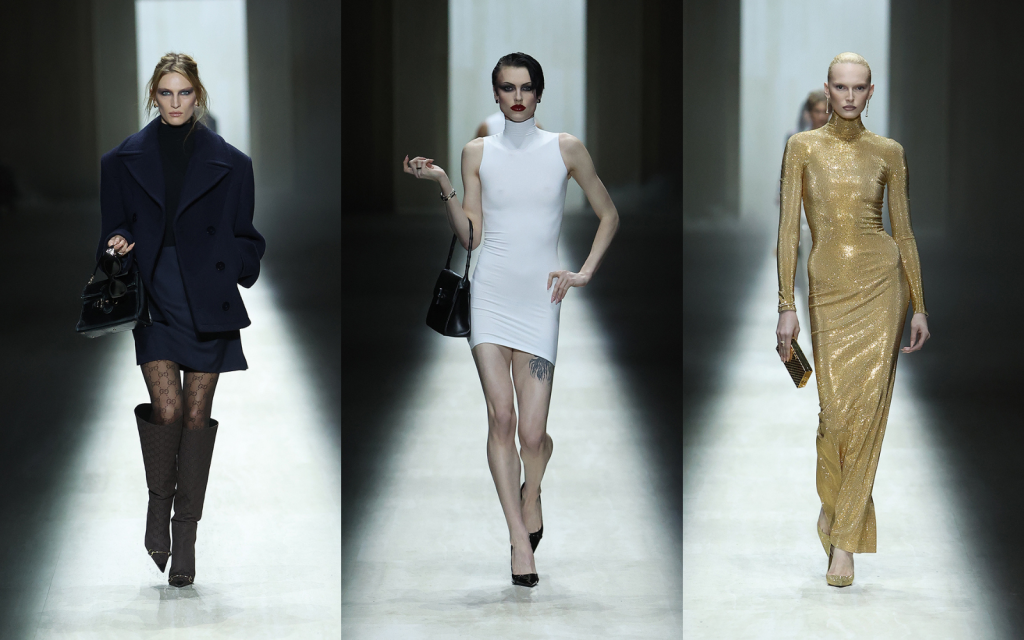
The opening look was a white dress resembling hosiery, thin, seamless, and tightly hugging the body.
It functioned almost like a blank page.
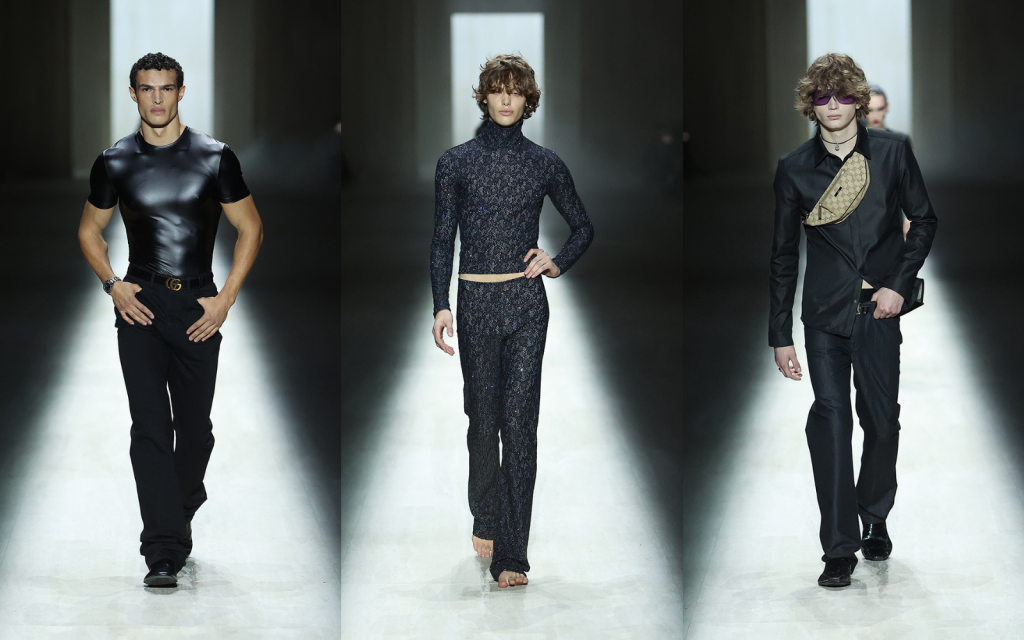
From there, the collection expanded into a world of body consciousness: muscle tees, slim jeans, stretch dresses clinging to the body like a second skin.
The body became the focal point of everything.
Muscular men appeared in white sleeveless T-shirts.
Women walked in minidresses wrapped tightly around their silhouettes.
It was fashion that spoke directly about physical attraction.
Demna admitted the theme was deeply personal. After years of dissatisfaction with his own body, he now openly says:
“I want to feel sexy.
I want to feel attractive.
I want to like myself.”
This collection, in many ways, is the result of that emotional shift.
The Shadow of Tom Ford and Gucci’s Golden Era
In Gucci’s history, one period still defines the brand’s sensual identity: the late 1990s under Tom Ford.
Demna acknowledges that influence.
“For my generation, Tom Ford’s Gucci introduced real sex appeal into fashion.”
That legacy appeared everywhere in the show, towering stilettos, backless dresses, silhouettes emphasizing hips and waist.
And when Kate Moss closed the runway in a dramatic black backless gown with a diamond-studded GG G-string peeking out, the message felt unmistakable:
The era of seductive Gucci may be returning.
Gucci for Gen Z
Yet Demna did not only look to the past.
He invited musicians and digital-era personalities into the Gucci universe, underground rappers, YouTubers, athletes, and influencers, walking the same runway as supermodels.
It reflected Demna’s belief that Gucci should not belong to a single social class.
Instead, it should represent a spectrum of identities: from Milanese high society to street-culture youth listening to rap.
Between Fashion and Product
Of course, Gucci is not a small label.
It is a massive luxury business machine.
So while the collection carried emotional and cultural messages, its commercial backbone remained unmistakable.
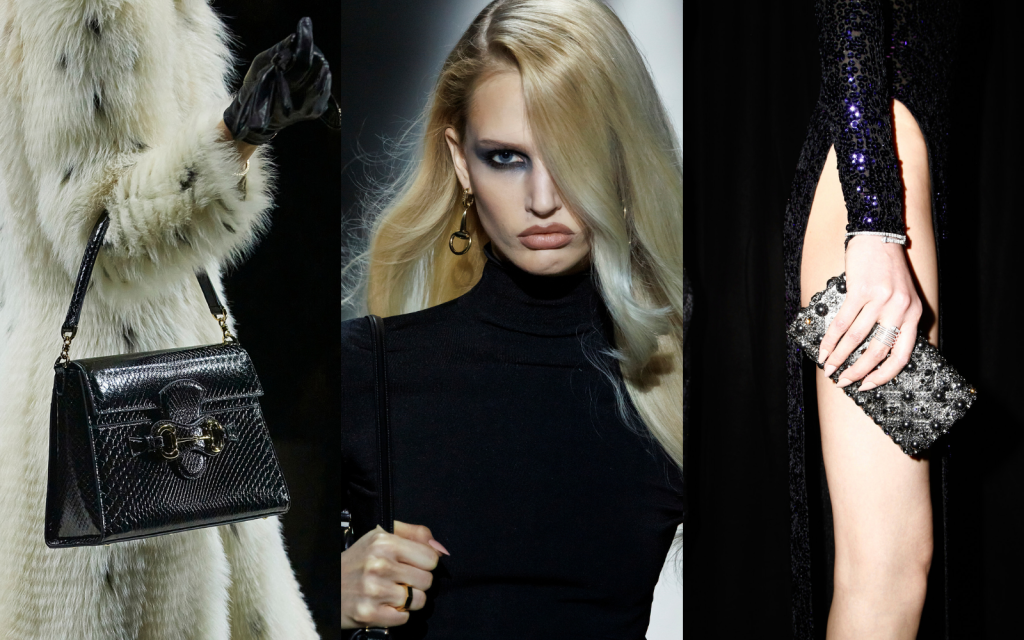
The Bamboo 1947 bag was updated with a lighter silhouette.
The Jackie bag appeared in softer, crushable leather.
Loafers and slippers returned in refreshed designs.
Nearly every runway look carried a bag.
A reminder that in the world of Gucci, fashion and commerce always move together.
Fashion in a Darker World
Demna has spoken openly about how dark the world feels today, war, economic anxiety, and social tension.
It has forced him to reconsider fashion’s role.
Once he used fashion as a political tool.
Now he wants it to become a space for dreaming.
A place where people can feel desire again.
“I want to feel FOMO,” he said, the fear of missing out, the urge to live fully.
What It Means to “Feel Gucci”
Demna recalled a conversation with his 16-year-old cousin who spends much of her life on Roblox.
She told him Gucci is not just a brand.
It is a word.
If someone says, “I feel Gucci,” it means wanting to go out, do something wild, meet people, and live vividly.
That, ultimately, is what Demna hopes to achieve with this collection.
An Opening Chapter
Not everyone agrees about the success of this debut.
Some see it as bold.
Others think it does not go far enough.
But one thing is undeniable: Demna has made the world look at Gucci again.
And in fashion, regaining attention is often the first step toward revival.
Spring in Milan this year arrived not only on the trees outside the venue, but also on Gucci’s runway.
Demna called it Primavera.