

Reported by Manit Maneephantakun
In a fashion world that often seems to circle back to the same references again and again, a familiar question inevitably arises: is there anything new left to say? Especially when it comes to themes that have been revisited countless times, nautical chic, with its sailor tops, navy trousers, maritime codes, and seafaring silhouettes that have surfaced throughout fashion history in nearly every era. Yet for Maximilian Davis, the young designer steadily writing a new chapter for Ferragamo, the answer appears to be clear: there is still plenty more to explore.
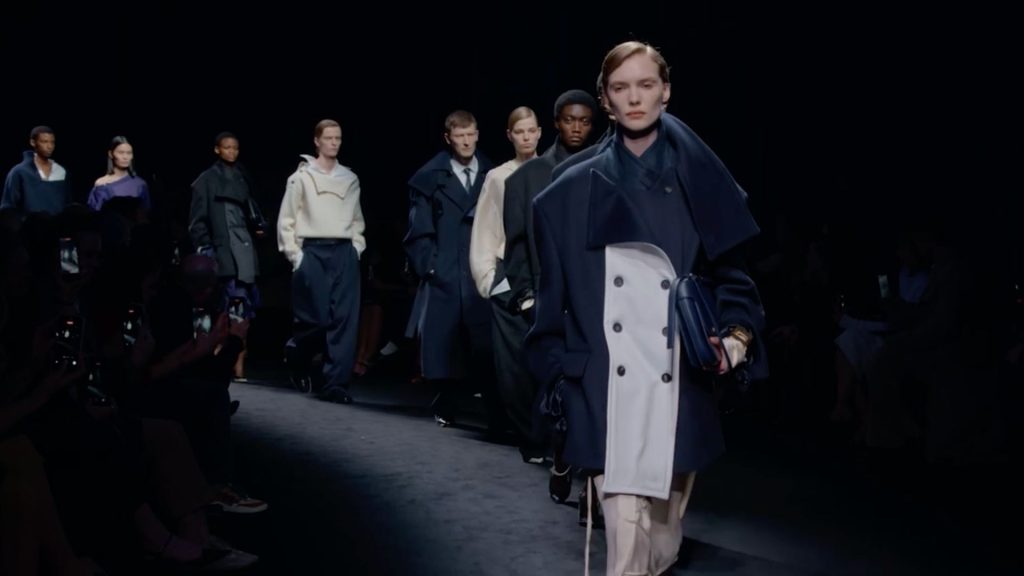
One afternoon in Milan, Ferragamo’s Fall/Winter 2026 show opened inside a semi-circular space enveloped by heavy midnight-blue velvet curtains. The atmosphere was dim, almost subterranean, like stepping into a clandestine bar during the Prohibition era. The set was not merely theatrical staging; it marked a deliberate return to the world of the speakeasy Davis had first introduced last season, an imagined space where characters from entirely different worlds could cross paths without restriction.
In Davis’s imagination, this hidden bar is populated not only by men in sharp suits and evening attire. Artists linger by the walls, sailors drift in from distant voyages, dockworkers mingle with flappers, and women who have just stepped beyond the confines of an older world begin to inhabit a modern one.
Part of the collection’s inspiration draws from the work of Charles Demuth, the American Precisionist painter who once captured the life of Provincetown in watercolor and geometric composition. His subjects; sailors, fishermen, dockworkers, and the nightlife that unfolded in speakeasies, echoed in the collection’s palette: muted purples, deep navy, and shades of ivory that flowed quietly through the entire show.
Davis opened the narrative with oversized navy cashmere peacoats, garments that at first glance resembled the familiar coats of naval uniform tradition. Yet as the models approached, that apparent simplicity unraveled into something more intricate. Panels lined with ivory silk were buttoned into the structure of the coats, creating the illusion that the garment had been fragmented and reconstructed. The effect felt almost Cubist, like a painting translated into clothing.
It was, in essence, a decoding of the traditional sailor’s uniform and its reconstruction through a contemporary fashion vocabulary.
Guernsey-inspired knit sweaters followed, their high collars deliberately unbuttoned and allowed to fall softly around the neck, as if the discipline of the uniform were beginning to loosen.
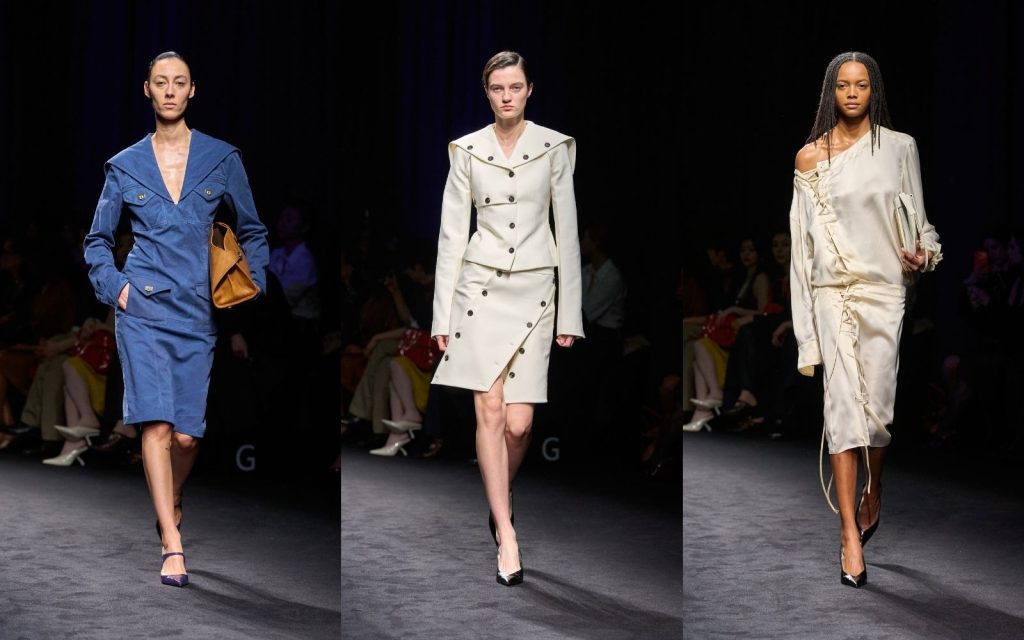
Then came an ivory satin middy blouse, reminiscent of a sailor’s top but elevated with sharper intention. Dresses and shirt-and-skirt ensembles that followed were marked with maritime placket lacing, drawn in a striking graphic line that extended from shoulder to knee.
The garments began to resemble moving drawings, lines tracing themselves across the body.
The buttoned panels introduced in the opening looks continued to evolve throughout the collection. Dresses and skirt suits in wool and leather appeared assembled from sections that seemed almost detached before being held together by rows of buttons. The result was unexpectedly graphic and striking, as if the architecture of naval uniforms had been dismantled to reveal their inner mechanics.
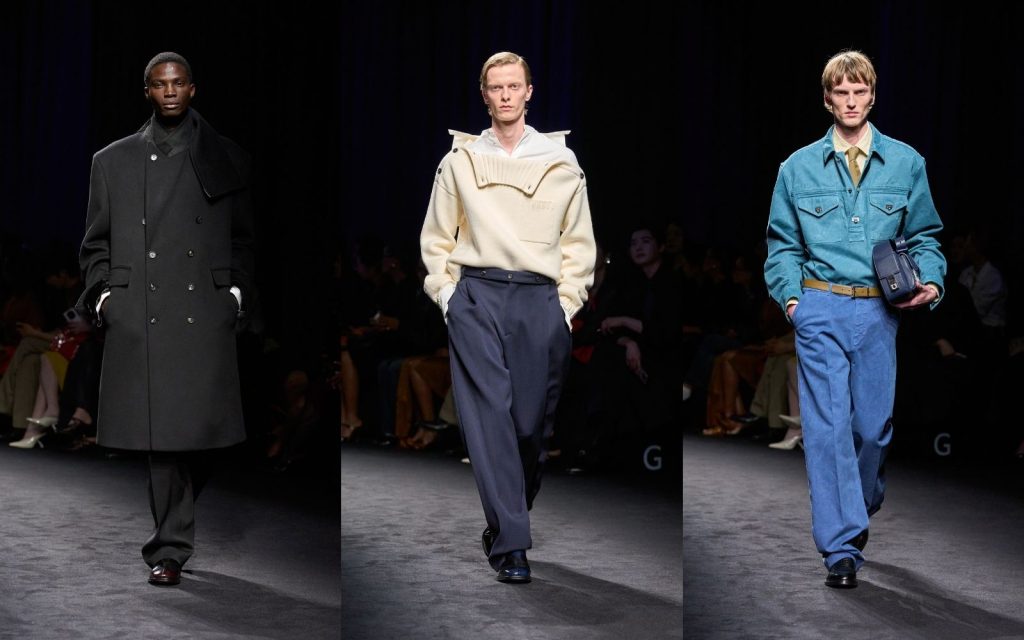
At times Davis appeared slightly carried away by this fascination with panels and fastenings; certain looks bordered on over-elaboration, with too many closures and dangling elements. Yet the sense of disorder within order became part of the collection’s charm. Beneath the strict codes of naval dress, Davis introduced a subtle spirit of déshabillé, an after-hours ease.
Sailor trousers were partially unbuttoned to reveal a triangle of white lining. Skirts opened at strategic panels, offering glimpses of skin. Shirts appeared with collars that could be buttoned on or removed entirely.
The garments existed in a delicate state between two conditions:
between discipline and release,
between uniform and its undoing.
Midway through the show, Davis deepened the emotional atmosphere through texture and reflection. Sculpted gold lamé ruffle dresses shimmered under the dim lighting, catching glints like reflections across dark water. Jacquards in muted purples returned once more to Demuth’s palette.
Meanwhile the menswear carried a new confidence. Narrow-waisted tailoring with full-leg trousers appeared beneath luxurious leather blouson jackets. Some looks carried a subtle military undertone; others hinted at European bourgeois refinement. Together they suggested a room filled with many personalities, each belonging to a different social world yet coexisting within the same space.
Among the most compelling pieces were quilted leather barn jackets adorned with the house’s signature Gancini hardware, objects that embodied Ferragamo’s quiet approach to luxury.
As the show approached its final act, the mood shifted fully into night. Georgette dresses with accordion pleats cinched mid-calf moved like the heavy curtains lining the venue itself. Then the lamé shimmer returned in full intensity; gold cocktail dresses, delicate flapper slips, and gowns that erupted into fishtail hems.
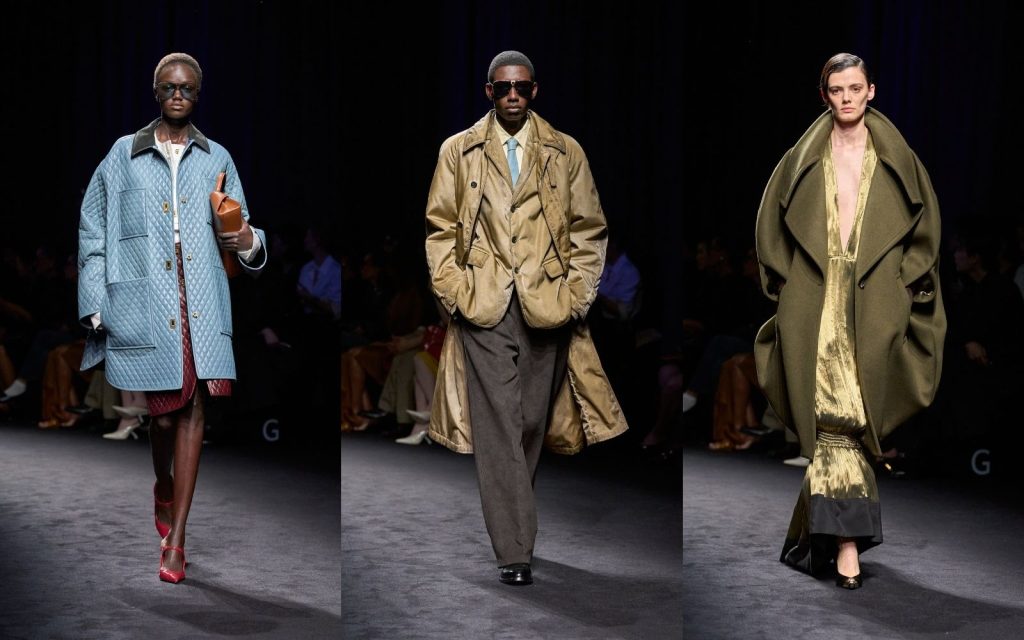
The finale felt like the peak of a speakeasy evening, just before the lights dim and the music fades.
Behind the scenes, Davis explained that he had once again delved into the archives of Salvatore Ferragamo, discovering an innovative molded sole technique that inspired new wedge heels shaped like waves, as well as crystal-toe pumps that looked almost like pieces of jewelry.
For Davis, the design process was ultimately about bringing together characters from different worlds:
sailors, artists, flappers, nocturnal adventurers.
Each of them entering the same room.
Under Maximilian Davis, Ferragamo remains a house in the midst of self-discovery. At times the designer seems to move in multiple directions simultaneously. Yet this season, those threads began to align into something more coherent.
The collection carried both discipline and unruliness, the rigid codes of uniforms and the liberated spirit of nightlife.
The result was a new kind of elegance: one that appears constantly in motion, almost as if it were coming apart while being rebuilt at the same time.
Like a ship leaving the harbor, uncertain of its destination, yet propelled forward by the irresistible energy of the journey.